


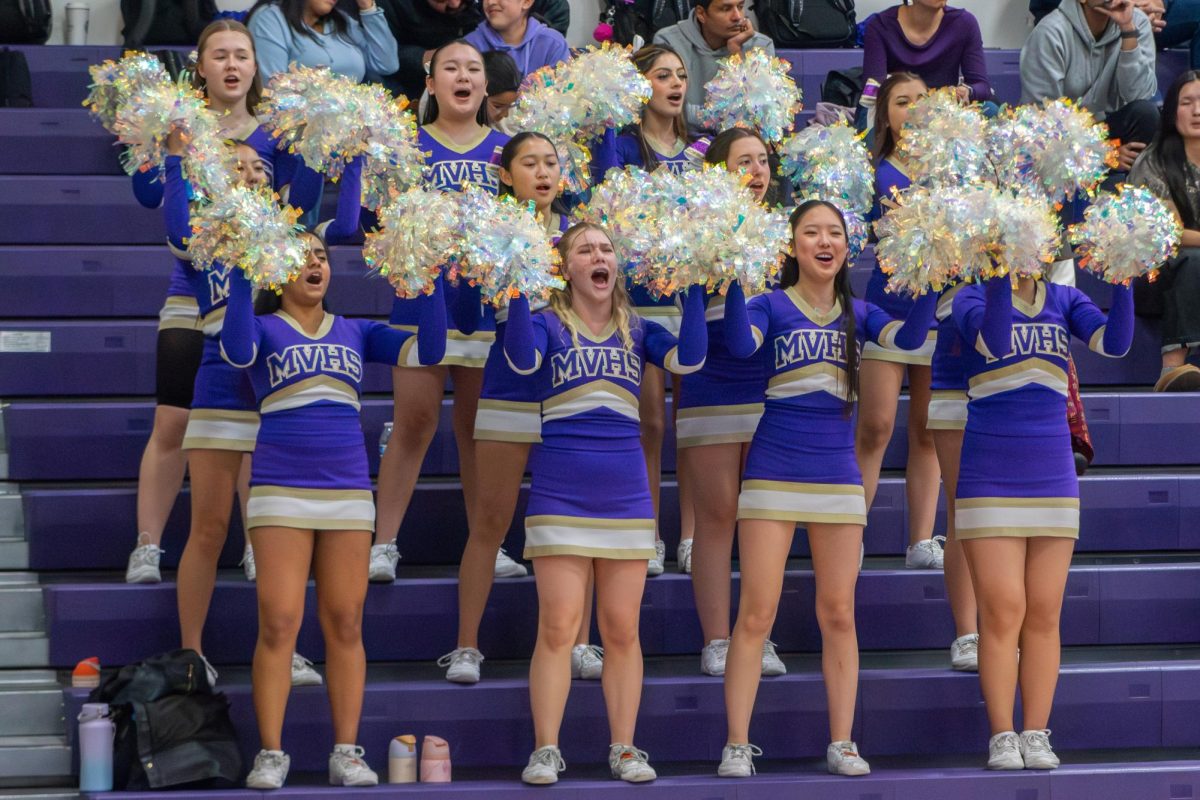
For a school obsessed with numbers — GPA, how many AP classes you’re taking, your SAT score — we’ve forgotten about a crucial one: be it soccer, football or tennis, over 40% of the student population participates in school sports. And yet, like artistic extracurriculars and pastimes, sports are often viewed negatively or as inferior to the more academic pursuits we care about. At MVHS, we pride ourselves on excellence, but only in the areas we’ve chosen to value. When the topic of school-sanctioned sports comes up, we’re often quick to dismiss our teams, suggesting that all MVHS teams are terrible or attending games or tournaments for fun is pointless.
Generalizing all of our sport teams as “terrible” is not only dismissive of the hours spent training, at practice and at games, but is also blatantly untrue. The average high school student athlete spends between 10 to 15 hours weekly on their sport. In the past month, Varsity Girls Basketball and Varsity Girls Soccer (for the first time in 14 years!) made it to CCS. Countless other MVHS teams excel at the local and state levels — achievements clearly spelled out in the school emails and social media posts we scroll past.
Overlooking our athletes’ successes fosters an environment that skates around uplifting hard work and instead pushes a close-minded view of what “success” is. Celebrating these achievements, along with personal bests, exists within individual team cultures, but we should strive to integrate them in MVHS’s culture as a whole.
Our dismissal of sports feeds into our view of collegiate athletics as well. In common conversation, being athletically recruited from a school is seen as the “easier route” to getting into college — there is an assumption that student athletes aren’t held to the same academic standards as students who get in the traditional way.
 And yet, getting into a college for sports doesn’t mean that someone didn’t get in based on their own merit. Student athletes do the same amount of work as another student, just in a different way. To diminish that strips them of their achievements and downplays their effort. After all, considering that only 6% of all high school athletes go on to play a collegiate sport in any league, it’s an incredible feat to even get to that stage of athleticism and skill. It’s not only false to assume athletics is an easier path, it’s disrespectful to the discipline, sacrifice and talent needed to compete at that level.
Furthermore, when someone is recruited, eyes turn towards that college’s academic rigor or their presumed “prestige” rather than their teams. But people choose their college for vastly different reasons. Viewing a college solely in terms of their US News ranking (something MVHS is especially privy to) overshadows the other countless features and amenities a college has to offer. Before asking why someone would possibly commit to a given school, we need to look beyond what we consider “prestige” and look at their sports teams, their coaching or their facilities. Athletic scholarships, and the financial stability they provide for the next four years, may also factor into students’ recruitment.
At any other high school in the U.S., heading to a game after school might be seen as a fun hangout. At MVHS, it’s a rare occurrence instead. When considering how to build a culture that accepts that success and prestige may look very different for people, we can turn to MVHS’s Student Athletic Senate, who have put significant effort into initiating supportive and celebratory environments, including hosting annual signing ceremonies for committed seniors. This year, the SAS introduced a point system to increase sports game attendance from other student athletes, culminating in a pizza party for the winning team. Following their example, students should strive to attend these games as well.
Full student sections bolster high school athletes’ motivation and build their confidence. Celebrating others’ achievements beyond our narrow view of what “achievement” looks like constructs a community with school pride. It constructs a community that feels excitement at the thought of lifting each other up. The divisiveness that arises when someone casually dismisses sports or playing collegiately pits students against each other. We need to strive for a school where everyone’s achievements are celebrated, not only by shifting our own mindsets but by physically showing up for our classmates.