


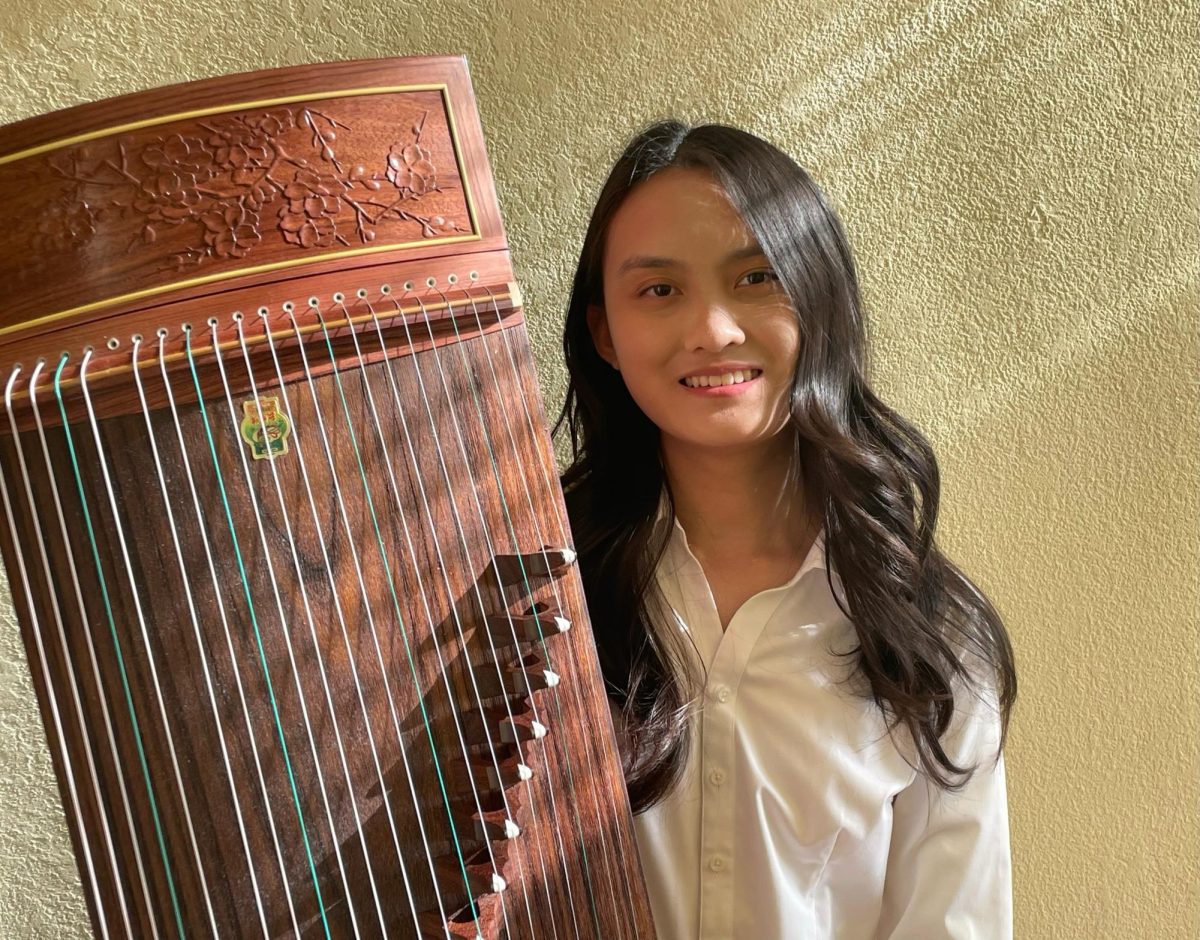
EE: Hi there! My name is Liz Liu, and today I’m joined by senior Lindsey Niu. Niu has played the guzheng for 14 years, since she was four years old. The guzheng is a traditional Chinese Zither, which is a stringed instrument, and despite having over 2000 years of history, is still a core instrument in many Chinese orchestras today.
EE: What would you say inspired you to start playing?
LN: It’s actually pretty interesting. My dad, around like 20 years ago, saw his coworker could play guzheng, and he was pretty inspired. He was like, I should let my daughter play guzheng, like if I even have a daughter in the future. It turns out, when I was born, he just thought, ‘Oh, I should encourage her to try guzheng.’ So, when I was only four years old, he registered me for a guzheng class, and that’s how I started playing it.
EE: And why have you decided to keep playing the guzheng over the years?
LN: When I was only four, I didn’t have a really great passion towards guzheng, but over time, I started enjoying it more for myself, because I think guzheng makes me kind of special, and I like the sounds of it. It makes me feel calm and relaxed. Also, a lot of my peers were playing piano or violin when I was in China, so I think guzheng kind of made me different, and also made me feel more connected to my cultural roots.
EE: Did you go to a class to learn the guzheng, and do you have any special connections with your teachers?
LN: Yeah, I still have a special connection with my teachers. I registered for the class, and even now, when I just stop taking classes specifically for guzheng, but when I have time, I return to the class and be a part-time tutor or TA for the guzheng studio I took guzheng classes at.
EE: How does it make you feel as a TA for this guzheng class, and knowing that you’re helping other people learn the guzheng?
LN: It feels like a transition, and teaching guzheng, and seeing little kids learning it. It makes me feel like I’m teaching myself when I was a little kid, and it feels like I’m passing my experiences and knowledge to younger people.
EE: By the way, do you have a favorite song for guzheng?
LN: I actually have lots of favorite songs, like “Qing Hua Ci” or like “Zhan Tai Feng,” but I also like to integrate some western music, like western pop music, into guzheng notes, and start playing a tune for guzheng. For example, I integrated “See You Again” or some other Western pop music.
EE: Why would you say they’re your favorite songs to play?
LN: Generally, two reasons. The first one is like Qing Hua Ci is really Chinese style, and I think it sounds really elegant. It sounds pretty good. I like to play music that actually has a background or story behind it. Zhan Tai Feng is about people fighting a typhoon, and the music has different transitions, sometimes slow, sometimes really fast, and it has a lot of emotion behind it, so I like to play such expressive music.
EE: Interesting, wow! What would you say inspired you to start integrating Western music with the guzheng?
LN: On social media, people like to post how they play their instrument, and for a lot of the Western instruments, like violin, it’s really easy to play pop music, and it lets a lot more new students be interested in their type of instrument. For guzheng, it’s hard to promote such an instrument because they have a different tone and you have to tune it every single time when you play Western music. It requires some music knowledge and background to tune the guzheng strings. Some people started tuning such music and posting on social media to promote guzheng. So I was inspired and started doing that.
EE: What would you say is your favorite part of playing the guzheng?
LN: I think it’s after I already learned enough technical skills and started to play the music I really like and after I started to tune my guzheng to actually learn or create some music notes.
EE: Who do you play for? Would you say you play for yourself or your family?
LN: Mostly, I play for myself. Sometimes I’ll go to a music festival, so for those moments I’ll play for other people, maybe during Chinese New Year to celebrate.
EE: How does it make you feel as you do that?
LN: It makes me feel like more accomplished because it’s all like the skills I learned have actually been applied to certain scenarios. Also, it makes me feel more connected to my culture, and makes me feel like I have some certain connections with the past version of myself, because after I started high school, I moved into a different country and transitioned a lot, so guzheng seems like one of the few connections I still have to the past version of myself.
EE: Thank you so much to Lindsey for joining us today and sharing your experiences in playing the guzheng.
Background music is Zhan Tai Feng and Zai Shui Yi Fang, played by Lindsey Niu.


