


JC: Hi, I’m Jonah.
JL: And I’m Juju.
JC: Lego announced a new kind of playset recently: one incorporating “smart bricks” that make sounds in response to motion detection. The reception to this product was less than enthusiastic, with many arguing that these additions are unnecessary and defy the analog creativity at the heart of the traditional Lego play experience. This got me thinking about other everyday objects that have incorporated a seemingly nonessential “smart” element: Meta glasses, Roombas, smart refrigerators, Kindles and more. Ordinary items are increasingly being redesigned with a digital component. And while this shift has benefits, it also comes with notable drawbacks.
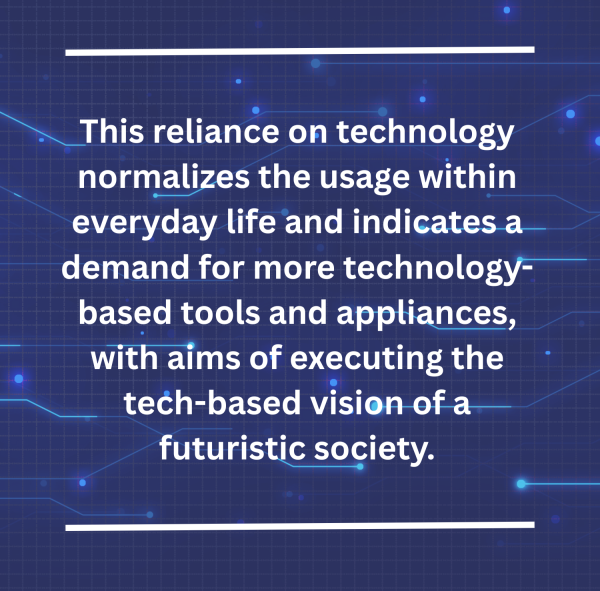
JL: This incorporation of technology into daily objects, called Internet-of-Things, or IoTs, represents a new phase of the digital world. A reason as to why technification has grown so popular in recent years is due to tech companies wanting to take advantage of our growing reliance on technology to sell products to consumers. According to the Pew Research Center, nine in 10 U.S. adults use the internet daily, with 41% admitting to “almost constantly” being online. As for students, 97% U.S. teens report that they use the internet on a daily basis, with four in ten admitting to being “constantly online” and 41% admitting to having over eight hours of screen time per day. This reliance on technology normalizes the usage within everyday life and indicates a demand for more technology-based tools and appliances, with aims of executing the tech-based vision of a futuristic society.
JC: There is some truth to this “digital utopia” theory. Gadgets reduce the manual labor required for everyday tasks, especially with remote capabilities, making them convenient and suitable for a wide variety of ages. Additionally, IoT devices can be more energy-efficient in some cases. According to the Department of Energy, for instance, smart thermostats that automatically regulate temperature can save 10% on yearly heating and cooling costs.
JL: But these conveniences are not uniform across the board, with a lot of the implemented conveniences of these smart technologies being questionable. For example, items like smart toothbrushes, smart toasters and even smart trash cans bring into question both the actual convenience and necessity of these tech products, given that they don’t have any higher value compared to their non-technological counterparts. Products like the smart toaster don’t offer any benefits that a normal toaster wouldn’t provide besides a screen that tells users the weather, time and the option to change toaster settings for specific kinds of bread. All of these components are completely unnecessary for a toaster, and it doesn’t even function properly. It feels as though these elements are purely there to add a technological aspect to toasters for the sake of adding them.
JL: Furthermore, while some smart tools have the capacity to save energy, other devices like speakers and cameras actually increase the amount of energy people use in their day-to-day lives. These factors, along with the fact that the systems these tools rely on are very complicated and hard to understand, undercut the conveniences these products have.
JC: Beyond these questionable qualities of IoT devices, reliance on these technologies, especially in smart homes, poses significant security risks, raising concerns about surveillance and digital privacy. Recently, a controversial Ring commercial shared at the Super Bowl depicted Ring cameras scanning a neighborhood to locate a missing dog. Many were quick to criticize the company for pushing dystopian surveillance tools, raising concerns about the security of smart devices.
JC: Estimates from industry threat summaries indicate that, from 2024 to 2025, the frequency of cybersecurity attacks on IoTs increased by 124%, with approximately 820,000 attempted attacks per day. Furthermore, many IoT devices, from smart speakers to wearables, are known to collect and sell sensitive consumer data, such as health metrics.
JL: These products are also generally less dependable, with a lot of IoT tools relying on Wi-Fi, which can result in more inconveniences during events like Wi-Fi outages. Heavy Wi-Fi usage also has the capacity to strain users’ network usage and bandwidth. Smart devices may also have qualities that are hidden behind paywalls, with products like the Oura Ring, a ring that’s meant to track data on its users’ personal health, offering a subscription in order to access all of its features, these paywalls make these technologies less accessible to those who can’t afford it. These items can also become unsupported by their companies, due to updated technology or the existence of newer models, rendering them wasteful and non-functional.
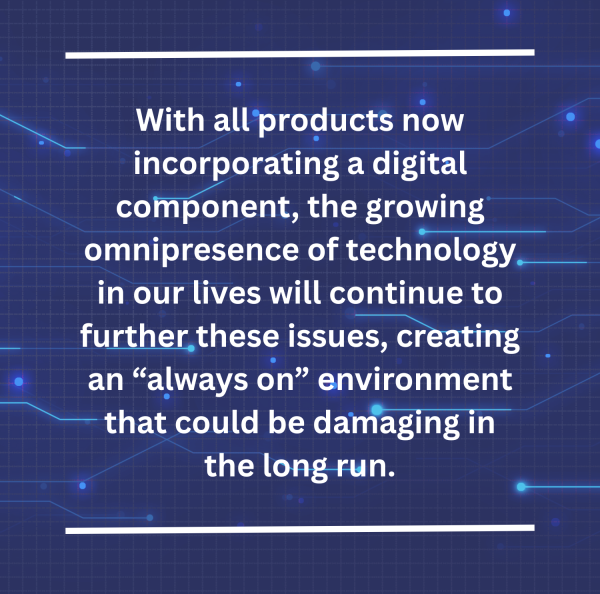
JC: Notably, a reliance on IoTs can be associated with the same problems internet reliance causes. Digital dependence fosters addiction, decreased attention spans, anxiety, depression, and social isolation. With all products now incorporating a digital component, the growing omnipresence of technology in our lives will continue to further these issues, creating an “always on” environment that could be damaging in the long run.
JC: In the wake of the growing digitalization, some experiencing technological fatigue have begun abstaining from broader technology use, practicing digital minimalism. Digital minimalism is characterized by varying degrees of separation from technology, often stressing intentionality in screen use. Accordingly, many have returned to “dumb technologies,” including old phones, record players and analog cameras, resisting the adoption of IoT devices.
JL: This technification is only going to continue as time goes on, meaning that it’s important for us to learn how to use technology in a responsible manner. This means being selective about what products we choose to buy and considering how truly necessary and convenient they are. We also need to update our digital literacy, or our ability to keep up to date with and properly navigate newer technologies. This means educating ourselves more on technology and its uses, practicing internet safety and thinking critically over the benefits and dangers of these newer pieces of technology. With this in mind, we can be able to maintain our safety and trust within these ever-growing technological products.
JC: This was Jonah —
JL: And Juju.
JC: Thanks for tuning in!