


Politics, despite its relevancy and widespread impact, often feels more like a series of major headlines than issues that impact us directly. Across the nation, only 32% of Americans actually follow national politics closely, revealing a lack of political participation. Considering that domestic politics is confusing enough even for American-born citizens, the challenge more than doubles for immigrants. Shifting to possibly a new political system, dealing with news in a new language or struggling with gaps in civic education make engaging in politics a journey scattered with obstacles. As a result, engaging in the political process through efforts like voting in national elections appears to be another burden on one’s back — proven in how naturalized citizens’ voting has typically lagged behind American-born citizens’ numbers.
For the second generation, most of us have been raised in the United States and taught the basics of civic education and how to navigate our complex political system, but we aren’t eligible to vote yet. Our hand in the political process is fated to wait for our 18th birthdays. The extent to which we can exert our opinions and preach action therefore is projected onto those around us who can vote — our parents, our older friends and our extended family. To ensure representation and equity, we have a civic responsibility to inform the less politically educated around us. However, we must be careful when toeing the line between information and influence. 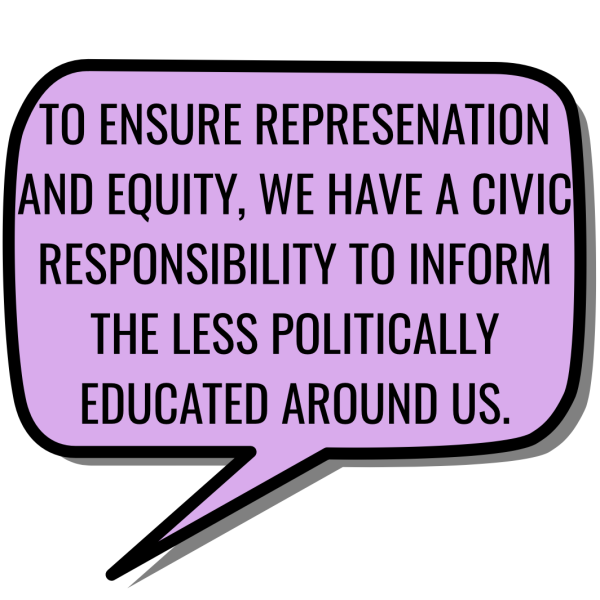
One could argue that a politically uneducated voter shouldn’t vote for the risk of poor choice. However, politics extends far beyond the ballot. When voters don’t understand what’s at stake or the breadth of the consequences of a certain policy, specialized interest groups or radical minorities have disproportionate influence. Laws affecting health insurance, nutrition aid and social safety impact everyone, but especially our immigrant parents. Yet, if they can’t comprehend the often complex, elitist language of political explainers or fall trap to the misinformation that circulates on WeChat and WhatsApp, they lose the chance to fight for the issues that directly affect them and their families.
A well-functioning democracy requires educated citizens who participate in it. Having a voice within government function is crucial to avoid a government that doesn’t represent the people. As the more politically educated generation with greater access to more resources in comparison to our parents, if we want to live in a representative democracy, we need to work to fuel it through education. This education extends beyond issues highlighted in headlines. Teaching those around us about voter registration and reviewing the information pamphlets often lost in the shredder are also key steps to preparing people for a future of political participation and engagement. However, despite the slew of information we could provide, they ultimately need to make their own decisions at the ballot box.
When discussing politics, bias is inevitable — no matter how nonpartisan one considers themselves, internalized ideas and the media around us influence what we relay to those around us. When attempting to encourage political discourse and learning, along with a greater understanding of government functions, we must stress the importance of developing individual political opinions.
Organizations like the League of Women Voters embody this sentiment. The nonprofit strives to up voter engagement and participation while encouraging an equal representation of all voices. In the process, it presents nonpartisan opinions and avoids backing any particular candidate. When it comes to encouraging voters and political participation, we must instill the principle of developing individual opinions as well. A well-researched public who knows what it wants and needs is a public who cares about bettering our nation.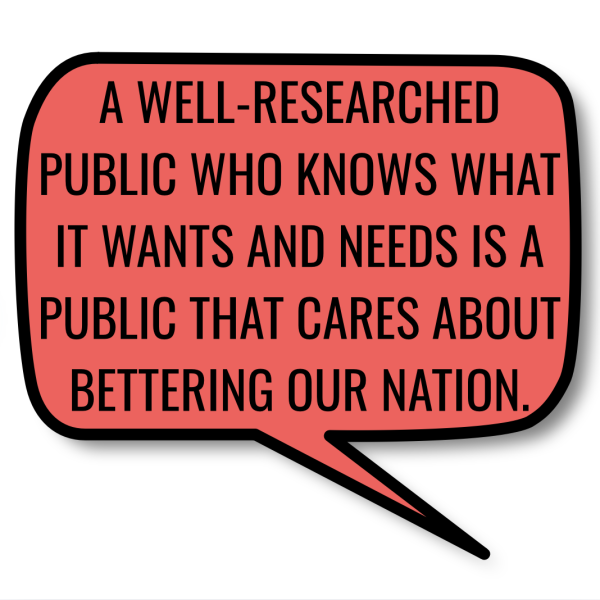
If we want a strong democracy that isn’t impeded by misinformation, then we must take the lead in encouraging others around us. If we have the time and resources to be politically educated, then we need to inform those around us so they better understand the choices they make. This discussion matters — youth who had been reached out to by political groups or discussed politics with those around them were much more likely to vote. Yet to build better civic participation, we need to approach the process with information. Explain the mechanics of voting, registration, polling. Center accuracy. When talking to immigrant parents with a weaker understanding of American politics, we should strive to create a voter base that cares about issues and wants to remain politically active and engaged. Whether it’s for your party of choice or not, voting is crucial — “not being interested” shouldn’t be an acceptable excuse.