


“I did things — you have never had a job. You’ve never accomplished anything.”
This was one of many verbal attacks launched during the final NYC mayoral debate — which has been characterized by the non-stop exchange of insults — between Andrew Cuomo, Curtis Sliwa and Zohran Mamdani. While quips like this make powerful soundbites and scratch the public’s itch for drama, they reveal a worrying trend in recent American debates — these remarks do not concern the recipient’s political campaign or the issues being discussed, but rather, insult the candidates themselves.
In earlier American politics, discussion between politicians was distinguished by precise rhetoric and respectful responses, as seen in the 1980 presidential debates between Jimmy Carter and Ronald Reagan. Clips that have gained popularity on social media at that time exemplify a more respectful era in political discourse — both Carter and Reagan were soft-spoken, exchanging pleasantries and using precise language. This politeness resonated with the American public, allowing for a political environment far less volatile than today’s.
In contrast, recent debates have generated more memes than progress. For instance, the 2020 presidential debates between Donald Trump and Joe Biden are remembered for their complete absence of civility, with Trump’s constant interruptions and Biden’s infamous response: “Will you shut up, man?” The two resumed this trend when they sparred again in 2024, refusing to shake hands before trading insults and personal attacks once more. Exchanges like these have come to define American politics, creating an atmosphere where incivility is acceptable and even effective.
An article from The Guardian reveals that the Flesch-Kincaid reading levels of presidents’ speeches have been steadily decreasing at a linear rate since the 1820s — about two to three levels less every few decades. By contrast, further research into the lexile level of presidents like John F. Kennedy, Richard Nixon and Ronald Reagan indicate that, although their language showed some decline in complexity compared to previous presidents, they still were able to maintain a significantly higher level of clarity compared to the diction of more recent presidents and politicians. The lack of care for formality implies a shift among politicians towards oversimplification for the sake of eliciting a response, lowering the bar for general nuance in political discussion.
As language has grown less formal, conduct has followed suit. Politicians like Nancy Pelosi and John Boehner, though not generally known for rudeness, still have publicly been disrespectful to other politicians, the former through tearing up Trump’s State of the Union Speech and the latter through calling Ted Cruz “Lucifer in the flesh,” an insult followed by the remark, “I have never worked with a more miserable son of a b—- in my life.” Other politicians, such as Gavin Newsom, gain recognition and support by sparking public outrage rather than utilizing persuasion.
Trends like these are only amplified by increased social media communication. The algorithms of platforms like X and Instagram reward divisive content and have consequently seen an increase in inflammatory messages targeting certain opinions and fueling political polarization, from both politicians and ordinary civilians, undermining common ground and civility. A study from Pew Research Center indicates that 47% of Americans feel like people have gotten ruder since the pandemic, a phenomenon that can be explained by Albert Bandura’s social learning theory — a hypothesis stating that people learn behavior from observing and replicating an authority figure’s behavior. A different study from Psychology Today highlights how exposure to aggressive politics can negatively impact a person’s behavior when confronted with day-to-day activities.
Despite these implications, politicians seem unlikely to slow in their broadcast of disrespect. In a recent example, rather than formally addressing protestors or issuing a statement in light of the nationwide No Kings protests, President Donald Trump responded by posting an AI-generated video of himself dropping feces on protestors via a fighter jet, not only making no effort to calm the protests but also inviting further conflict.
Trump is known for posting negative comments about people and events he personally disagrees with. Many of his statements made in person and online, though garnering large amounts of views, likes and shares, are misleading and steeped in controversy. The shift toward sensationalism in politics for the sake of creating outrage correlates with a measurable drop in evidence-mining institution (EMI) scores in political communication, as recorded by Nature, indicating a shift away from evidence-based arguments to intuition-based ones. For instance, Trump’s repeated, unfounded claims that the 2020 election was “rigged” led 69% of Republicans at the time to believe that Joe Biden was an illegitimate president. Ultimately, this creates a positive feedback loop: politicians use inflammatory or misleading language to appeal to polarized audiences, leading media outlets to amplify those reactions for clicks, and citizens begin to internalize those patterns in everyday discourse.
The erosion of civility in political discourse has tangible consequences — primarily a lack of trust from the general public. The number of people who distrust the government is at an all-time high. Near nonstop tweets from political figures and memes about them from content creators lead to something akin to news fatigue, in which people consume information at such a staggering rate that critical engagement begins to decline. A lack of media literacy is one of the root problems — as a result of constant disinformation stemming from politicians, media can no longer be treated as unbiased. In fact, there is so much partisan media that people struggle to evaluate sources with a critical lens and separate opinion from fact. This results in a disillusioned population that increasingly sees politics as a zero-sum game instead of a shared civic responsibility.
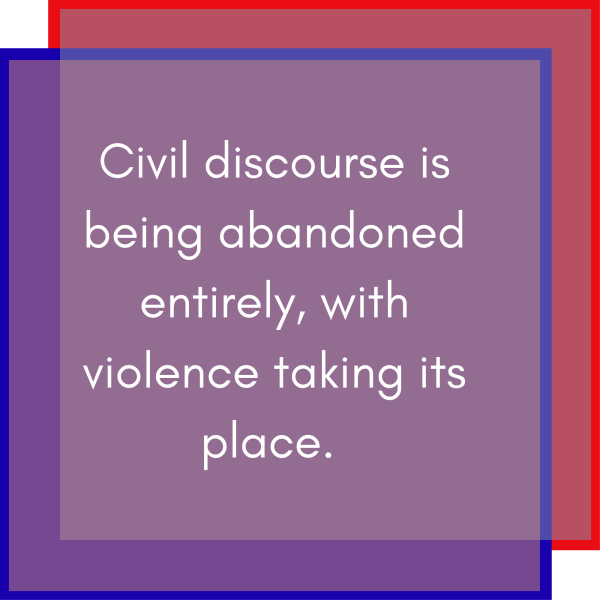 As a result, America has reached its limit: polarization is at its maximum. The assassination of political activist Charlie Kirk and its aftermath are symptoms of a broader, existential conflict: civil discourse is being abandoned entirely, with violence taking its place. What should have been a reckoning for America instead became an “us versus them” battle, in which people from both ends of the political spectrum sought to demonize the other. Polarization is reaching a point where no agreement is possible, and America is increasingly seeing the deadly consequences.
With the potential to heal the country’s rampant political polarization, civil discourse is now more important than ever. Organizations like the nonprofit Braver Angels have already begun taking steps to bridge the political divide through discussion. Braver Angels hosts regular “Red/Blue Workshops,” bringing together Republicans and Democrats to voice their opinions and listen to one another’s arguments. Participants who attended these workshops reported largely positive experiences, with one attendee claiming, “I found that we are more alike than we are different and that’s the bottom line for me.”
The promotion of civil discussion is beginning to catch on, with Sal Khan’s Schoolhouse.world hosting Dialogue Events. During Dialogue Events, two students with opposing viewpoints meet one-on-one and discuss controversial issues. Feedback from these discussions contributes to students’ Dialogue Portfolios, which they can submit to colleges when applying.
Among the colleges formally accepting Dialogue Portfolios are the University of Chicago, Columbia University, Johns Hopkins University, Colby College, Northwestern University and Washington University. Other colleges have begun prioritizing civil discourse in other ways, with certain applications asking students to describe times when they navigated disagreement. These methods collectively aim to promote engagement and civility among students, enabling them to apply these skills in their adult lives.
 Ultimately, the power to promote respectful discourse rests with individuals. If more people make a conscious effort to practice civility in their daily lives, society as a whole will benefit. For instance, by practicing community service, people can stay connected and engaged in local and national politics, promoting diverse perspectives and discussion. It’s also crucial that people learn to re-emphasize basic conversation skills, such as active listening and politeness. By learning these skills, people can reflect on personal attitudes and actions while being mindful of their preconceived notions. Involvement, empathy and integrity are all key in creating a more respectful society.
The deprioritization of formality and respect in general discussion has damaged politics, creating a highly volatile environment. By restoring the virtue of civil discourse, we can take steps toward mitigating polarization and strengthening not only communities, but the nation as a whole.