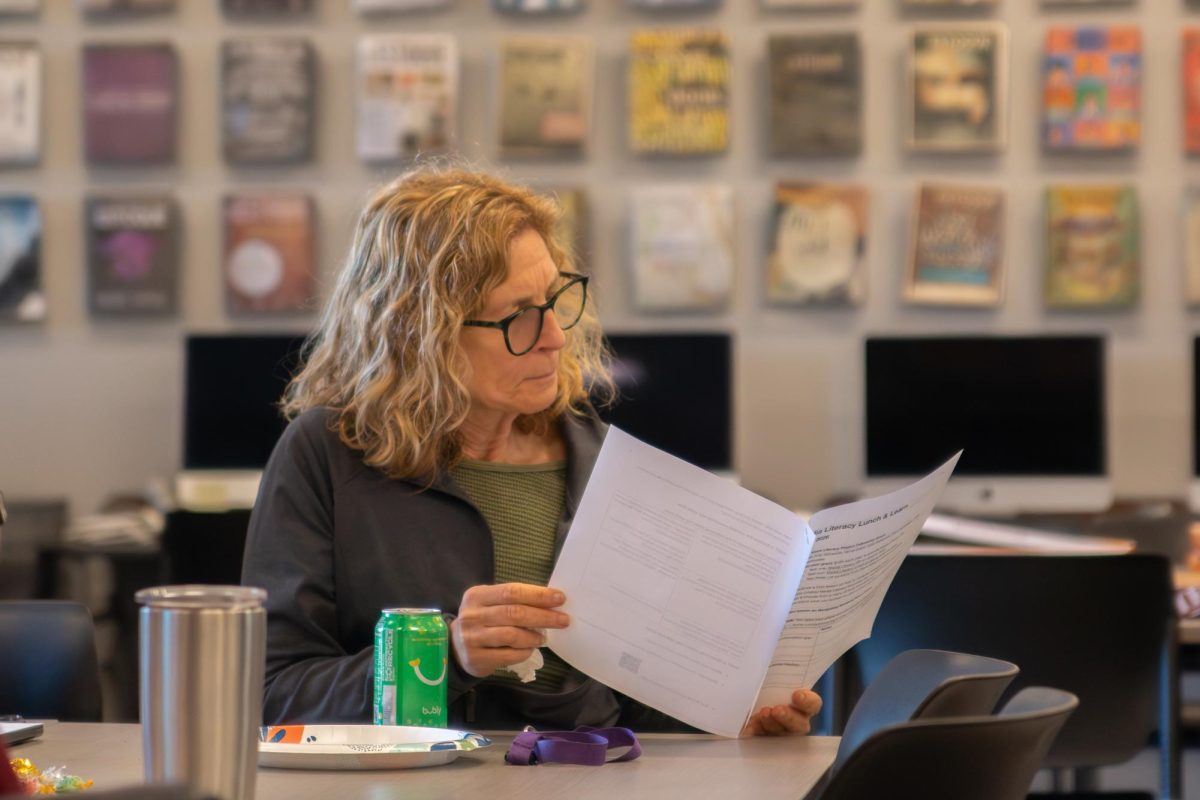



The FUHSD News Literacy Project Fellowship team held its fourth installment of the Media Literacy Lunch and Learn professional development series at MVHS on Wednesday, March 25. English Curriculum Lead Julia Satterthwaite, Homestead High School Teacher Librarian Verna Grant and Cupertino High School Library Media Teacher Julia Hedstrom led the PD.
The event featured a presentation led by the organizers, interactive activities — such as discussions examining a social media post and evaluating its credibility — and time for teachers to begin incorporating the news literacy into their lesson plans.
The Lunch and Learns are part of a multi-year initiative funded by the News Literacy Project, a nonprofit organization dedicated to equipping teachers with the tools to incorporate media literacy into everyday curriculum. According to Grant, after launching the program two years ago and hosting a full-day summer professional development session for 34 teachers, the organizers decided to expand their outreach by visiting various school sites during the school year and offering lunch to encourage teacher participation.
Chemistry teacher Supriya Moore attended the professional development to better understand media literacy before incorporating it into her classroom. She is planning to implement a “Fact or Fiction” activity in which students find chemistry-related news articles and evaluate their credibility using their media literacy and chemistry skills. Moore emphasized the importance of this work, noting that while she primarily receives her news from established sources, many students rely on social media for information.
“Media literacy is important to my students’ generation,” Moore said. “I kept thinking, are our students taught how to decipher what is trustworthy media and what is not? I’m a science teacher, and I live in this little silo where I just teach science, but I don’t know if it’s part of the curriculum. It could be part of an English or social studies curriculum, but what if my students are never exposed to this, and they graduate high school without media literacy?”
As teachers discussed how to incorporate media literacy concepts in their own subjects, history teacher and event attendee Bonnie Belshe says there are already clear connections to skills taught in the classroom. She explains how history classes regularly require students to evaluate sources and corroborate information, a practice that closely mirrors media literacy. By making these parallels more apparent, Belshe says students can better use their own analytical skills beyond just academic settings.
“It would be really helpful for students if we help specifically bridge that gap for them,” Belshe said. “Your media literacy is tied to your historical thinking and analysis skills. Making that connection more explicit for students and taking these skills outside the classroom and into your phone that you carry at all times is important. Let’s tie these skills together.”