



California Gov. Gavin Newsom signed Senate Bill 63 into law on Oct. 13, 2025, allowing the supporters of the Connect Bay Area Transit Initiative to petition for 186,000 signatures by June 6 in order to add the sales-tax measure on the November ballot for 2026. This measure would implement a 0.5% tax increase in the counties of Alameda, Contra Costa, San Mateo and Santa Clara — and a 1% tax increase in San Francisco County — raising over $1 billion annually for public transit services. Money from the tax increase would then go to improve the “safety, cleanliness, convenience and seamless integration of transit services,” according to the Connect Bay Area website, impacting VTA, BART, Muni, CalTrain and other organizations.
Currently, supporters of Connect Bay Area are in the process of seeking signatures for the petition. Harry Neil, a Transbay Coalition member, Connect Bay Area’s Santa Clara County campaign lead and ‘20 MV alum, describes the initiative’s various approaches to getting people to sign. Neil explains that having a presence at local events and fairs, putting up flyers and spreading the word through social media are all methods the organization has used, having gained over 1,000 signatures for the petition themself. He calls this measure a citizens’ initiative, which allows a place for statutory proposals on the ballot if supported by a specific number of signatures, and has found that many Bay Area residents are often supportive of preserving transit.
“I’ve seen a lot of enthusiasm in the field from people who recognize that our transit’s important even if they might not personally take it,” Neil said. “They understand that every person on the train is someone who isn’t driving and taking up space on the highway. They might say, ‘Oh, when I was a student I took BART up to Berkeley, and it was an awesome experience,’ or ‘Whenever I go to the Giants game, I always take Caltrain up,’ and they want to save our transit, so there’s been tons and tons of enthusiasm from the public in that way.”
Although the measure is now making progress toward getting legal approval, previously in 2024, there was an attempt to authorize a regional measure under SB 1031. Neil explains that although the legislation had the same goal as SB 63, the earlier measure ultimately failed due to an overly ambitious and unfocused nine-county funding approach — aiming to include the entire Bay Area — which contrasts with the five-county target of SB 63.
Movement towards changing the funding sources for transit agencies is very vital for some organizations, as BART Media Relations Manager Chris Filippi explains that a new funding model is a necessity for BART to maintain its ridership and reach since funding relies on passenger fares. Filippi notes that since the pandemic BART’s daily ridership has declined from 400,000 riders to about 200,000 riders per day.
“We still have that same funding model in place, but it just doesn’t work for us anymore, because our ridership has gone down,” Filippi said. “That really is the big concern for BART going forward, and what BART needs — and many of our Bay Area transit agencies need — is a new funding model.”
Similarly, VTA Public Information Officer Stacey Hendler Ross explains that with money from the measure, VTA will have the chance to not only preserve, but expand their service, hire more drivers and improve rider accessibility. While no plan for fund allocation has been finalized, Hendler Ross notes that VTA has been making an effort to educate people about the potential impacts the measure would have on their organization and ask Bay Area residents what types of transportation improvements are important to their cities.
“Since we don’t know the specific projects, it’s hard to comment really on what specific impact it would have on people,” Hendler Ross said. “But we like to think that the projects and the services that we offer have a tremendous impact on a huge number of passengers in our community. Our ridership is about 20 million a year, and 20 million rides going everywhere in the county makes quite an impact in this area.”
However, some groups, such as the Silicon Valley Taxpayers Association, oppose the bill, arguing that the measure’s tax would be more expensive for Bay Area residents. Omar Chatty, a spokesperson from the SVTA, explains that when considering other measures that have increased Bay Area taxes in the past few years, it’s important to know where to draw the line.
“We just passed Measure A, a five year tax of 8% so we can’t keep doing this,” Chatty said. “We can’t keep adding these taxes. At some point, we have to say, ‘Come on, let’s be more efficient,’ and we believe that we can be more efficient.”
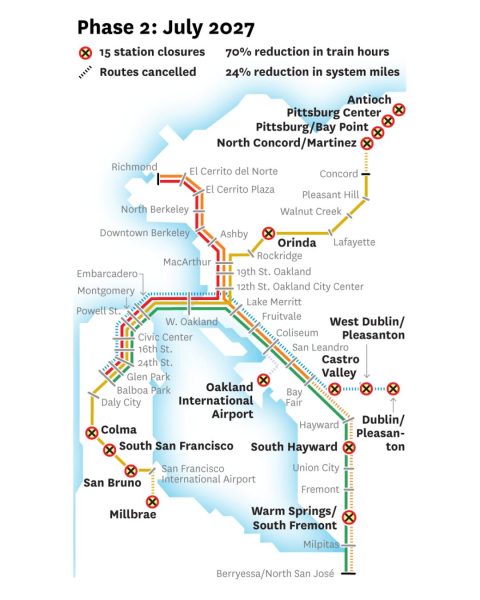
While Chatty and the SVTA raise concerns over affordability, Connect Bay Area Communications Lead Jeff Cretan explains that the bill is necessary for those who primarily rely on public transit. Cretan mentions BART’s plan to close up to 15 stations due to their financial struggles, explaining that the incoming death spiral caused by the transit budget will impact those who regularly use transit. From his experience working with City Hall and state legislation relating to transit, Cretan believes public transportation is the backbone of both the Bay Area and its economy with many workers and working-class people relying on it to get to work.
“Public transit is how the Bay Area works,” Cretan said. “The people who oppose this, their solution is basically to gut the system, and gutting the system will mean you cut service anywhere from 30% of immunity service to 70%. The people are going to suffer, people who can’t afford to get an Uber, can’t afford to have a car. Those are people who are trying to get to work — be it an office building downtown or a barista job somewhere — and they need the bus. When you talk about a functioning society, you need transit.”