


The Supreme Court sided with Maryland parents in the case Mahmoud v. Taylor, ruling that parents can now legally withdraw their elementary aged children from lessons involving LGBTQ+-inclusive books. The court reached its 6-3 decision on June 27, setting a national precedent that contradicts FUHSD’s current opt-out process.
The ruling came after Maryland parents protested the addition of several LGBTQ+ children’s books to elementary school curricula in their school district. While the district initially honored parent opt-out requests, it eventually halted the practice due to an influx of opt-outs. The parents’ lawsuit was filed in 2023 by Muslim parents who sought to remove their child from lessons involving LGBTQ+ books. It was aimed at ensuring parents’ right to opt their children out of lessons they felt burdened their right to freedom of religion. According to NPR, the ruling may lead to parents opting their children out of lessons on evolution or anything else they can prove is incompatible with their religious practice.
Within FUHSD, Associate Superintendent Trudy Gross routinely deals with parental opt-out requests at the district level. Gross says that with the current process, religious circumstances would not be enough reason to grant a student an exemption from a lesson. Instead, parents must prove that students’ learning or well-being would be harmed without the exemption. However, the new ruling changes the requirements, now accepting religion-based opt-out forms. In response, FUHSD administration is working with district lawyers on an opt-out form.
Homestead High School English teacher Dr. James Aguirre, who sits on the State Advisory Board to the Superintendent of Education, says that in early 2025, he had received a resource called the Epic Toolkit. Created by the Santa Clara Unified School District, the toolkit is an in-depth guide for responding to students and families with concerns about curriculum decisions. Prior to the ruling, Aguirre and other literature teachers from FUHSD were in the process of adapting the toolkit for use in our district. Ultimately, the Supreme Court decision has lessened the resource’s applicability, potentially making it easier for a parent to obtain permission to remove their child from a lesson with LGBTQ+ themes.
When faced with a parent requesting to opt their child out of LGBTQ+ material in around 2020, English teacher Randy Holaday recalls the opt-out process being straightforward, with the principal ultimately making the choice of whether to honor the request. However, the Supreme Court ruling means that legal pushback against the process may be stronger.
“Things might start changing if parents are unhappy with the principal’s decision and they decide to try to sue the district,” Holaday said. “At the very least, it’s just going to make it easier for parents to feel like they can get litigious, and that itself is enough to either scare people or just make the process a lot harder.”
Aguirre has faced similar issues to Holaday’s in the past, with students “making enough stink” about having an openly gay teacher that they had to be removed from his class. He agrees that district policies will take precedence over the Supreme Court ruling for now, but parents with knowledge of the case might take action with this development.
As someone who is passionate about diversity and inclusion within the FUHSD curriculum, Aguirre believes students should be exposed to reading about various cultures and identities represented in the school’s demographics.
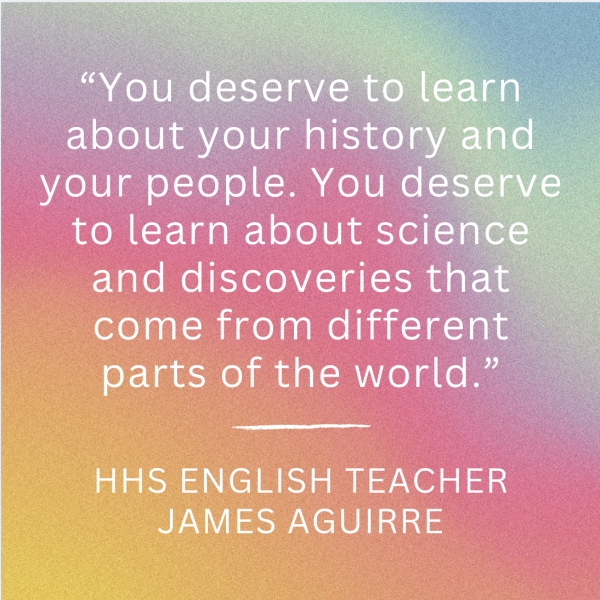
“I want to teach literature that looks like my students,” Aguirre said. “I want to teach things where my students can see themselves. You deserve to read about your people and your experiences. You deserve to learn about your history and your people. You deserve to learn about science and discoveries that come from different parts of the world. So I’m just trying to do a good job over here.”
Holaday shares the sentiment, stating that diversity is a large part of his and the district’s philosophy of teaching literature, which is reflected by the variety of viewpoints and experiences present in books being taught, like “Aristotle and Dante Discover the Secrets of the Universe,” “The Kite Runner” and “The Great Gatsby.”
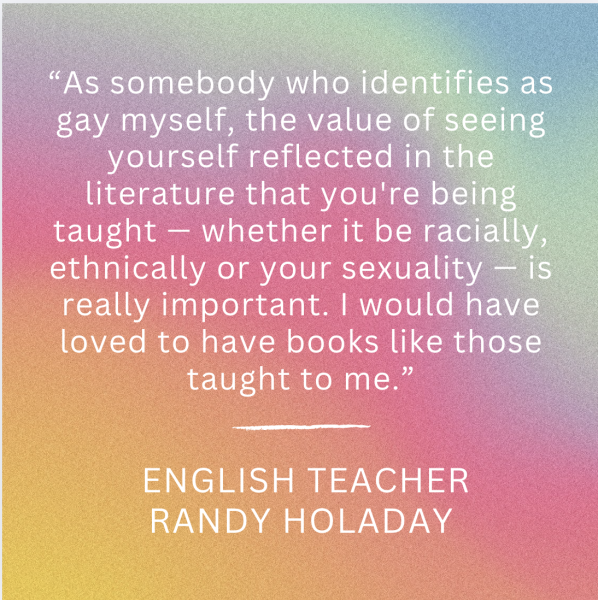
“Part of English curriculum is exposing all students to diverse perspectives, and LGBTQ+ is one of them,” Holaday said. “As somebody who identifies as gay myself, the value of seeing yourself reflected in the literature that you’re being taught — whether it be racially, ethnically or your sexuality — is really important. I would have loved to have books like those taught to me.”