

Spoilers for “Project Hail Mary” ahead
A mysterious interstellar bacteria is eating the Sun, threatening to kill billions and wipe out countless species. Waking up from a coma aboard a spaceship on a suicide mission to a far-off star, a single amnesiac astronaut must orient himself in the universe while hoping to regain his memories and find Earth’s salvation. Yet “Project Hail Mary,” based on Andy Weir’s 2022 book of the same name, isn’t as hopeless as its premise might suggest — actually, it’s not hopeless at all.
The film, released on March 20, follows former researcher and current middle school science teacher Dr. Ryland Grace (Ryan Gosling) as he journeys lightyears through space to find the cure for Astrophage — an alien bacteria feeding off and dimming the Sun — by traveling to the only unaffected star in the universe. As he regains his memories and makes an unexpected connection with a crab-like, echolocating alien named Rocky (James Ortiz) attempting to save his own sun, Grace’s cowardice turns to bravery and he learns to put the needs of two planets over his own.
“Project Hail Mary” dares to ask the question, “Could Ryan Gosling have chemistry with a rock?” The answer, it turns out, is yes. Gosling’s acting excels on its own, starting the movie as a disgruntled, depressed and clumsy non-astronaut humorously commanding the ship’s computer to take him home. Yet he truly shines when interacting with Eva Stratt (Sandra Hüller), a serious government agent, and lovable fellow space traveller Rocky. Grace’s back-and-forth exchanges with Rocky and the moments he hits scientific flow state are wildly funny. He trips on spacewalks, tumbles into walls trying to run away from an alien spaceship and screams when entering zero gravity: physical acting that feels relatable rather than slapstick.

Witty, playful exchanges between characters and humorous moments of attempted communication between Rocky and Grace are fast-paced, keeping the movie engaging. On the other hand, heartfelt moments, like when Rocky offers to sacrifice some of his fuel so Grace can return to Earth, are appropriately lingering and touching, culminating in a deeply emotional payoff. They’re seldom undercut by jokes, letting the audience sit with tension or grief longer than an equivalent Marvel scene would.
Even though both the humorous and emotional moments of the movie shine on their own, composer Daniel Pemberton’s score elevates them to star status. Blending jaunty, inquisitive sounds during moments of discovery with sweeping scores that sound straight out of a hope-core montage for emotional beats, Pemberton, who previously collaborated with the film’s directors Phil Lord and Chris Miller on the “Spiderverse” movies, delivers a wacky, yet celestial tone throughout. Oftentimes, though, this score is the only thing that suggests a scene’s intended mood to the audience; the film’s heavy use of montage means that some scenes’ emotions can’t be fully communicated through dialogue or acting, relying solely on the backing track.
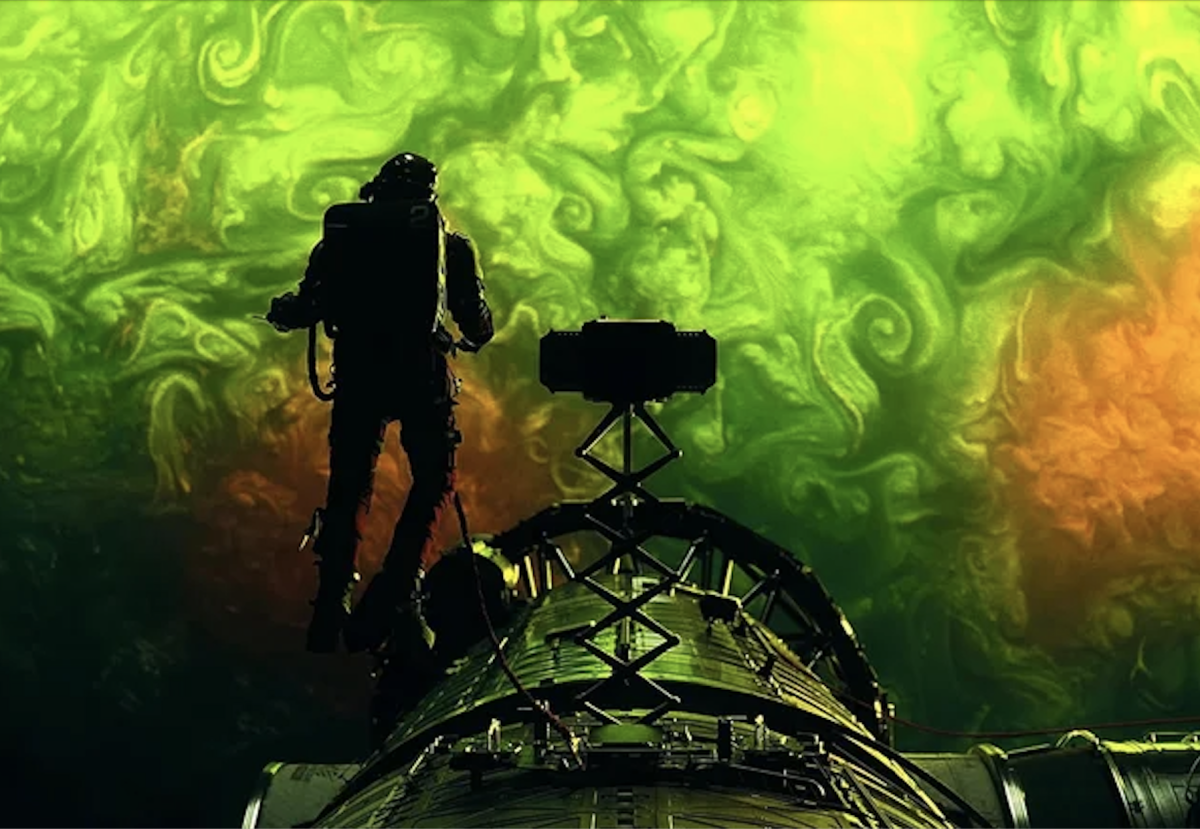
Beyond its lovable characters and stellar score, “Project Hail Mary”’s visuals are also dazzling, especially because they were made entirely with practical effects. In a Hollywood era marked by throwing CGI at every mildly unrealistic storyboard, this film is a breath of fresh air. For instance, production used ultraviolet cameras for unique cosmic views and animatronic puppets for Rocky. This detail breathes more life into a film already teeming with attention to detail from cast, crew and production alike.
Throughout his arc, Grace’s most hard-hitting moments come when he chooses to sacrifice himself for the greater good: risking life and limb to collect samples of an amoeba that might destroy Astrophage, and sacrificing his only chance to return home in order to save Rocky’s life and planet. These moments carry so much weight due to the flashbacks to Grace’s prior cowardice and selfishness, like resisting joining the crew on its suicide mission when he was the only person on Earth qualified to.
But this character arc comes at the expense of Grace’s original characterization in the book. There, he is shown as scientifically minded and curious from the start, waking up from his induced coma and immediately getting to work calculating the gravity aboard the spaceship using physics. While no movie would have the runtime to include the countless experiments and math Grace performs in the book, the choice to not include a single one makes him seem pathetic and helpless at the beginning, rather than a brilliant scientific mind. “The Martian,” an adaptation of another Andy Weir novel, included the scientific process without sacrificing plot or runtime. This choice removes some of the cosmic wonder and love for science that made the book more heartwarming, trading it in for a few more comedic beats early in the story.
The conflict itself also feels intentionally distanced from making any sort of political statement. When trying to solve the existential threat of Astrophage, all the world’s major countries work together to pour money into research for a solution, making centralized decisions without major nationalistic pushback or bureaucratic obstacles. This fantasy la-la land of global unity requires more suspension of disbelief than witnessing alien contact, but feels like a comforting moment of escape from the conflicts in our reality.
Despite this stretch of imagination, “Project Hail Mary” is a heartfelt supernova of bravery, camaraderie across species and the exhilarating, dazzling feeling of discovery. It’s a masterclass in emotionally reaching an audience that manages to be visually beautiful, humorous and heartfelt at the same time.
RATING: 4/5