

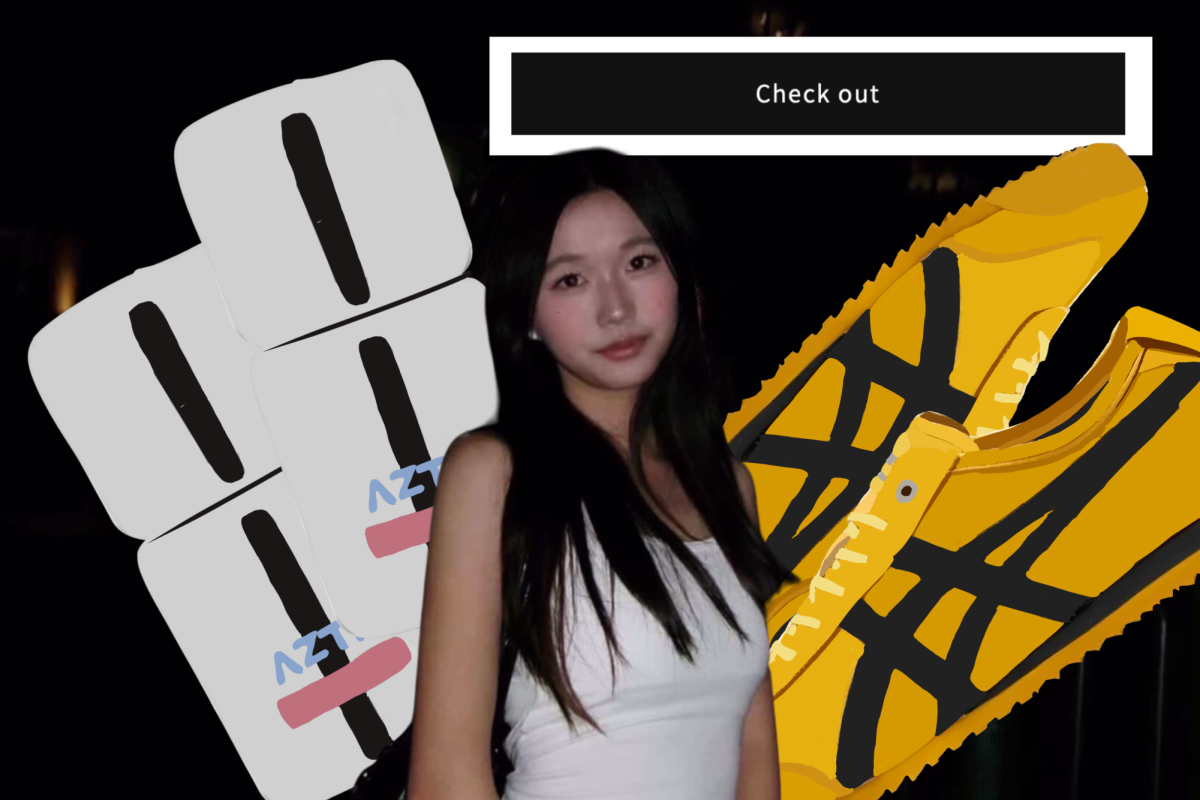
As the AZTK liquid blush in shade JC04, a new pair of yellow-and-black Onitsuka Tigers and the latest leopard-print 8 Ball hoodie I’d been stalking online for ages piled up in my online shopping cart, I couldn’t have been more eager to press the “Place Order” button. There was this new thrill I experienced, as if every purchase I made placed another small brick in the wall of my identity, and I reveled in the idea that I was in control. Regardless, a small nagging thought poked at me, prompting me to remember that desires don’t appear organically. They often come from our feeds.
Still, I turned a blind eye to the flaws behind every influencer with curated lives and endless posts on my algorithm, trying to push products toward me. I convinced myself I was immune because it seemed rational to act like my awareness of these tactics was proof I wasn’t susceptible to them.
Then one day at school, someone walked past me wearing the same Onitsuka Tigers I had sitting in my cart. I couldn’t help but stare at it for a beat longer than normal.
The yellow looked brighter in real life. The black looked cleaner. And instantly, I felt that tiny flip in my stomach — that oh wait, I actually really want those feeling — way stronger than before. The sneakers looked better in motion than they ever had in their flattened product shots.
The weird part wasn’t the shoe itself, but the feeling in my chest, like this version of me I kept trying to assemble suddenly walked past, embodied by someone else. I watched them move down the hallway and felt a mix of admiration and jealousy that I couldn’t sort out quickly enough.
And in that little moment, something clicked. I traced back my obsessive desire and realized all the moments in which it had accumulated unknowingly came from seeing the pair of shoes over and over in edits, hauls, GRWMs and drama-free morning routines on TikTok. It came from Instagram posts where shoes were casually slung next to matcha lattes from HeyTea and artfully messy bedrooms. It came from Netflix characters who always seemed to wear something just a little too aligned with whatever was trending online that exact month. It had never come from me on my own accord. In other words, my “want” was created by the media I consumed.
The person walking past me in those sneakers was just the final push of a want that had been planted and watered for weeks without me ever noticing. It was never individuality or my own taste, but the system doing exactly what it was designed to do: manufacture desire.
As I stood there pretending to listen to my friend recount her math quiz, I felt the truth unfold in front of me in real time. I had told myself for so long that I was successfully ignoring the algorithm that fed me trends of influencers pushing products on the surface level, but the truth was that TikTok edits and Instagram posts were already mapping out wants I didn’t even know I had yet. They showed me the version of “cool” I’d been trained to recognize, and I stepped right into it without noticing. It was manufacturing the exact feeling I had in that moment as I watched them walk down the hallway, and all I had to do was click “Checkout.”
The feeling didn’t stop at the sneaker. It branched out, spreading into the rest of my feed, every show I watched, and every microtrend I saved. The more I thought about it, the more I realized that the sense of “cool” I held inside my head wasn’t even mine to begin with. It had been handed to me prepackaged, pretested and pre-approved.
I was confused, but the thread had unraveled.
The more I looked back, the more I saw the cycle I had been trapped in. Something would appear in my life, embodying a kind of uniqueness I craved. I’d adopt it, and so would the others around me. As soon as we all caught on, it became basic. Then, as if on cue, the media would push something new to revive that feeling of originality, and I’d follow again, convinced this new product was fresher, truer and more me.
I stepped into each new version of myself willingly, believing what I was expressing was authentic. Underneath, everything was choreographed and written ahead of time, and I was just the performer who didn’t realize there was a script.
At MVHS, we often buy ourselves into identities through music tastes, clothing and even the colleges we apply to. Too often, choosing a school isn’t truly about the one we want, but about what that school says about us. Everyone wants to appear certain about their future and wear a label that suggests clarity and direction. So we adopt the same slang, the same playlists, the same hobbies, because belonging to what’s “cool” feels safer than standing apart. Rarely do we stop to question where these desires originate, or who taught us to want them.
In my experience, the thrill of buying still hasn’t disappeared, but it’s simply become more complicated. This new awareness hasn’t killed my excitement, but just layered it with an odd combination of betrayal and awe.
Two days later, when I opened my laptop again, my cart was still there. The blush, the hoodie and the sneakers sat together, and for once, I could see the overlap clearly: the parts of me that were real and the parts of me that were borrowed through a manufactured want. Not much of it was real.
There was no sudden realization. I just sat there, feeling strangely small and intensely alive. For the first time, I understood that I wasn’t just the consumer, but the product as well, and that the identity I kept trying to refine was built on the desires handed to me.
So I closed my laptop and let myself sit in that awareness, not to reject everything, or to pretend I was above the system, but just to know it was there. And in that quiet moment, I felt like I finally saw myself, far clearer than before, for the very first time.