



KY: Hi, I’m Kate —
JL: And I’m Joyce.
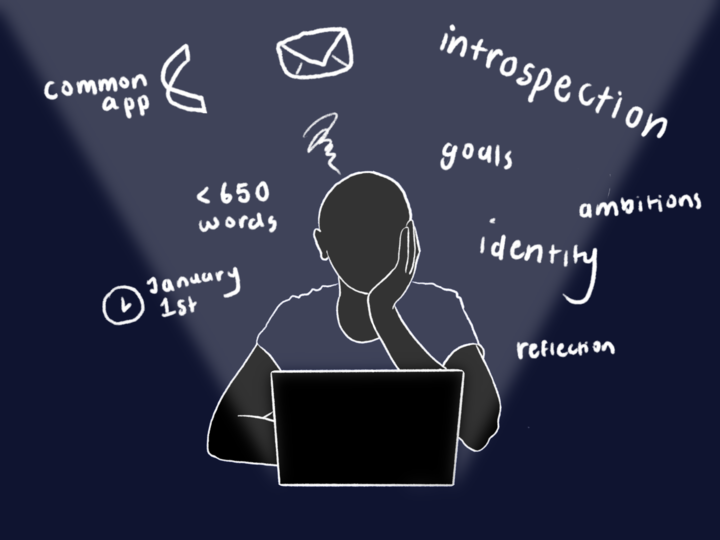
KY: Today, we’ll be talking about a taboo topic: college apps.
JL: Before anything else, let’s just start by acknowledging that college application season is completely unhinged, and we’re in the most stressful part of it right now as we finalize our applications and set up applicant portals. Every senior I know is battle-scarred and nearing the end, literally and figuratively.
KY: A lot of seniors are spending most of their time trying to translate years of experience, growth and decisions into structured essays and activity lists.
JL: And while the process is fairly standardized, the people going through it are obviously more than numbers and words on a PDF, which creates an interesting tension between an applicant’s identity and formatting it into a 12 pt font, Times New Roman essay and a dozen dropdown boxes.
KY: A complaint I’ve heard amongst students, parents and college admissions counselors is that the application process encourages students to choose between embellished “authenticity” and actual honesty. On social media and at home, students are constantly pushed to “stand out,” and it leads to them purposefully misrepresenting themselves, such as in creating fake activities, statistics and storylines.
JL: I’ve also seen this in how applicants will choose to forgo including their own personality in order to tailor their applications to be what they think admissions officers want to hear. It becomes very performative. And even though they market this process as deeply personal, like they’re searching for your “authentic self,” it feels rehearsed even when it’s true. There’s so much pressure to be deep but not alarming, vulnerable but not messy and vaguely inspirational but also not cocky.
KY: I think a part of this nuanced issue lies within the word count allotted to students, which forces people to cut down on what they really sound like and their actual experiences in order to fit what they want to say into the space provided. When I was putting together a supplemental essay about what fuels me creatively, I found it was difficult to include specific anecdotes and descriptive language while also keeping to my initial narrative.
JL: If you think about it, the word limit’s like a personality filter. It’s kind of ironic how much you have to learn about yourself, just to cut 90% of it out in the end.
KY: Another part of what gets me about this process is how easy it is to get into your head and stress about being just another statistic or application file. I feel this way when I’m reading my email each morning or when I read admissions statistics from the colleges I’m applying to.
JL: Right? When you open your email, your inbox is flooded with messages from colleges, all saying that they’d “love to see you at their campus.” It is flattering but it feels strange knowing you’re just another student out of hundreds of thousands of other hopefuls.
KY: Honestly, putting yourself out there in these applications can be insanely stressful, but honestly, I feel like there is merit to this process. While it’s easy to think you’re just going through the motions, I feel like I’ve truly learned more about myself and what I truly prioritize and love, like what challenges have pushed me forward as a person.
JL: Definitely. When you’re staring at a blank doc, you can’t hide behind activity lists or resumes — you actually have to decide what matters enough to write about. You’re forced to choose which experiences and memories deserve the space and which parts of yourself you’re most proud of. I personally deeply appreciate that opportunity for introspection when I feel like I’m constantly doing.
KY: I also feel a true sense of gratitude for the people and parts in my life that have gotten me to a position where I can take the next step in my education. College applications have shown me that each success, failure, moment of joy and mental breakdown haven’t been for nothing, and I’m seeing that in what I’m putting out there.
JL: Agreed! I especially love essays that call for reflection on the communities I’m a part of and the people I cherish. From my club get-togethers and late night conversations with friends to karaoke study breaks with summer program roommates, going down memory lane brings so much warmth and encouragement during this process.
KY: I think that’s the key: taking away as many positives as possible from the process. In that way, we can maintain optimism about the application process and where we’ll eventually end up. A lot of applicants fall in love with schools and fully envision themselves as students, and may fall too deep into fear and anxiety. While this may sound cliche, it’s truly all about the perspective and mindset you bring into this time of life.
JL: I think that really answers the central question of what to do when the process starts feeling robotic and kind of dehumanizing. When you can’t escape that feeling, and you can’t fully accept it either, always remember that irrespective of essays and decisions, the process manages to offer valuable, integral reflection for understanding your identity and goals.
KY: Definitely, the only way to push through is to stop treating it like judgment of your worth and more like a mirror that shows certain parts of you, but not the whole truth, and really dig deep into them. Take away what you can about yourself while you’re doing it.
JL: At the end of the day, they’re just prompts that ask you to pause and reflect, even if it does it in a stressful and imperfect way. Because no matter what school handle ends up on your Instagram bio or the MV26 decisions page next year, it’s the moments that have gotten us here and those that are yet to come that truly count. This was Joyce —
KY: And Kate.
JL: Thanks for tuning in!
Music: “Ocean Drift” by AmbientAUDIOVISION on Pixabay | Used with permission