


Elspeth Luu:
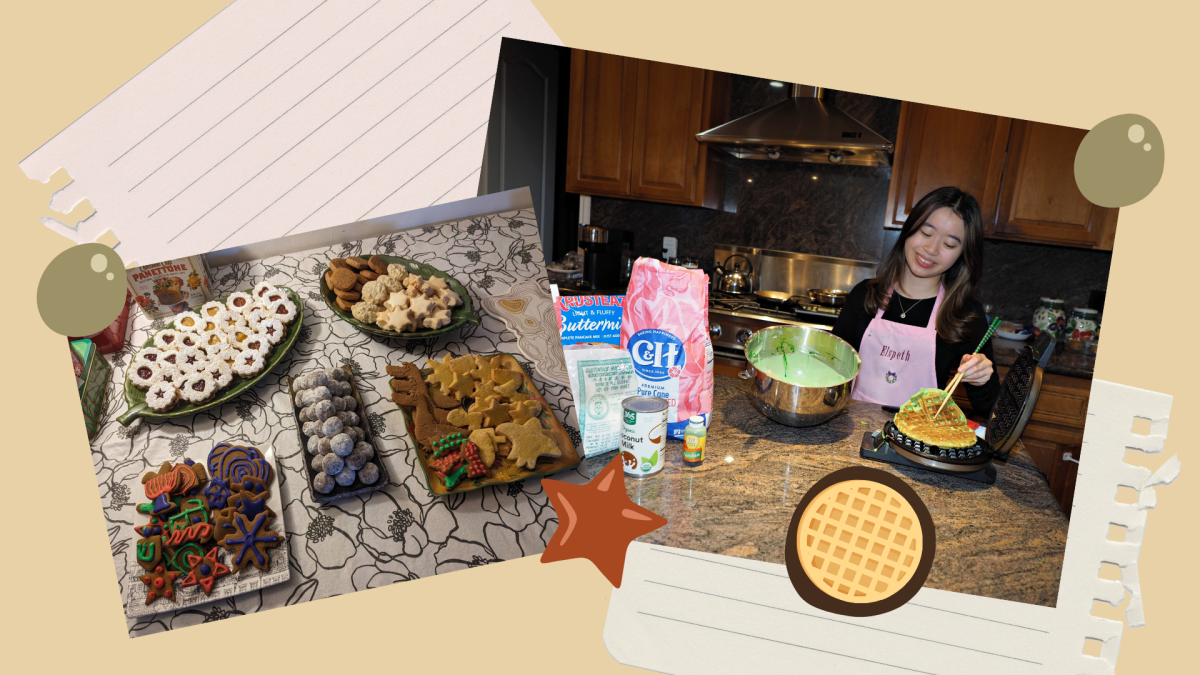
Every Sunday, the aromatic smell of vanilla fills the air as senior Elspeth Luu cooks bánh kẹp lá dứa with her family. Bánh kẹp lá dứa, or green waffles, are a traditional Vietnamese street food that incorporates pandan extract and tapioca starch. Although the waffles do not necessarily resemble waffles from other cultures due to the different flavor, the unique ingredients make the recipe special to her and her family.
“This recipe has been passed down from generation to generation in my family, but each generation has sort of modified it a little bit, and the person most closely to me who’s modified the recipe would be my dad,” Luu said. “It’s nice for me to continue that legacy by continuing to experiment with it myself, and that also gives me creative liberties and freedom in cooking.”
For her bánh flan, Luu experiments with the coconut-sugar-to-water ratio and the caramel mixture because the first time she made it, the dish ended up too sweet. For the bánh kẹp lá dứa, she likes to experiment with cooking time and temperature as she works towards creating the perfect crispy waffle. She has worked with countless elements of the dish, trying out different iterations of the recipe.
“I feel like as I’ve gotten older, I’ve also been able to take on more responsibilities within the whole waffle-making process and even make them on my own while taking creative liberties,” Luu said. “That sort of progression shows how I’ve grown to love cooking and see it as a form of expression and make it my own.”
Family recipes have been a way for Luu to honor elements of her own Vietnamese heritage while also incorporating elements of her own personal flair. For Luu, cooking has been a way to find a balance between her life in America and her Vietnamese descent. Something she feels serves as a strong example of this is her usage of Nước Mắm (Vietnamese fish sauce) and mayonnaise when she pan-fries fish.
“I feel like having those two condiments almost signifies a blending of cultures,” Luu said. “Taking two cultures, merging them and forming my own creation out of that.”
Cooking has allowed Luu to both create her own recipes and discover parts of her own identity. It has also allowed her to grow closer to her family, since it is an activity they enjoy doing together. Both cooking and eating are important parts of Luu’s culture, as she notes that food plays a vital role during family reunions.
“I think that there are certain elements of culture that are important to remember, especially language and food; those are big ones,” Luu said. “Since I was born here and raised in the US, I feel like maintaining these elements of my culture has allowed me to grow closer to my roots.”
Tara Brumand:
In fifth grade, junior Tara Brumand was nervous about interacting and connecting with new people. When she made a friend, she felt especially excited about forging a friendship with someone new and important to her. Sensing this, her mom spent the whole day making ghormeh sabzi, a traditional Persian stew, so Brumand could share the dish — and her culture — with her new friend.
“She was like, ‘Take your friend to the park, eat this together and get to know each other better,’” Brumand said. “I feel like that was a really special moment, because that friend became really close to me — probably not just because of the stew, but in general. It showed how much my mom cared about my happiness and my well being. She really demonstrated that for me that day, and that’s really special to me.”
Throughout her life, ghormeh sabzi has always held a special place in Brumand’s heart, as it is a staple dish from Persian culture that many families enjoy. She highlights how in Persian culture caring for guests and loved ones is emphasized, which makes cooking food and putting care and effort into each dish an important way to show respect. As a result, Brumand believes that ghormeh sabzi is the best representation of her culture due to its extensive cooking and preparation time, making it a genuine labor of love.

“It’s always been the standard that you must treat the people in your life as if they are worth spending time and energy for,” Brumand said. “You must always make them feel like they are valued, and honestly, that’s how I feel when I eat that food. I feel so valued and loved, because I know my mom spent hours of her time just making this dish.”
However, Brumand has found that food is more than just an expression of love and gratitude in her culture. Food also allows her to connect with fellow Persians, spanning the multiple unique regions of Iran. As a very diverse culture, each visit to Brumand’s other Persian friends’ houses gives her the opportunity to experience the more niche sub-cultures and regional differences through the food that they’re making. She enjoys the fact that she can experience different aspects of the Persian community while also adding to her own understanding and knowledge of her roots.
While it isn’t specific to one person or region, ghormeh sabzi has been a treasured meal in her family for generations, passed down maternally from her great-grandmother to her grandma, and then from her grandma to her mom. As the years have passed, Brumand has noted that each woman adds their own kind of specialization to the recipe. As a timeless classic in her family, Brumand intends to also keep passing the recipe for ghormeh sabzi down to her children, should she choose to have them.
“I feel like a lot of us second-generation Iranians in America have kind of lost the language, the heritage and the culture,” Brumand said. “I feel like for me, food especially has been a really strong way to preserve my ties to my culture. I really do intend to keep it and to spread it to the next generations if I can.”
Sarah Finck:
Starting in 2017, French teacher Sarah Finck and her husband have hosted annual holiday parties with their friends. In the parties, they combine Finck’s Hanukkah traditions with her husband’s tradition of baking Bredele cookies — and sharing them with friends — which he brought from Alsace, where he grew up. Originating in eastern France, a region that borders Germany, Bredele are German Christmas cookies ranging in size, structure and flavor. Finck notes that the cookies are mostly spiced, such as with cinnamon, and contain large amounts of almond.
“My husband and I have been having this party for most of the time that we’ve known each other and our friends,” Finck said. “We’ve made up to eight different kinds of these cookies, and we fill tins and tins and tins with them. The tradition in France is to bring an assorted tin to your workplace or to your neighbors and give that as a gift.”
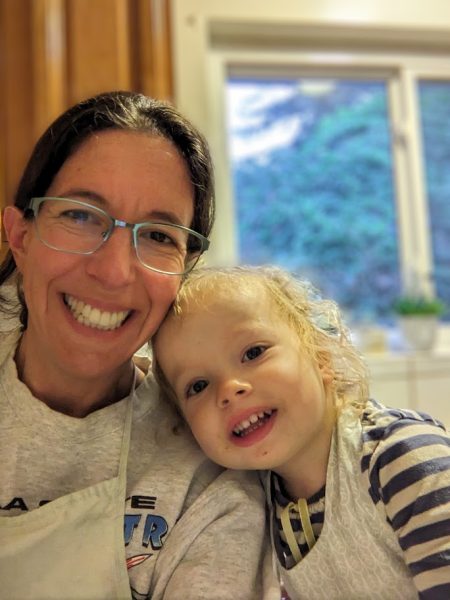
Similar to the community that gifting Bredeles fosters, Finck’s annual party has turned into a form of bringing her and her husband’s two friend groups together. Finck and her husband started hosting their party when they moved in together, and have continued that tradition — alongside making cookies — ever since. Despite Finck and her husband’s busy lives and the stress of the holiday season, Finck finds that hosting the party and bringing cookies to her colleagues, neighbors and friends allows them to connect. Now that the couple have included their young daughter Charlotte in the process, their cookie production has gone down, but they still include her in their tradition and produce enough Bredele to share around with their friends annually.
“Charlotte is not very effective in rolling, but I think she tries with the rolling pin and the cutting,” Finck said. “I believe she does give a pretty decent amount of help with that, and I think this year she will love that again. She’s all about crafts, so anything that’s cutting shapes she’ll probably want to help, and then she’ll help eat them. She’s not opposed to eating them.”
Introducing this tradition to Charlotte has given Finck the chance to introduce both her Jewish heritage and her husband’s Christian background to her. This has allowed Charlotte to explore both cultures. Since there are two religions for Charlotte to learn about, Finck finds that the topic has become tricky to navigate since she and her husband do not want to force their religions on their daughter. Although it’s difficult to celebrate religious traditions while simultaneously not imparting religion onto Charlotte, Finck hopes that Charlotte will keep their shared traditions a part of her own identity and continue to want to do them throughout her life.
“The party helps transmit these traditions to my daughter, so she knows what we eat on various holidays, and I do take her sometimes to events at a synagogue,” Finck said. “But even if we don’t practice religion very seriously, making, preparing and doing these rituals of food keeps the presence of Judaism in her life and in our family life.”