



MVHS alum ‘25 and De Anza College freshman Zhenhao Qi never intended to graduate early. During his two and a half years at MVHS, despite his structured schedule of getting up, going to school and doing his homework every day, Qi said he was unmotivated and unproductive. He spent most of his time after school hanging out with his friends and playing basketball, engrossed in social media and video games. The semester before he graduated, he only took three classes and didn’t need to attend school on Tuesdays and Thursdays.
The summer before his junior year, however, Qi had spent two months in China — an experience he describes as “transformative.” Being able to experience his cousins’ daily lives and observe how they approached academics and life caused him to become disillusioned with his life in California, to the point where he wanted to move to China permanently. While Qi felt he spent his time in California chasing validation, in China, he felt like he was devoting himself to meaningful work. Though he was ultimately unable to move due to financial constraints and visas, he knew he needed a change.
“I felt like I wouldn’t get that far if I stayed at MVHS, and I decided that a change of pace might be something that could whip me into shape and let me do something new,” Qi said. “I wasn’t sure what path I was exactly gonna take — I didn’t know if I was gonna go for a specialized education program or classes at De Anza or something else. I didn’t know what I was going to do. I just knew that wherever I was, I wasn’t that happy, and I should probably do something to change it.”
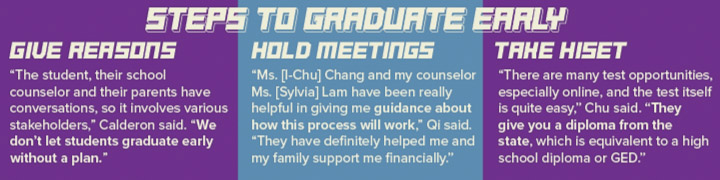
As a result, Qi decided to graduate in the middle of his junior year to take community college courses full time, and took the online California High School Equivalency Test, which earned him a California credential equivalent to a high school diploma. College and Career advisor Rogelio Calderon says graduating early is relatively rare, with only one or two students choosing that path every year, and often only graduating a semester early. However, he says that there are also many reasons students choose to graduate early — for example, to start working earlier or pursue their own projects.
“If a student feels like they’ve advanced with the curriculum and they feel ready to graduate early — they want to maybe take a college class and start as a college student a little bit earlier than everybody — then I support that fully,” Calderon said. “I’m hesitant with students who feel the pressure of graduating early to advance not necessarily because they have the skillset, but they feel that pressure to do so because it’s gonna get them X, Y and Z.”
MVHS alum ‘25 and De Anza College sophomore Alexander Chu graduated early both for a change of scene and to accelerate his college journey. At the start of 10th grade, he began struggling in his classes, even getting sent back to Geometry from Algebra 2. But the turning point came when he compared his grades to the GPAs necessary to attend college.
“That was kind of a really shocking moment,” Chu said. “It was like when movie characters like Mark Wahlberg or Robert Downey Jr. realized they needed to clean up their act. So I stopped doing the stuff that I found fun for that year, and then mostly focused on school.”
He worked hard to improve his grades and took multiple courses at De Anza. By the end of his junior year, Chu realized he had accumulated enough credits to graduate a year early and continue his education at De Anza. Like Qi, Chu took the HiSET test to earn his diploma, and aims to use the Transfer Admission Guarantee program to transfer to a UC after his sophomore year at De Anza, and will be eligible for the program if he meets TAG GPA requirements.
“My parents called me crazy for doing it, because the school system is designed to funnel you through four years of high school,” Chu said. “I had expected to be at high school every year, and instead, I just rushed straight into this with one month left — probably not the most rational idea in hindsight. I was leaving all my connections, my great friends here and mentors, and it was not something that I’d expected.”
Qi, who says his decision was also spontaneous, agrees that there were downsides he wished he’d researched before graduating early. Once he was no longer an enrolled high school student, he lost access to college resources like Naviance and MVHS guidance counselors, complicating his application process. His social life was also impacted — while he’s kept in touch with his friends at MVHS, they will leave for college if he continues at De Anza for Fall 2026. Calderon agrees that the impacts of graduating early on social life is important to take into consideration, especially given the significance of senior year to many students.
“You kind of miss out on that last semester, and I know not everybody cares about that,” Calderon said. “But I think a lot of students do care, and should care, because that second semester of your senior year is really the last time you’ll have as a young student before you go out into adulthood. So I think students miss the social part of it, and I know it’s not for everybody.”
However, Chu sees the change in a more positive light, favoring De Anza’s academic flexibility over “experiencing senioritis.” He emphasizes that if students are prepared for the coursework and prioritize their time management, the ability to set their own pace at community college can be more rewarding than MVHS’ relatively limited course options.
“High school is a very set path, and you can only go so fast,” Chu said. “In college, you have the ability to go as fast as you want, which means that if you’re prepared for that, and if you have good time management, it’s a great boon for yourself. However, if you’re not managing your time well, you can run yourself to the ground, because no one will stop you.”
Calderon also emphasizes the importance of considering students’ own needs and priorities when considering alternative routes. There are many ways to take community college courses as a high school student — such as through Middle College or dual enrollment — and Calderon encourages students to explore their options rather than being pressured to take a certain path.
“I think there’s no pressure for students to graduate early,” Calderon said. “Students benefit from enjoying the rest of their senior year, and no one really misses out on any journey by graduating a semester earlier or later than everybody else. Think about why you’re doing it, and hopefully it’s not coming from a sense of pressure, because then you’re not necessarily doing it for yourself.”
Although Qi doesn’t think his journey has been perfect, he’s happy that graduating early has given him the opportunity to find himself. By writing research papers and taking college courses at De Anza, he’s discovered his passion for biology. Qi hopes to eventually go to medical school to become a specialty doctor, a path he says he wouldn’t have considered had he stayed at MVHS.
“In high school, I felt really unfulfilled,” Qi said. “Back then, I was super addicted to video games, and I chased instant dopamine and instant gratification a lot. It was a very unhealthy lifestyle. And although, in retrospect, there could have been better ways in going about this and improving myself, I still feel like it was a pretty good choice, and I’m happy with the person I turned out to be.”
Correction (Nov. 10 1:00 p.m.): This article has been updated to clarify that Alexander Chu will be conditionally eligible for the TAG program if he meets GPA requirements, and he has not been accepted as of time of writing.