



Two adult sources are anonymous due to potential legal concerns and will be referred to as Source A and Source B.
The Cupertino City Council voted 4-1 to approve a 51-townhome project along Linda Vista Drive on April 1, despite concerns voiced by nearby residents. Originally, the townhome project consisted of 87 townhomes, with the initial proposal planning 35 units at Linda Vista Park and 52 along Linda Vista Drive. According to the California Department of Housing and Community Development, communities have an obligation to create new housing. Proponents for the development argue that the project will help alleviate the current housing crisis. However, nearby residents have petitioned against the proposed addition of 51 homes, as the project is expected to worsen traffic conditions due to increased enrollment at nearby schools such as Lincoln Elementary School, Kennedy Middle School and MVHS.
The 2.5-acre site at 10857 Linda Vista Drive was designated a moderate fire-risk sector bordering a high fire-risk area due to dense and dry vegetation, according to the 2025 Santa Clara County Fire Hazard Severity Zone Maps. Source A, a parent of an MVHS student, worries about the future of residents who plan on living in the area.
“If they add, let’s say 10 families, that’s fine, but 52 or 51 seems to be too many,” Source A said. “There’s no space inside to hold the parking, so the parking will have to be on the street. And if there are senior citizens living over there, that could be a big problem. If there’s a health issue, I don’t even think the ambulance can come in. At the very beginning, we didn’t even think about fire issues. We were just thinking about how to take care of the elderly.”
City Council Member R “Ray” Wang, the council’s sole dissenting vote, says that the high-fire risk, water infrastructure and evacuation planning influenced his decision to vote against the 51-townhome project. He adds that the pipes lack the necessary water pressure to accommodate an additional 51 homes, and the site lacks the evacuation routes necessary should a fire break out, jeopardizing the safety of all residents living in and near the townhouse.
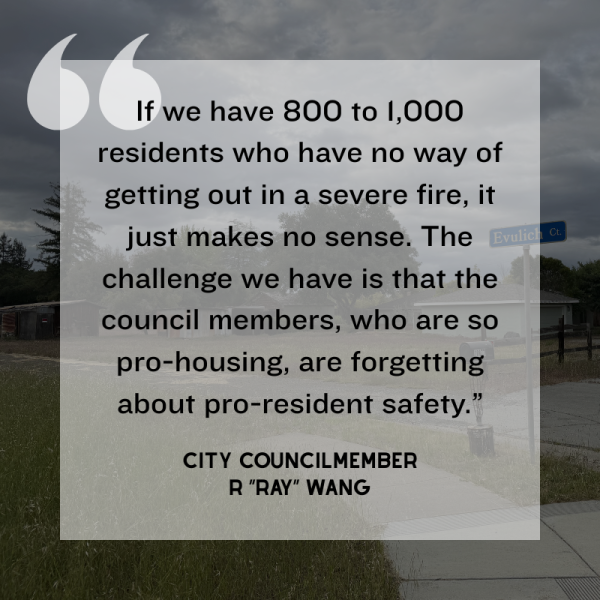
“If we’re going to put 51 townhomes on a two and a half acre site at Linda Vista, and we don’t have a good plan for evacuation routes, then why are we even bothering to do that?” Wang said. “We’re endangering everyone, including the townhomes project. If we have 800 to 1,000 residents who have no way of getting out in a severe fire, it just makes no sense. The challenge we have is that the council members, who are so pro-housing, are forgetting about pro-resident safety.”
As someone who helped organize the Linda Vista Unit 87 Petition, a formal petition to the Cupertino City Council advocating for the suspension of the project, Source A says that the whole ordeal has lacked transparency in properly notifying residents. Source A adds that SummerHill Homes, the developer of the 51-townhome project, abruptly canceled the day’s open house meeting by posting a notice on the door stating the meeting had been postponed.
“I think our main concern is about the process, because they’ve kept everything in secret before letting us know about it,” Source A said. “We first received a letter saying SummerHill Homes was going to build a townhouse, and then they invited everyone living close by to a meeting. That was the first time we learned about the project. But by then, they had already changed the zoning of that place. I didn’t know what had happened — they had made changes to everything already before notifying the whole neighborhood.”
Wang stresses residents should keep petitioning and demanding stronger evacuation routes to ensure their own safety — a measure that Wang and Vice Mayor Liang Chao have been pushing for. Source B, a resident currently living on the property, states that they have lost trust in the city council, as residents living on the 2.5-acre l and have been evicted to make space for the 51 townhomes. As a tenant at risk of eviction, Source B adds that it is the City Council’s responsibility to protect the rights of its residents and neighborhoods.
“It’s very hard for me to find a new place,” Source B said. “When we first moved here four years ago, the owner did not inform me about his plans to sell the house. Because of that, I am now losing my housing voucher and have to move out. Because I have five kids, I cannot afford rent in the Cupertino area — that’s why the city government has to protect the rights of the neighborhood too.”
As stated under the California Department of Housing and Community Development’s Regional Housing Needs Allocation (RHNA) list of responsibilities, a “portion of housing needs” is allocated “to each city, town, and county in the region.” Wang criticizes the state’s approach — since projects are often built to meet the state’s housing quota, they may not fully consider specific factors such as availability and space across different regions.
“If they’re going to build housing, it’s got to be affordable, instead of going out and destroying neighborhoods or ripping the retail establishments,” Wang said. “Yes, we have a housing crisis, but we need to hold people’s feet to the fire. We have to think about the economic impact of development on communities. The challenge here is that the state wants to take a one-size-fits-all approach and force-fit this housing crisis, but in the end, you don’t get any more affordable housing units. So we have to conclude that the state has failed in its approach.”