


Major spoilers for “Where the Wildflowers Grow” ahead.
Author Terah Shelton Harris published her contemporary Southern fiction novel “Where the Wildflowers Grow” on Feb. 17, which centers around themes of found family, grief, survival and redemption. It follows Leigh Wilde, the only survivor of a prison bus crash, who escapes and hides out on a flower farm in rural Alabama. There, she finds a safe haven to rebuild her life, forms connections on the farm and learns to heal from her traumatic past.
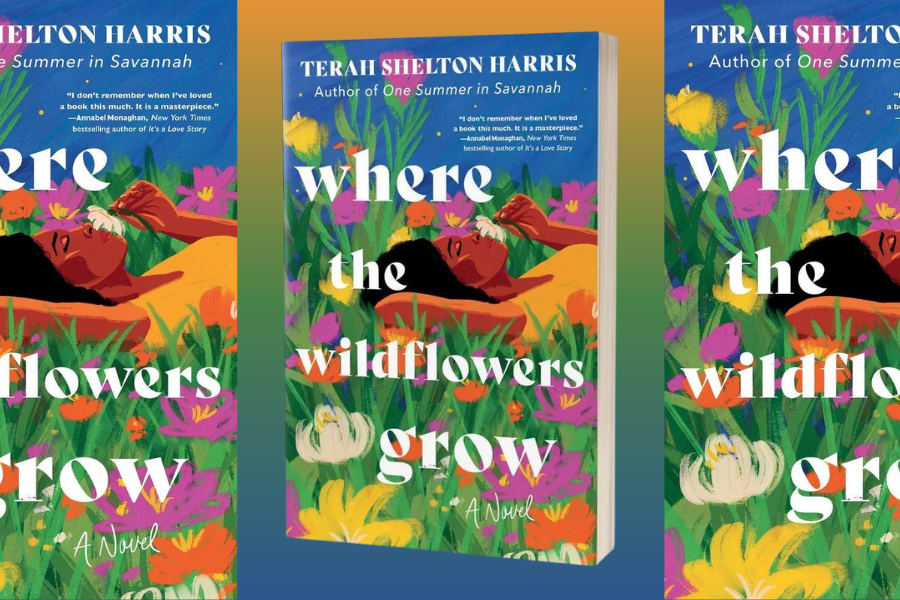
At first glance, the premise of Leigh reentering society after prison is promising. The novel’s stunningly illustrated cover tells the story better than the novel itself, showing Leigh lying peacefully in a field of brightly colored flowers that symbolize rebirth and healing. Raised off the grid, Leigh grew up existing entirely outside of society. As the book goes on, details about Leigh’s toxic family and tumultuous upbringing are slowly revealed, including her unstable father, neglectful mother and innocent sister Lila, who readers eventually learn was sexually abused by the same man her mother had an affair with. These hints about her mysterious past keep readers intrigued about the reason behind her imprisonment.
One of the novel’s significant strengths is the incorporation of the rich culture of rural Alabama in the book’s setting. Through Harris’s descriptions of the quilts of Gee Bend, the Cahaba lilies and the lush natural landscapes, she introduces the region’s unique traditions and natural beauty to a broader audience.
In her lengthy internal monologues, Harris has spurts of brilliant prose where her writing can be achingly beautiful. When Leigh reflects on the difference between surviving and living, she writes, “Survival is a lifetime of moments, hard stops and starts, strung together, then tested and defeated by fate a thousand times. Surviving is the why of my story … But living is a run-on sentence — never-ending, a collection of experiences that strengthen you along the way.” This captures the essence of the book and the weight of Leigh’s journey of going from basic survival to living a full life.
Unfortunately, the unnatural dialogue in “Where the Wildflowers Grow” cripples the novel. Characters speak in rambling monologues and philosophical quotes that don’t fit a natural conversation. When Jackson Shepherd, the farm’s owner, first invites Leigh to work with him, he says, “It was weird, I thought — because of course you’ve seen flowers before. And I wondered how you could do that, look at something with such innocent appreciation. And then you show up on the farm out of nowhere and help Luke for no reason. I knew then it was about more than just loving flowers. That there was more to you.” Here, Jackson’s speech feels unnatural, as Harris uses his character to express her own ideas instead of giving him a believable voice.
Her style also has a tendency to over-explain instead of letting the narrative speak for itself. Harris spouts a lot of insightful wisdom and heartfelt quotes, but the plot and characters lack depth to back her ideas up. Although Leigh spends a lot of time sitting around contemplating, there is never enough concrete plot action to push her forward as a character. Because the story glosses over the events and reasoning that should drive her growth, her development and introspection feels forced.
Harris spends entire paragraphs describing irrelevant things, such as “October, the middle child of autumn, drastic in its extremes, demanded attention with its temperatures swinging between summer remnants and the child of impending winter.” This isn’t a contest to see who can use more flowery figurative language. Instead of progressing the plot, Harris spends pages upon pages describing everything from flowers to dinner to yoga, taking away from the story’s momentum.
These unnecessary flourishes contribute to the irregular pacing. For most of the novel, the plot drags sluggishly along, only for Harris to cram in a whirlwind of events at the end — such as the flower farm being suddenly destroyed by a tornado. She also tries to salvage this train wreck by writing a climatic ending, where Leigh sacrifices her freedom and turns herself in so that the reward money can be used to save the storm-ravaged farm from ruin. As a result, the entire plot is stuffed haphazardly into the last couple of chapters, including the reveal of Leigh’s crime that landed her in prison: watching her family and the man who assaulted her sister burn to death, then being wrongly accused of murdering him.
Aside from the somber ending, “Where the Wildflowers Grow” also suffers from an unbelievably fluffy romance that lacks substance. For a novel supposedly grappling with heavy topics, it spends a lot of time describing the good looks and muscles of Jackson, the romantic interest. As a result, it often reads more like a shallow rom-com than a serious book about guilt and forgiveness. Because readers are never given a chance to get invested in the relationship, the emotional climaxes fall flat. Leigh becomes a damsel in distress who blindly trusts Jackson, instead of the independent and wary protagonist she was at the beginning.
The novel is plagued by flawless characters like Jackson — he is idealistically portrayed with unwavering devotion, kindness and patience toward Leigh. Although he has experienced healing from his own traumas, it is unrealistic for him to be so perfectly capable of handling Leigh’s emotions and situations, as if he’s had full clinical training as a therapist. The other characters, including Jackson’s best friends, Luke and Tibb, are also altruistic saints who will do anything to help this girl they hardly know, despite her often closed-off and sullen attitude.
The only person who doesn’t treat Leigh like she’s some goddess is Jackson’s ex-girlfriend and her love rival, Carly. However, Carly is a stereotypical cartoon villain who is palpably jealous of Leigh. However, when she realizes Jackson truly loves Leigh, she suddenly becomes understanding and vulnerable. Her character is so confusingly constructed that readers can never truly understand her, yet she later plays a pivotal role when Leigh asks her to turn her in for the reward money. Leigh herself also fluctuates wildly between being guarded and magically trusting strangers — she should be more tense and on edge, given that she’s an escaped felon.
Beyond issues with the characterization and plot, glaring grammatical errors, stiff transitions and inconsistent tenses make the novel even more disorganized, taking readers out of the story. As a whole, the novel almost feels unedited. While the foundation for a profound story about grief and survival is there, the execution strips away the emotional intensity and depth, making it forgettable — readers looking for a nuanced exploration of trauma will leave disappointed.
RATING: 2/5