

EE: Although MVHS has no shortage of dedicated teachers, a small group stands apart. Shuffling between classrooms, hauling supplies and racing the clock during tight passing periods, they navigate challenges most of their colleagues never have to consider. And while they share the same situation, each teacher brings a distinct perspective to what it means to be constantly shifting classrooms.
EE: Brian Chow, the design, art and photography teacher, has always had multiple classrooms throughout his years teaching at MVHS. As a teacher with so many subjects to teach, there have been some years where he has to rotate between four classrooms.
BC: It’s been a norm since I’ve been teaching the different rooms for different facilities. So my courses require different facilities and different setups. It’s actually better to have a classroom studio set up that’s specific to what I need to teach the course in, so if I’m teaching ceramics or 3D design, I need to be in a facility that supports that.
EE: He also explains how his classrooms are set up. For example, if he needs a complete studio to take photographs, he has a place to do it in the room next to his Photography and Design class.
BC: If they didn’t have that and tried to combine it all in one room, it would diminish the curriculum quite a bit, because it limits what I can do. Think of it this way, science would be the same thing. If you were to have a chemistry lab and a biology lab in the same room, it’s a little more difficult to manage at the same time than to have their separate spaces. It’s a lot easier and more seamless to do the work as well as teach, instruct and learn in that room. So it’s a similar kind of concept.
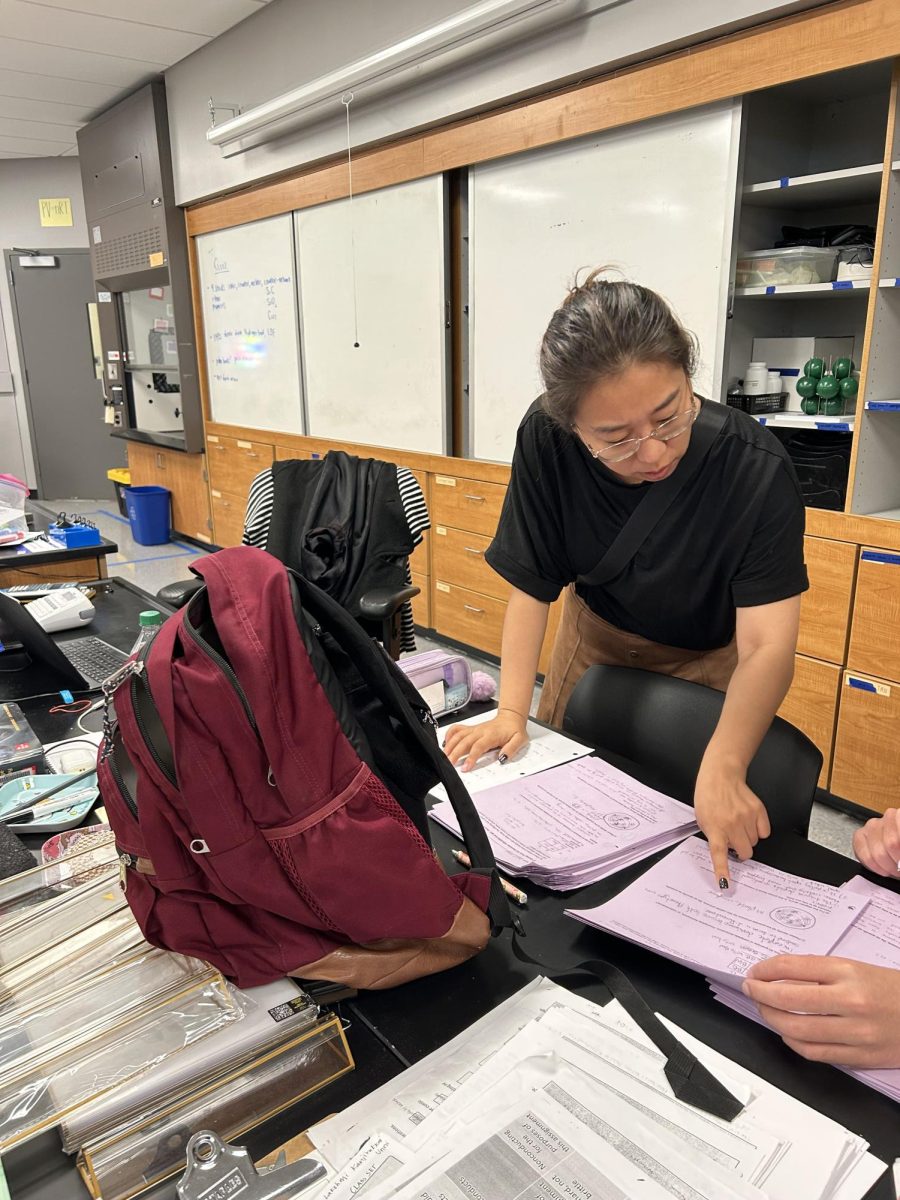
EE: For Chemistry Honors and AP Biology teacher Sooyoung Choi, this is her reality as she deals with setting up labs for both classes, and she admits that there are some pros to teaching in multiple classrooms. For example, she likes how the AP Biology and Chemistry Honors classes are in different rooms.
SC: So I think that flexibility is pretty cool. It’s quite nice. So I do like the geographical separation also for me, because sometimes it is hard for me to switch from biology to chemistry to Science and Society. And so being in three separate locations — kind of like you want your workspace to be separate from your personal space — it does help in managing that aspect.
EE: Another problem that teachers face with multiple classrooms is the amount of time it takes to move from one classroom to another, especially when they’re far apart. AP Physics teacher Jim Birdsong teaches in buildings B and E and acknowledges that although there are times when scheduling classes far apart is an issue, he has little to no problem with it.
JB: Never showed up late because I’ve had a hard time getting from here to there or vice versa. We do a good job in scheduling all the science teachers so that if they are going to make a room change, they typically have a tutorial or a brunch break or a prep in between, but sometimes that can’t happen. So there have been years where I’ve had to switch buildings in five minutes. You just plan for it.
EE: Although there are some teachers who feel this way, that isn’t the case for Choi, as she has classes that are farther apart than usual. One of her classroom switches even requires her to trek halfway across the school to arrive at her class. After repeatedly finding herself caught in the same bottlenecks and crowded stairwells, she says it’s become impossible not to empathize with the rush her students face between classes, and to recognize that she has to deal with that too.
SC: It’s pretty crazy. I think the E to D building is actually impossible. I don’t actually know how the students do it, either, and I do think there has to be an understanding from teachers, if you’re going from like F building to D building, that they’re always going to be perpetually late. Unless you’re shoving students as you’re walking up those stairs, there’s just no possibility of getting there on time. So it’s just something I’ve learned — I just asked my seventh period for understanding, that I’m a minute late to the class sometimes.
EE: Lastly, teachers with different classrooms don’t really have the capability to call it their own classroom, as supplies and decorations have to be split between the classrooms. Choi, after being unsure what to do because she would have to end up having to change classrooms after the school year, decided to go all out decorating all of her classrooms, no matter where she would go the next year.
SC: Over my seven years of teaching, I just decided, heck with it, I’m just gonna personalize this classroom and make it mine, and I do think it gives me a calmer sense of inner peace, like this is my space, and in doing that, I think it makes me a better teacher, because I’m able to be calmer. And I also think for students, they feel more welcomed, because I have all these decorations in my classrooms, and I make tea stations, and I make things that allow the students to feel a little bit more included. So this year, I’m aware that I might still be changing classrooms, but I decided that having that ownership is still important, so even if it’s temporary I decided to do it.
EE: That is it for this story, thank you to Ms. Choi, Mr. Birdsong and Mr. Chow for your perspectives, and see you all next time!
Music:
“Good Night – Lofi Cozy Chill Music” by FASSounds on Pixabay
“Lofi Study – Calm Peaceful Chill Hop” by FASSounds on Pixabay
“Lofi background music” by lofidreams on Pixabay