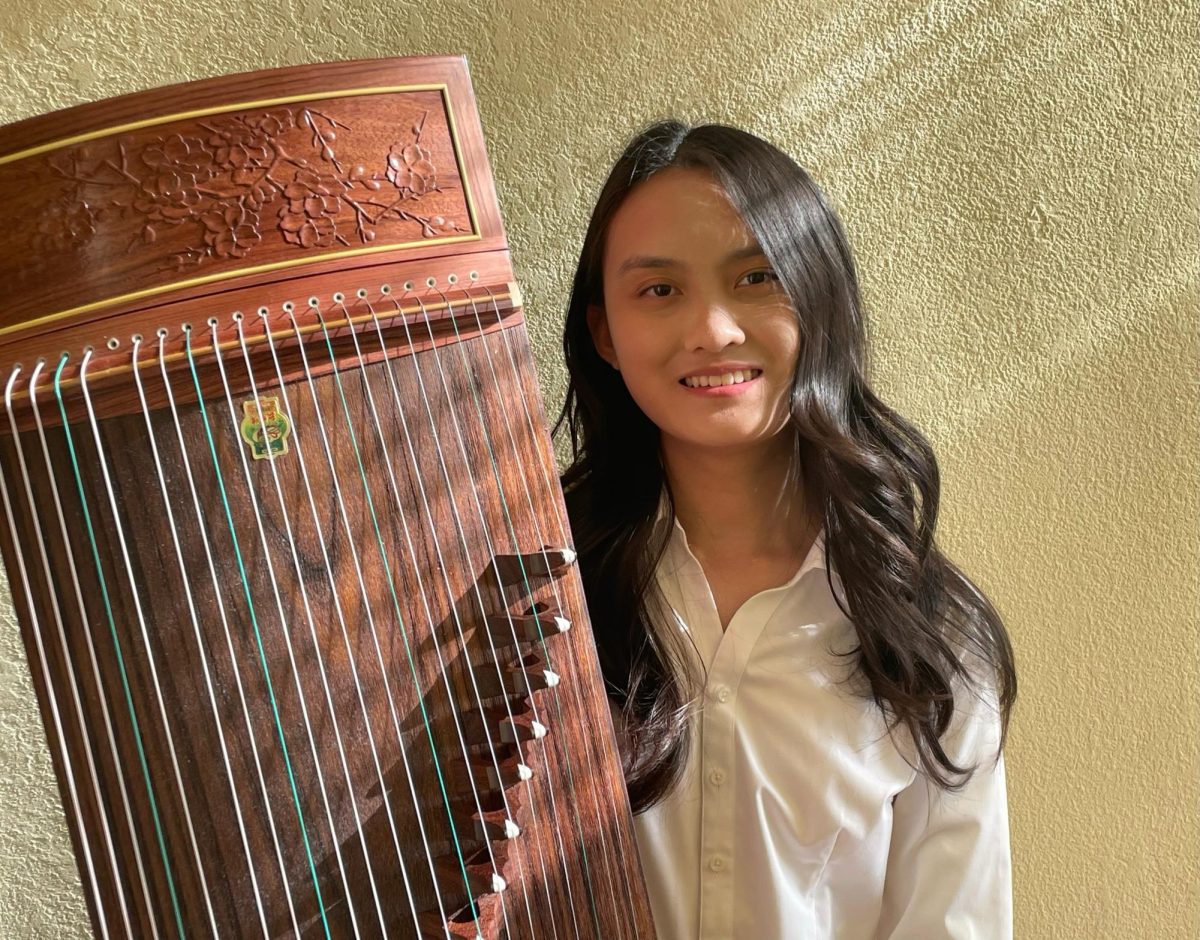



EM: Hi, I’m Emma Ma. I’ll be your host for today’s podcast, where we’ll be looking into the musical experiences of Winnie Liang, a junior in Middle College who has played a traditional Chinese instrument called the guqin for several years. Let’s find out what it’s like to play a little-known instrument while listening to the unique melodies of the guqin.
EM: Tell us about how and when you first got into the guqin. What about this instrument drew you in or was interesting to you?
WL: The first time that I got into guqin, it was in 2019 and I was watching this new Chinese drama that was just aired on YouTube called “The Untamed.” It’s a Chinese historical drama with magical realism. One of the characters in that drama — his name is Lan Wangji — played the guqin, and it was one of his weapons. In that drama, there were multiple scenes of him playing that instrument where there were actual sounds of the guqin, and I could hear its melody. I just thought that that instrument was so special, because contrary to the dominant instruments — like Western instruments, piano, violin — guqin is not an instrument that you can play in front of a crowd for large performances. It’s not dramatic. It’s more suited for the individual to play at your own time, when you’re by yourself and in a quiet setting. It’s more intimate in that sense, and that’s what attracted me.
EM: For people who are listening who might not really even know what you’re talking about and what the guqin is, can you give them an overview of what it is and anything you know about its history?
WL: Guqin dates back to about 3000 years ago in China. It’s a flat instrument, like a guitar that lays on the table, with seven strings. On the left end, it’s smaller, and then it opens to a wider part for you to play on. On the head of the guqin, there’s strings that drop down like a waterfall. It’s made of wood, and the good ones are all handcrafted and made of woven silk.
EM: How do people usually react when they hear that you play this more unique instrument?
WL: Usually, when I tell people that I play this instrument, they don’t know about it. The guqin is also very uncommon in China compared to things like guzheng or the pipa. My teacher, her name is Wang Fei, and her teacher’s name is Li Xiangting. He’s one of the presidents for the Chinese Guqin Organization, and one of the most well known guqin players that is currently still alive in China. During the time that he was playing that instrument, it was forbidden by law to play that instrument. So even now, a lot of people don’t know about this instrument in China and in America.
EM: What does it feel like when you play the guqin, and how would you describe the sound of it?
WL: For the guqin, usually when people play it, performances are usually played in front of around 10 people, and usually no more. It ties into a lot of Chinese philosophy — a lot of Chinese philosophers like Confucius (Kongzi) all played this instrument. A lot of the pieces that I play with my teacher are from poems that date back to Chinese history. For example, “Qiu Feng Ci” is a Chinese historical poem, and we play that song while reciting the poem. So usually when I play guqin, I choose songs that match with the current season, and I choose a song that matches with my current mood.
EM: What challenges did you face while learning the guqin and how did you overcome them?
WL: Like I said earlier, guqin is more of an unpopular instrument. The way that the music is expressed is different from the most dominant types of music, such as Western music. It’s more subtle. The emotions aren’t expressed in a dramatic way, so it’s harder to pick up what the feeling of the piece is trying to tell you. All the music that you play has a very deep historical background, so you have to have a good knowledge of Chinese history and Chinese literature to be able to actually fully understand the piece that you’re playing. That was one of the most difficult parts, because for Chinese guqin, we don’t use music notes to play the instrument. We use pictographs of Chinese characters. It was hard for me at the time when I first started, because I was entering sixth grade, and I wasn’t that fluent in Chinese at that time. I was unable to read Chinese characters, so I had to force myself to memorize all those pictographs and Chinese characters.
EM: Do you think, then, that guqin has helped you learn more Chinese or connect more with your Chinese heritage and the culture or history?
WL: Definitely. Guqin is one of the things that forced me to learn Chinese. Honestly, originally, I did not want to learn Chinese. I kind of hated Chinese. After I found a passion for the instrument, I was more willing to look into Chinese literature. I wanted to know what emotion this music is trying to tell me, and so it prompted me to study Chinese literature more.
EM: What’s your favorite thing about playing the guqin or what’s a memorable moment you’ve had while playing or practicing?
WL: I’d say one of the most memorable moments for playing this instrument is when I go to the North American Guqin Association. Every month or so, we have a little meeting where all the students of our teacher meet together, and we play a song that we like for that season in front of everyone. Other people who like this instrument would watch us perform, and we would also view YouTube videos, and we would post on our account. That was very memorable. It was one of the first times I felt like this piece I’m playing, I’m not just playing for myself, but there’s also people who value the instrument that I play and value my performance.
EM: Because of wrestling, you’ve had to pause your playing for a few years. So how did you feel when you stopped playing? And do you have plans to pick it back up in the future?
WL: I actually stopped taking the classes this year because it’s my junior year, and I can’t cut my nails to play the instrument. Compared to the zither, where you have nail clips that help you to strum the strings, for guqin, we have to grow our fingernails. I can’t do that because of wrestling, because I don’t want to scratch my opponents in the face. Through last year and my freshman year, I realized that when I have my nails cut, the sound that comes out of the instrument every time I strum the string is really muffled. I just feel like I wasn’t cherishing the instrument and the music piece. Also, there’s more stress in junior year, so I stopped playing the guqin. But whenever I feel a little stressed, or I feel like a specific song — for example, in autumn, I feel like I need to play a piece — I will still play it. I do plan to start this again next year for my senior year, when I have more free time.
EM: Do you have any tips or advice for people who may be interested in playing guqin or other more traditional, history-connected instruments?
WL: For people who want to get into this instrument, it’s really important that when you’re making this decision, you’re willing to dedicate some of your time into learning and studying Chinese literature. That is one of the most important things you need to know about in order to present the music in its proper way, because this instrument is very conventional and traditional, so you have to be able to adapt to that.
EM: And that’s all for today’s episode. Thank you so much to Winnie for sharing your memories and experiences of playing guqin with us!
Music by Winnie Liang | Used with permission