




Santa Clara County voters passed Measure A in the special election on Nov. 4, with 57% voting in favor. Measure A proposes a 0.625% increase in sales tax in response to the funding gap for public hospitals caused by the One Big Beautiful Bill, which included cuts and changes to Medicare, Medicaid and Supplemental Nutrition Assistance Program food benefits. At the county level, this means a $1 billion funding gap in healthcare alone — and Measure A is projected to partially fill this gap by raising approximately $330 million in revenue over the next five years.
Santa Clara County was particularly impacted by cuts to Medicare as the four local public hospitals — O’Connor Hospital, Santa Clara Valley Medical Center, Regional Medical Center and St. Louise Regional Hospital — all make up a safety net hospital system. Broadly speaking, this means they accept patients regardless of income or insurance, admitting a disproportionate amount of patients who are of low income or uninsured. Despite only 6% of California’s hospitals being public, they provide 36% of all Medi-Cal and uninsured care, making them particularly essential to the more than 450,000 people registered for Medicaid in Santa Clara County.
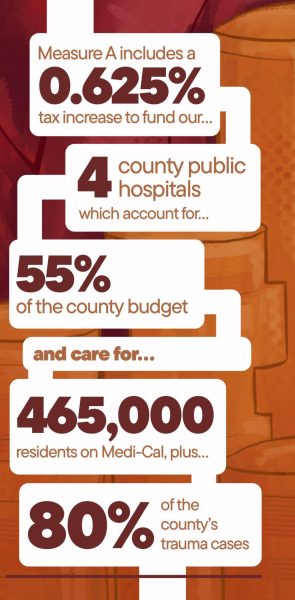
Public hospitals also shoulder a disproportionate burden of acute care, with over 50% of California’s trauma and burn centers operating under the public health system. Since barriers in preventative care also make lower income patients more likely than higher income patients to go to the emergency room, the public hospitals that serve them also take on the more expensive costs of emergency care. As a result, Danielle Mahabir, a nurse at O’Connor Hospital and area representative chair for the Registered Nurses Professional Association, supported Measure A as a way to ensure care for people from lower income brackets.
“As nurses on the board of RNPA, we decided collectively that this would be a huge benefit to our patient population, and that the benefits would drastically outpace the risks associated with the bill,” Mahabir said. “That’s when we decided to throw our full support behind Measure A and donate our time, our money and all of our energy toward getting this measure passed, and we did it.”
Mahabir notes that the federal cuts harm not just patients, but nurses as well. According to her, Santa Clara County’s public hospitals already come close to violating their nurse-to-patient ratios, which are negotiated between the nurses’ union and county to ensure sufficient bandwidth to care for each patient. She says nurses often go without adequate rest periods or have to take on additional responsibilities within their teams. As a result, she and other RNPA members mobilized nurses via a leadership summit and supplied them with campaigning kits that included flyers, postcards and buttons.
“We centered it around the fact that as nurses, we’re really trusted in the community,” Mahabir said. “When we tell people, ‘You need to vote yes on this,’ they listen.”
While supporters backed Measure A as essential for maintaining care, Cupertino City Councilman Ray Wang argues that Measure A fails to address the county’s financial mismanagement regarding healthcare. He notes that the county has already overextended itself in recent years by buying the now public hospitals from private companies to prevent permanent closures. Even so, the county has not balanced the hospital budgets, instead allowing them to take up an outsized portion of the county budget. Coming from a background in hospital management, he says a county should spend approximately 20% of its overall budget on healthcare — in Santa Clara County, that number is 55%.
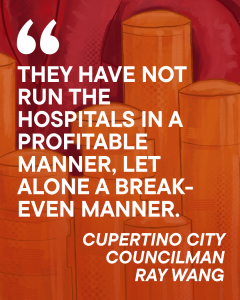
“They have not run the hospitals in a profitable manner, let alone a break-even manner,” Wang said. “There’s a lot of hard decisions that need to be made, but it’s harder to make them if you’re owned by the county than if you’re a private entity. They made the decision because they were told they had to — because there were union jobs at stake, there was healthcare at stake, there was federal funding at stake. They should have appointed someone to cut costs, but everyone’s afraid to do that, so they figured we’ll raise taxes on people and we can get away with it.”
As all four public hospitals continue to lose money, Wang says unsustainable staffing ratios and high salaries for supervisors are significant factors in the deficit. However, he also worries that the lack of an earmark — a specified purpose for which Measure A tax revenue will be used — could make it even more difficult to hold the county accountable for its financial decisions. Despite ultimately voting in favor of Measure A, math teacher Melinda Gaul shares Wang’s concern.
“Some people were like, ‘Well, that money for the sales tax can be used for anything. They didn’t really specify exactly,’” Gaul said. “That is concerning, because we don’t know for sure if the funds will end up going to where they said they would. My hope would be that people are honest and won’t redirect the funds to other causes.”
Gaul says she understands how many residents may have voted against Measure A out of concern that as a sales tax, Measure A would be regressive, meaning it would be toughest on lower income communities, like much of the county hospital patient population. Mahabir says that while the RNPA board initially shared this concern, it ultimately decided that by protecting public healthcare, which largely serves lower income communities, Measure A is progressive rather than regressive. Even so, Wang says, rushing the measure without earmarking funds was not the best decision.

“I think everybody felt empathy for the fact we might lose beds, we might lose care, we might lose access,” Wang said. “I think people were sympathetic to making sure that everybody got care, even if they were legal or illegal. The majority of people I talked to were just worried about the principle of actually taxation without specific allocation.”
Now that Measure A has already passed, Wang sees educating the public on the root causes of the public hospital deficits — financial mismanagement, care to undocumented immigrants and federal funding cuts, according to him — as the necessary next step. He believes that if voters want a sustainable public healthcare system, they should educate themselves on the Board of Supervisors’ role and vote for supervisors who are willing to make tough decisions — a rare find given the political nature of the job. Mahabir agrees that structural changes are necessary to balance healthcare budgets, but in a different manner — while as a union representative, she supports Measure A, speaking personally, she says the tax system is fundamentally inequitable.
“If you’re a billionaire, you’re doing something unethical, because nobody should have to ration their insulin while you buy another yacht,” Mahabir said. “The rich have been benefiting off the backs of the shrinking middle class and the growing poor for centuries, and it is beyond time to get some meaningful legislation that will effectively cause the ultra wealthy to pay their fair share.”
In the meantime, however, Mahabir says she and the RNPA will continue to advocate for state legislators to earmark additional funding for the state public health system to avoid having to cut care or put further strain on nurses. Even so, she emphasizes that Measure A is a good start for the county and California as a whole.
“They really taught a lesson to any other county health and hospital system that you don’t have to take the effects of H.R. 1 laying down,” Mahabir said. “You can fight back. You can save your community from the disastrous effects of the Trump regime. You don’t have to go straight to closing a hospital. Communities will rise up, and they will rally to care for one another, and that is exactly what Santa Clara County did here.”