



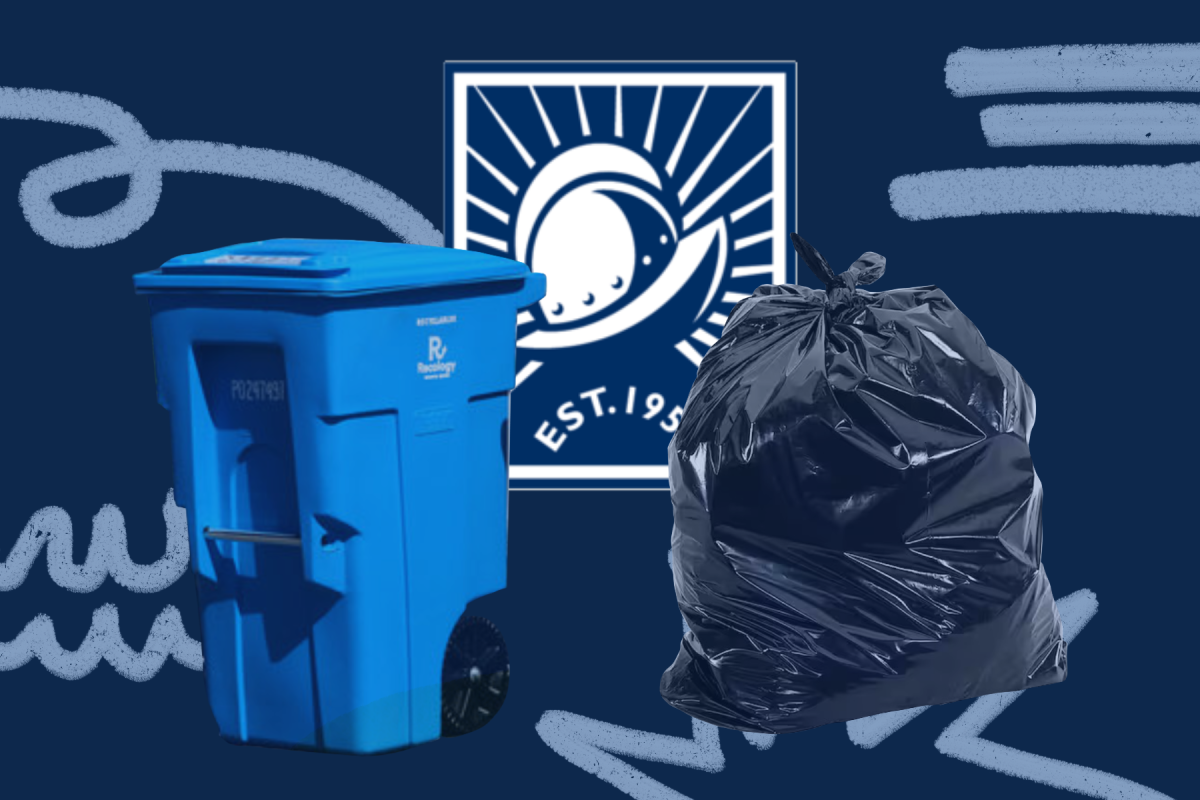
The total generation of U.S. municipal solid waste in 2018 was 292.4 million tons, or 4.9 pounds per person per day. When organic waste breaks down in landfills, the waste releases methane, a greenhouse gas responsible for roughly 30% of the global temperature rise since the Industrial Revolution. To combat this, Recology South Bay Waste Zero Manager Yvonne Lau works on waste diversion — the practice of minimizing waste sent to landfills by sending recyclable and compostable material to recovery facilities — through a range of strategies, including outreach to businesses and residents through presentations and tabling events.
“A lot of the time, when people come to our events, it’s the people who are most interested in learning about waste,” Lau said. “But the issue is that there are a lot of people who are not very engaged, and so reaching out to them is a challenge. We may go door to door and draft communication materials that our customers can understand better. Sometimes we’ll use certain languages that resonate with them or speak using a lot of pictures.”
Waste diversion is part of Cupertino’s overall sustainability goals. In 2022, as part of its “Climate Action Plan 2.0,” Cupertino created a strategy to eventually reduce landfill waste by 90% by 2040. The plan includes a potential fee for incorrectly sorted materials and plans to educate the community about proper waste disposal practices through methods like Lau’s.
Despite these initiatives providing waste solutions, the changing nature of local and statewide waste-sorting regulations can make it difficult for residents and business owners to stay updated. Cupertino Environmental Programs Assistant Steven Hirsch educates businesses on proper waste sorting and helps ensure compliance with state and local regulations.
Hirsch adds that communication like Lau’s regarding proper waste disposal is especially important, as it not only improves awareness of waste policies but also raises awareness about the impact mistakes can have. In 2024, Cupertino commissioned a “Waste Characterization Study,” which found that 58-68% of the material sent to the landfill could have been recovered if prepared and sorted properly. Additionally, contaminant material — materials wrongly placed in the recycling bin — accounted for 25%-31% of the recycling stream.
“When a landfill item gets recycled, it can contaminate some of the other recyclables and make it so they can’t be recycled,” Hirsch said. “If something gets landfilled that has grease or automotive fluids on it from a shop, and they put that in the recycle, and that seeps into some of the paper stuff, then that material is not recyclable anymore. When that gets dumped in the garbage truck, it all gets mixed together. I don’t think they realize how one person contaminating their load can contaminate the wider load.”
But the issue isn’t always ignorance or a lack of care. Terms like “green” or “eco-friendly” do not have a standardized definition, meaning companies can use them without meeting any specific criteria. Products that are marketed as such aren’t necessarily divertible in a practical context. Also, even products marketed as 100% recyclable may have only some recyclable components, with much of the product going to the landfill. These labels don’t take into account that recycling and composting infrastructure varies significantly from city to city due to the different facilities available in each area.
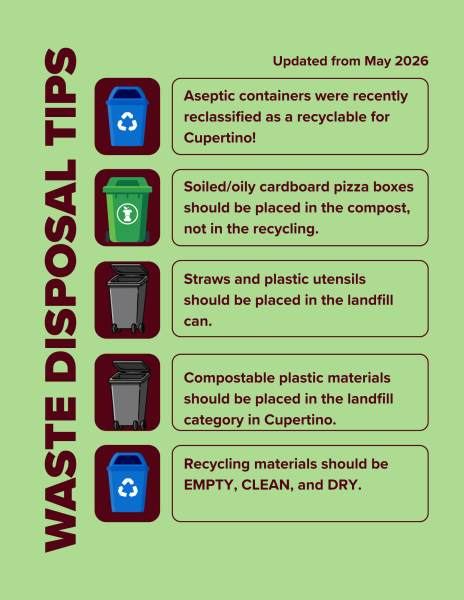
“A lot of people purchase compostable plastic products thinking it’s environmentally friendly,” Hirsch said. “Unfortunately, they’re paying more for that product, and it’s not doing what they think it’s doing. While these materials can eventually break down, they usually take 90 to 180 days, which is much longer than the composting process at all of the facilities that collect the material in our area. Since the rest of that material breaks down faster, compostable plastics are often screened out as contamination and sent to landfills.”
To address this confusion, Hirsch recommends that people check Cupertino’s sustainability website for updates. The website features include guides for waste sorting and the Green Newsletter, which residents can subscribe to to get notified about Cupertino’s sustainability initiatives. Other tools, like Sunnyvale’s “How to Get Rid of Anything,” give specific instructions for disposing of a variety of materials. While Lau acknowledges that education is crucial, she says residents must be open-minded to create change.
“The most challenging part is we can only do so much with education, recommending services or how to set up a system, but we are often met with a lot of resistance,” Lau said. “We also need to be met in the middle and have the customer be willing to do so on their part. Dealing with the lack of improvement when we put so much effort in is very challenging for me to grasp.”
At MVHS, junior Kate Baccash notices that students are often unaware of their impact on the environment. In particular, she notes that many students’ consumption choices could also be more environmentally conscious. In the U.S., there was a 50% increase in textile waste, such as discarded clothes, from 2000 to 2018, which is largely attributed to fast fashion. As part of the IRPD class, she started planning a clothing swap event for the community to raise awareness about clothing waste.
“During the event, I talked about swapping clothes to reduce or to increase the clothes’ active lifespan,” Baccash said. “After the event, I hope everybody will learn a little something about the environmental impact of their clothes. Hopefully, this will encourage them to donate more often in the future, or even sell their old clothes instead of just throwing them away.”
Similar to clothing swap events like Baccash’s, Hirsch highlights other city events that people can participate in, ranging from community cleanups to composting workshops. Hirsch, who has worked in various sustainability outreach roles in Palo Alto, San Jose and Santa Clara, says that his favorite part of the job is helping people access clear information so that they can understand the importance of sustainability initiatives.
“I find it the most rewarding when somebody has a question or is confused and suddenly, something clicks, like an aha moment,” Hirsch said. “People are often very appreciative when they finally get clear information they’ve been searching for, and I find it fulfilling to be able to teach or help in that way. I understand the regulations can be overwhelming, but they exist to benefit our planet and the ecosystem.”
Beyond daily actions — such as switching to reusable items and being more deliberate about waste sorting — Hirsch encourages students to consider how sustainability can fit into their future careers and aspirations. A 2024 report found that jobs related to clean energy grew at double the rate of overall U.S. employment. Hirsch’s own interest in sustainability was cultivated when he took classes at the Kirsch Center at De Anza College. The professors’ passion for their environmental work inspired him to pursue a career where he could look back and know that he made a positive impact on the world.
“Even if you don’t work directly in those fields, you can still incorporate sustainability into whatever career you choose,” Hirsch said. “Every business and profession can be environmentally conscious in some way. I hope that you all keep this in mind throughout your careers.”