



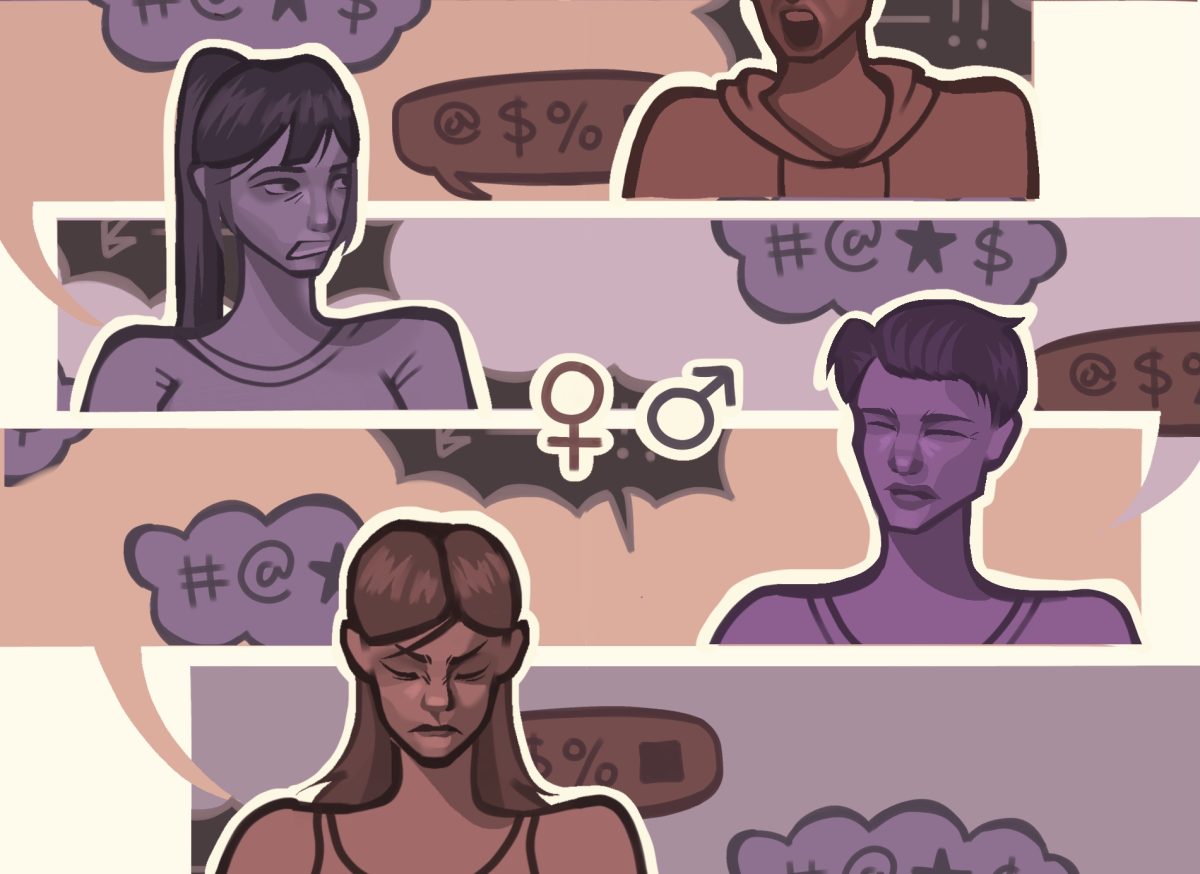
“Boo, you w—-.”
This is one of the most iconic lines from the cult classic “Mean Girls,” among many instances in which the characters refer to each other using extremely charged gendered insults. Often with profane associations, gendered slang has long been normalized in pop culture, at times even perceived as cool. But behind the seemingly lighthearted usage, these words continue to carry the weight of outdated gender expectations and sexist ideology — ultimately raising the question of whether their usage is just an innocuous trifle or reflective of broader societal issues.
Whether present in deliberate expression or ingrained biases, sexist thought has been propagated for thousands of years, originating from early civilizations’ shift into an agricultural society. According to Jennifer Saul, a philosophy professor at the University of Waterloo investigating the philosophy of language and its intersection with feminism, centuries of the ideology have left an indelible mark on the English language, and the effects manifest in different ways in regards to each gender.
“There’s been a huge history of male dominance in society, and it’s not surprising that it comes into language as well,” Saul said. “Some examples present themselves in words, but some of them are just in the way that we use and interpret the language, and all of those are really tricky to deal with.”
For instance, junior Stefan Hsueh points out that gendered terms among men often dictate their capability. In recent developments in internet culture, this trend is exemplified through the rise of Generation Alpha slang such as “sigma” and “chad.” Both terms refer to successful, attractive men and most often misogynistic archetypes in the social hierarchy. With roots in the manosphere, a group of communities that promote misogynistic ideologies, the meanings of these words are not lost on society despite taking on satirical and hazier definitions.
“With men, they want to be taken seriously,” Hsueh said. “That sort of ego chasing makes it so insults tend to put other men down or make them appear childlike, so you wouldn’t take them so seriously.”
By contrast, Hsueh noticed that gendered slang directed towards women are more often sexually charged, either referring to their bodies or promiscuity. Junior Aashka Nadathur agrees, adding that terms associated with femininity also tend to take on negative connotations over time. Using “b—-” as an example, Nadathur explains the process of pejoration, when terms gain a negative connotation over time, often resulting in dehumanization.
“It changed from this objective meaning of a dog as an animal, and instead, it turned women into an animal,” Nadathur said. “The word dehumanized them in a way that was meant to keep them contained and not let them truly express their identity and personality. People very much blow over certain terms like swear words such as b—-, w—- or s—, that demean women most of the time, but the reason they’re kind of blown over in a casual nature is because of how prominent the patriarchy is in our way of speaking.”
Between 2000 and 2022, usage of “b—-” nearly doubled, with a huge spike in usage occurring throughout the 2010s. As the word became more pervasive — evolving alongside pop culture — it started taking on a variety of context based definitions, sometimes used as a greeting or even as a compliment. Despite the patriarchal history behind the term, Nadathur is not troubled by its casual application. Rather, she believes that casual usage stands as a form of reclamation and may even be beneficial or reduce its negative impact.
“While I also think it’s very important for people to acknowledge the history of gendered slang and the history of these words, using them in casual nature in the media isn’t necessarily a bad thing,” Nadathur said. “It pushes the idea that words are, in fact, just words sometimes. And one of the ways that we can combat this negative meaning when using a word is by remembering that fact.”
On the other hand, Saul believes that while many of these terms which take on a different meaning are seemingly reclaimed by the communities they were meant to insult, it is difficult to completely erase the history of a word. According to Saul, these words should be treated with more caution, since reclamation isn’t as straightforward as it seems.
“It’s hard to completely reclaim a word,” Saul said. “It can be a good thing, but you also have to have an awareness that not everyone’s going to be okay with it — some of the people who you care about are also going to have a problem with it. One common misconception is thinking that gendered terms are not something that we should worry about at all. You get people thinking you’re making a fuss out of nothing. ‘Nobody cares about this. It doesn’t affect anyone.’ And I think that’s not right.”
Nadathur echoes this sentiment and acknowledges that people need to exercise caution when using a reclaimed word. To Nadathur, while partial reclamation may mitigate the negative impact of a certain word, educating the public of the history and implications behind the terms presents a much more effective solution.
“I want students to be more educated,” Nadathur said. “I want students to understand the extent to which words come and understand that not all words are meant for them, even if they want it to be. Sometimes you just can’t say a word, not because it’s restricted, but just because there’s no context in which you can use it that would make it okay to use — even if it’s modernized and used in a casual nature.”
This sentiment regarding education is not lost on MVHS teachers. Honors American Literature holds in-class discussions on the topic of gender and its expression through language. While Hsueh, who primarily encountered this topic in his literature class, acknowledges that certain classes at MVHS do their part in educating students on these issues, he notes that there are still flaws in the system and emphasizes that education should happen earlier among children.
“You can only get as much value out of the class as you put into it,” Hsueh said. “You’ve got to take risks in order for you to learn. As for gendered terms, or any foul language, it is a slippery slope. It’s a very difficult thing to fix, because within social circles, there’s no changing what individuals do. I think the only way to really fully enact strong change is to start teaching people from a young age that this stuff is not cool. You need to stop it early.”
Following this line of logic, Nadathur points out an important motivation behind seeking this education — empathy. As Nadathur explains, exercising caution when using gendered slang isn’t just about avoiding perpetuating harmful stereotypes. It’s also about fostering empathy and creating an environment where others feel comfortable around you.
“When you use words without knowing what they really mean, that reduces your own empathy, because you don’t even have enough empathy to care about what they mean and what they stand for,” Nadathur said. “We all learn the golden rule when we’re kids: treat others the way that you want to be treated, and that works not just through your actions, but through your words, too. Those in themselves are an action, so speak to other people the way you want to be spoken to.”