


“I was experimenting. You know, discovering the secrets of the universe.”
– “Aristotle and Dante Discover the Secrets of the Universe”
For incoming freshmen, MVHS’s ninth-grade Literature and Writing curriculum aims foster students’ sense of discovery and curiosity, introducing books featuring diverse themes to encourage students to engage with different perspectives and experiences. Students read “Aristotle and Dante Discover the Secrets of the Universe” by Benjamin Alire Sáenz — a book navigating Aristotle and Dante’s exploration of their sexualities and Mexican culture throughout the novel — in the fall semester.
Junior Sophie Xu said it was the first book she read with LGBTQ+ protagonists. She said the novel introduced her to different perspectives she had not seen before, highlighting that she particularly enjoyed the portrayal of the two protagonists’ romance and how the novel captured both their personal struggles and the external pressures they faced.
“The book definitely gave me more exposure to different kinds of literature and our society as a whole,” Xu said. “I think the author did a really good job of characterizing Ari and Dante’s relationship and the different kinds of conflicts they faced. It was interesting to me to see how they overcame that and pursued their relationship despite the criticism of other people.”
Senior Nolan Yiu found the exploration of sexuality and culture similarly impactful in the unit on “On Earth We’re Briefly Gorgeous” by Ocean Vuong in Honors American Literature, which is his favorite book from in the class in his junior year. He appreciates how the book’s themes brought together the diverse racial, gender and class perspectives analyzed throughout the course. He emphasized how the book was not only effective as an educational text but also as an enjoyable piece of literature overall, prompting his interest in Vuong’s work.
 “Not everybody’s experience is always the same, but I think the book was very nuanced when describing situations like coming out to family or friends,” Yiu said. “I also just really enjoy Vuong’s writing style. I saw one of his poetry collections later that summer, called ‘Time is a Mother,’ and I picked it up. I thought it was also really good, so that got me into more of his work as well.”
Another book centered on an LGBTQ+ narrative that Yiu encountered in the senior-exclusive Mythology and Folklore class is “The Magic Fish,” a graphic novel written and illustrated by Trung Le Nguyen. Yiu enjoys the book’s unique blend of mythology and modern perspectives, adding that the visual format enhances the storytelling, making it more engaging.
Although English teacher Jessica Kaufman also praises the art and unique storytelling in “The Magic Fish,” she believes that it may not be the most suitable for seniors. She finds that the reading level is relatively accessible and would prefer a more challenging text, such as “The Song of Achilles” by Madeline Miller, which retells the relationship between Achilles and Patroclus during the Trojan War.
“While I love ‘The Magic Fish,’ and I love that we have a queer text somewhere, I do think we could do more with it,” Kaufman said. “I would really like to do the book ‘Song of Achilles’ because it’s a retelling of a Greek myth and is also a queer text, and it just fits really well with the curriculum. It’s beautiful — makes you cry. I love it.”
While the MVHS’s literature curriculum includes texts with an explicit focus on LGBTQ+ characters’ identities and relationships, some teachers also spotlight more subtle LGBTQ+ themes in books. Xu notes that in her World Literature class, students briefly analyzed the potential romantic undertones between Amir and Hassan in “The Kite Runner” by Khaled Hosseini. Similarly, Yiu said that while studying “The Great Gatsby” by F. Scott Fitzgerald in Honors American Literature, students explored the implied relationship between Nick Carraway and Mr. McKee.
While Kaufman doesn’t view “The Kite Runner” as queer literature, she notes how she emphasizes potential LGBTQ+ themes in “Dracula” by Bram Stoker in Mythology and Folklore. Having formerly taught the courses British Literature and World Core with English teacher Randy Holaday — courses without LGBTQ+ texts — she says she values opportunities to explore queerness in texts like “Dracula.”
“Mr. Holaday and myself were teachers of British Literature, and both of us are queer, so we always added queer perspectives to everything,” Kaufman said. “I do that for any novel, regardless of it being LGBTQ+ or not, because if it’s something that deals with identity, then it’s important to talk about it and frame the classroom as a safe space. ‘Dracula’ is so much fun because vampires basically embody our fears. We talked about it with ‘The Importance of Being Earnest’ because it was written by Oscar Wilde, who was a gay man in the Victorian age. Victorian society was very sexually repressed, so in ‘Dracula’ specifically, you can see it come out in the writing a lot. There’s huge homoerotic themes between Harker and Dracula.”
Yiu believes that it is important to discuss LGBTQ+ themes in texts that do not explicitly present them, as it can help students recognize that literature is not confined to a single genre and reflects the intersectionality of identity, which most students can relate to. He commends the curriculum’s effort to increase exposure to LGBTQ+ voices, even when the topic may be seen as polarizing due to the recent rise of homophobia.
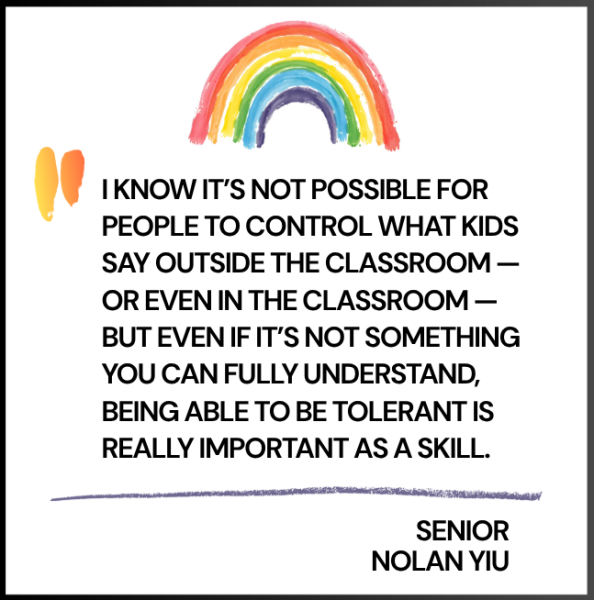
“While walking around MVHS on days where we discuss queerness specifically, I sometimes overhear some people joking about it in more derogatory ways,” Yiu said. “I know it’s not possible for people to control what kids say outside the classroom — or even in the classroom — but even if it’s not something you can fully understand, being able to be tolerant is really important as a skill.”
Xu agrees on the significance of openly teaching LGBTQ+ perspectives, noting how early exposure can help normalize these topics and encourage students to be more open-minded. She recalls how being introduced to “Aristotle and Dante Discover the Secrets of the Universe” informed her of the marginalization of LGBTQ+ individuals.
“I think that it’s really important to include queer texts in education,” Xu said. “I think that it coming even before freshman year is important so that the younger generation can get exposed to topics like this. It helps shape people to be more compassionate and understanding, too. By withholding it, we’re painting queer communities as something odd that shouldn’t be discussed.”
These student perspectives are reflected in discussions among MVHS English teachers, who, according to Kaufman, actively contribute to improving the curriculum by adding and replacing books, modifying lesson plans and balancing representation throughout each course. Going forward, Kaufman hopes teachers will find ways to incorporate inclusive perspectives without overlooking others.
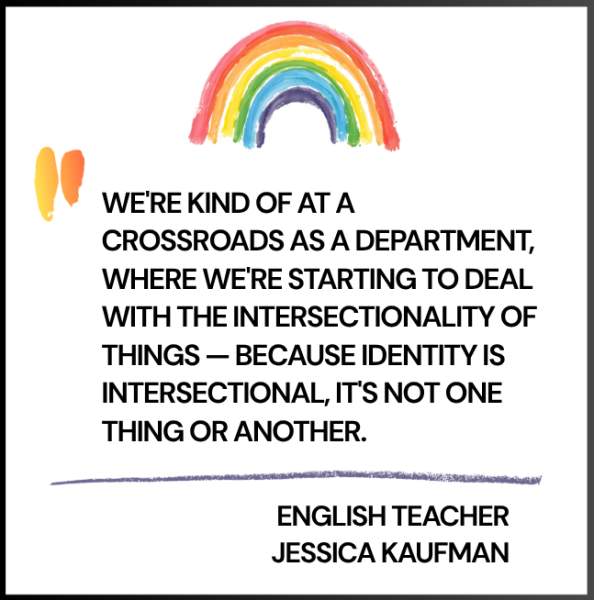
“Those of us who identify as queer within the department obviously see a need to have more queer voices,” Kaufman said. “There’s been a lot of focus recently on race, and previous to that, gender. I feel like every time we focus on one thing, other things tend to go away. I don’t think it’s intentional, it just happens. I think now, we’re kind of at a crossroads as a department, where we’re starting to deal with the intersectionality of things — because identity is intersectional, it’s not one thing or another.”