

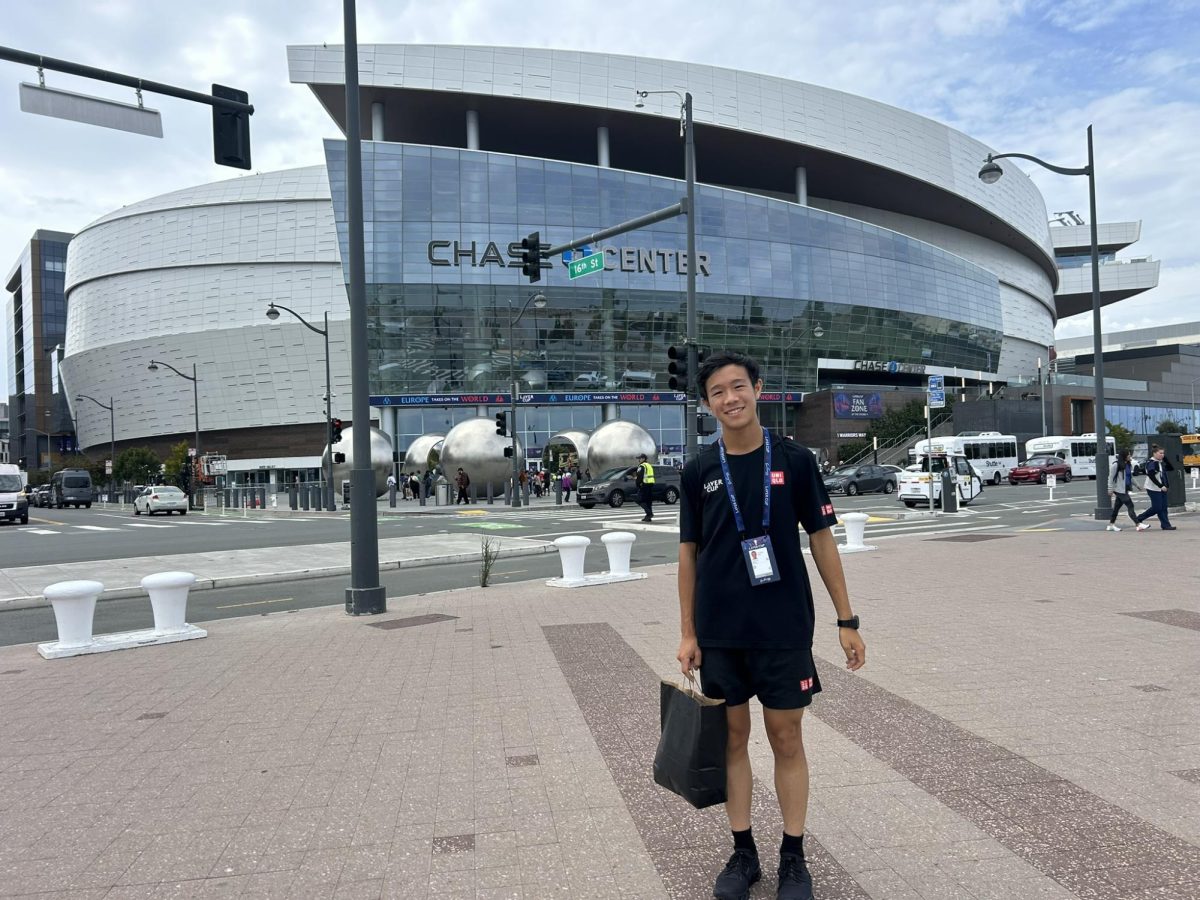
At the 2025 Laver Cup, an annual global tennis tournament held in San Francisco with over 81,000 attendees, sophomore Jonathan Hom, alongside 24 other ball kids, looked up and saw unending waves of cheering and waving from the crowd. Hom stood there, hands shaking, feeling the pressure from the millions of live viewers watching his every move as they cheered on international superstars such as Roger Federer and Alex De Minaur.
Like many other ball kids, tennis has been a big part of Hom’s life. His mother, Tina Okawa, a tennis coach who grew up playing tennis at both the high school and collegiate levels, and his sister, who also grew up playing tennis, provided him with the support to start playing tennis at a young age. At four years old, he joined his mother in her daily tennis lessons, beginning by collecting balls and watching practices. As Hom got older, he started playing in competitive UTSA tournaments. Now, as a 3-star recruit, Hom earns ranking points by winning games, allowing him to compete in nationwide tournaments.
“I taught him from when he was two or three, starting with easy things such as rolling the ball on the ground,” Okawa said. “Later, we started using a balloon and a little toy badminton racket. He would just hit it up in the air, then proceed to learn the basic forehand and backhand strokes. Since he was quite young, I would frequently train both him and his 9-year-old sister, which was very difficult but fun. I’ve always loved tennis and loved watching him play and improve.”
After playing tennis for eight years, Hom’s journey as a ball kid began in 2022 at the Mubadala Silicon Valley Classic, a major women’s U.S. Open Series event. Okawa mentions that aside from Hom’s love for tennis and curiosity to watch the players up close, the requirements for the athletics merit badge for Scouting — volunteering at a professional athletic event — was a major initial motive for him to work as a ball kid. Reflecting back, he believes this event sparked his interest in being a ball kid.
“I loved the whole experience of retrieving the ball and seeing how the players carried themselves on the court,” Hom said. “It was also cool meeting the players and being in a professional environment where I could see up close what the players were doing and what it takes to get to that level.”
At the Mubadala Silicon Valley Classic, Hom was able to learn the basics of being a ball kid. He learned that at any given match, there would be four ball kids in each corner and two at the net. The job of each kid would be to chase the balls between points and give them to the players before they serve, as well as hand them any other things they might need between sets, such as towels. A few months later, Hom acted as a ball kid captain at the Golden Gate Classic held at Stanford.

As a captain, he not only directed the movement of the tennis ball between both sides of the net, but he was also able to build his leadership skills. Hom’s responsibilities included explaining how being a ball kid worked to the volunteers and directing them on the court. This experience was particularly special to him because he was able to train his mom.
“They paired me up with Jonathan, and he would train me,” Okawa said. “I would be at the baseline, he would be at the net. There were times when I wasn’t sure if I had to throw the ball over the net or keep it, and I would look at Jonathan and he would nod and tell me what to do. Reflecting back, it was an amazing experience for both of us.”
These experiences led Hom to his most ambitious ball kid job, the Laver Cup. The three-day men’s tournament consisted of nine singles and three doubles matches with a Team Europe vs. Team World format. As a result of the popularity of the tournament, Menlo High School sophomore Riley Huang recalls that only 12 boys and 12 girls were chosen out of the 400 applicants. These applicants were chosen through four different tryout sessions, where they were tested on their agility and attitude on the court through a variety of drills such as the spider drill and simulations of in-game scenarios.
After the trials, both Hom and Huang were selected to be part of the team of 24 ball kids. As ball kids, they had an up-close view on the professional matches, where they could observe the players to implement their skills and strengths into their own games. Hom notes that he was able to analyze the intense footwork, and how their feet were always shuffling, allowing them to track the balls and carefully time their hits. He also believes that being a ball boy has given him a heightened sense of awareness on the court, which has directly translated to his decision-making skills in tennis.
“I think when you’re a ball boy, you have to be really alert,” Hom said. “When the ball is coming at you, you have to know what’s going on to not get hit, then pick up the ball, and give it back to the player, all with millions of people watching your every move. This has helped me in tennis, where I have to carefully watch the ball and track it so I know where it’s going before I hit it.”
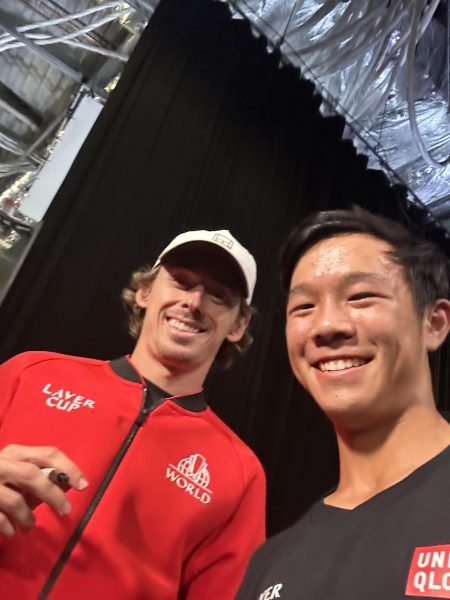
Hom also mentions that the players brought all-out intensity to every single point, whether that was during the serve or midway through the fifth rally, which is something he tries to do now when he plays. Both Hom and Huang recall that some of their fondest memories during the Laver Cup revolved around spending time with other ball kids who flew in from all different areas, ranging from Florida to Canada. Huang recalls a memorable moment in which the ball kids encountered Alex De Minaur, and Hom, without a phone, took his phone and took a selfie with the tennis superstar. He says that moments like these made this a once-in-a-lifetime experience.
“Since it was a small group, we were all really close, and we would hang out for hours on end throughout the whole weekend,” Huang said. “Everyone, including Jonathan, was really enjoyable to be around, and we were all having fun, cracking jokes, and just sharing the court with all those players.”
On the court, Hom encountered several obstacles, the most significant being managing pressure. To mitigate stress, he continually reminded himself to have fun with this experience. He also credits watching Carlos Alcaraz, a Team World player who participated in the event, as a way to calm himself. Alcaraz’s constant smile and composed demeanor — even under immense pressure to perform — showed a love for the game of tennis that Hom found grounding. Hom believes that this tournament allowed him to become a better tennis player who is now able to perform in high-pressure environments.
“Before the tournament, my coach told me that you just have to go out there and think positive thoughts and worry about nothing else,” Hom said. “Let’s say you’re playing a tournament against another high-level player and you’re thinking, ‘Oh, I’m going to lose.’ Don’t do that, just have fun with it, you’re there to play tennis.”