

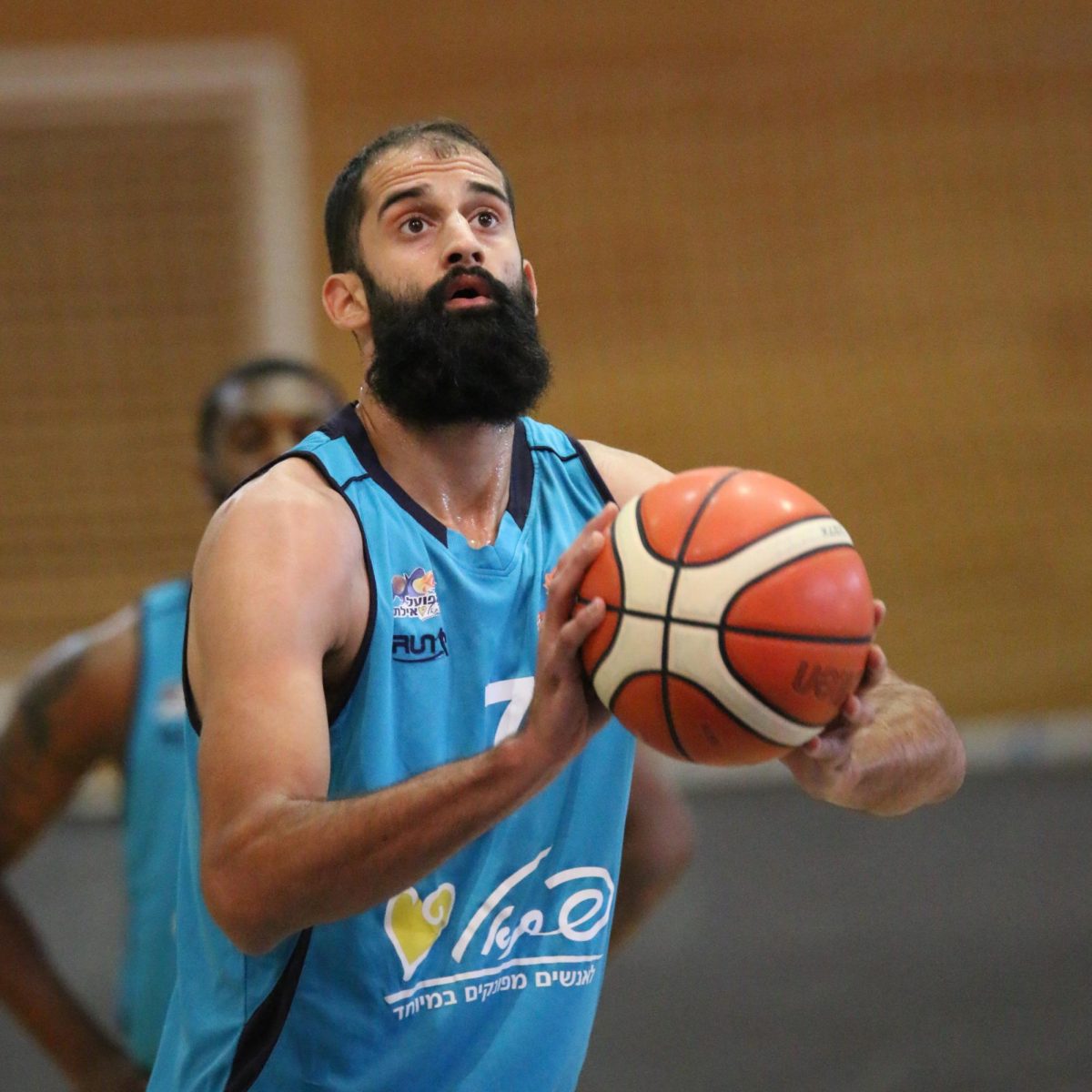
Long before college scouts visited the MVHS gym early in the morning or professional coaches evaluated him overseas, MVHS alum ‘04 Robert Rothbart had already defined his future: basketball would be his lifelong trajectory.
Rothbart wanted to be a professional basketball player his entire life — according to him, his mom said he had this dream as early as 8 years old. Former MVHS Varsity Basketball Coach Ed Campbell adds that Rothbart’s goals and passion for basketball were unusually concrete.
 “One of the first things he said to me was ‘I want to play in the NBA, and I think I can play in the NBA,’” Campbell said. “Some kids are shy about and play down their goals. But he was very clear, and he was the first player to say that he wanted to become a successful professional player. He knew that from an early age, and really went after that.”
According to Rothbart, that certainty didn’t emerge in isolation — basketball entered his life even before organized competition or formal coaching. With both his parents involved in professional basketball, he grew up immersed in the sport.
“Basketball for me was part of my life,” Rothbart said. “My mom was a professional player, and my dad was a professional coach. Nobody really pushed me toward it, but I naturally gravitated toward basketball. The youngest memories I have of myself are when I was 4 years old and had a basketball hoop in my living room.”
In third grade, Rothbart started playing in organized leagues, starting out with a Sunnyvale community league coached by his mother. Rothbart says his skill and physical abilities separated him from his peers even at an early age, reinforcing basketball as a strength and personal outlet.
“In the youth leagues, I would score 30 points a game,” Rothbart said. “It always felt great. It was a fun place for me to express myself.”
That development unfolded amid a highly mobile childhood. Rothbart attended nine schools in 12 years, passing through Cumberland Elementary, The Harker School and St. Francis High School. At the same time, he started competing in Amateur Athletic Union programs and attended major exposure camps in Las Vegas.
Throughout his childhood, basketball remained a constant that provided continuity within new social environments. For Rothbart, both his height and the court provided a sense of stability and pre-defined reputation that spared him from the usual difficulty of fitting into a new school.
“Every time I moved into another school, everyone said ‘he’s taller than the tallest guy,’” Rothbart said. “Everyone said, ‘Do you play basketball?’ It was always an anchor for me. When someone comes to a new school, they have the challenge of what their image is going to be, and for me it was always easy.”
On Rothbart’s first day at MVHS, he was challenged to a one-on-one. He says that what began as a personal challenge turned into a defining moment that established his standing among classmates.
“30 to 50 people showed up at the court across the street from 7-Eleven,” Rothbart said. “I fake like I’m going to shoot, and he turns to see how the shot went, but I do it above his head and keep the ball in my hands. As he’s turning back, I go the other way and dunk the ball. Eventually this guy and I became friends.”
When Rothbart started playing for the MVHS Boys Basketball team, Campbell immediately recognized Rothbart’s potential. He says that while height was the first thing that stood out, it was the underlying skill and talent that made him a special player.
“He reminded me of Toni Kukoc,” Campbell said. “He was what was, at the time, more of a European player. Even though they were very tall, they were trained with all-around skills, and Robert had all-around skills. His passing ability and the way he saw the floor was very, very advanced for someone who was just a sophomore or junior in high school.”
As a result, despite being assigned center, Rothbart says that he played a versatile role, handling the ball and sometimes operating at the perimeter. To accommodate this talent, Campbell implemented a Princeton-style offense, a system known for its complexity and reliant on smart passing.
“His basketball IQ was as tall as his height was,” Campbell said. “He could have flourished in a number of different systems. Seeing his potential and wanting to develop it as much as I could, I wanted to develop an offensive system that would showcase all his skills, because I know then that colleges and even professional teams would be pleased to see him developing in those ways.”
Beyond the tactical adjustments, what stood out to Campbell was that Rothbart “worked harder than anybody.” Despite transferring from St. Francis, a team with much higher talent at the time, Campbell says that Rothbart still worked hard to satisfy his childhood dreams of becoming a professional. With assistance from the MVHS water polo coach at the time, he gained early access to the gym and practiced for hours each morning under his mother’s guidance.
“It would have been easy for him to mope and not work as hard, maybe to feel like ‘this is below me, why am I here?’” Campbell said. “Never once was that a consideration. He was there all the time, early in the morning shooting free throws, willing to work hard and make the team as good as it could be. That’s the best trait of all — he showed maturity, care and ability to adapt and make the situation as best he could. All the kids were very happy to have the opportunity to play with him and elevate the program.”
Rothbart says that MVHS’ competitive academic and athletic culture at the time reinforced the expectations he would encounter professionally. He says that the environment rewarded his internal motivation and discipline.
“I was super competitive, and wanted us to win every single game,” Rothbart said. “The competitive nature helped, because it was something that I was also a part of, and it’s something you need for professional basketball because it’s super competitive.”
As his reputation grew, coaches began scouting at his early-morning sessions. Rothbart narrowed his recruitment to five major programs — UC Berkeley, UCLA, Stanford, Arizona and Indiana — before exploring the NBA draft process directly.
After initially withdrawing from the draft due to projections that he would be a late first round pick, Rothbart still decided to bypass college basketball and begin his professional career in France, expecting to return to the draft after a season. However, injuries disrupted that timeline, redirecting Rothbart into a career in Europe. Over time, he competed across multiple countries, such as France, Slovenia and Poland, before establishing himself in Israel.
There, Rothbart’s experience and composure helped him improve his team dynamics. According to first division coach Roy Hagai, his experience moving around countries in Europe helped him navigate cultural and professional differences.
 “He knew how to be a leader,” Hagai said. “He knew how to talk to the American players and the Israeli players, because he came from overseas and had the experience. Everybody looked to him as a model, because he was humble. After practice, he was professional and was taking care of his body.”
Hagai says that Rothbart had a rough start, as injuries and inconsistent performance put his position in jeopardy. However, a pivotal conversation shifted his expectations.
“He was injured a little bit, so it was tough for him to get into the season,” Hagai said. “I remember one talk we had after a month, and I told him you need to fight through it because if not I will not have a choice but to cut him. Since that talk, he was awesome. He got control of the situation and became the number one center in the league.
That shift materialized in a single game that redefined the team’s season and the career trajectories of both Hagai and Rothbart. Hagai says that the team’s poor performance put him in a position where he would be fired if he didn’t win the next game.
“I had packed my stuff from the apartment because I knew we were going to play the second-best team, and we were most likely not going to win,” Hagai said. “I thought it was my last game. We were down by 20 at halftime, and then Robert had an unbelievable second half. We won the game, and he was the MVP. Then we went on to win five in a row. I was coach of the year, and he was player of the year. It’s unbelievable, because in sports, 20 minutes can change a whole career.”
Midway through his career, Rothbart began thinking deliberately about his life after retirement. He says that seeing his peers struggle with transitioning away made him want to prepare.
“I was looking at my friends that were retiring, and they had nothing to do,” Rothbart said. “They bought a whole bunch of apartment complexes, and were just sitting there doing nothing. I knew I didn’t want to do that.”
Eventually, Rothbart decided to enroll at Arizona State University, finishing his bachelor’s degree online while still playing professionally. Rothbart said that the move reflected a shift toward long-term intellectual investment. He says that the shift can partially be traced back to MVHS, when his math teacher, Emmett Powers, put him in a demanding classroom environment that reframed his relationship with academics.
“He was a military man, and he treated his classes like it was the military,” Rothbart said. “The rules were clear for everybody, and there were strict rules. If your name wasn’t in the right place, or your homework wasn’t in a certain place, you would get a zero. I ended up a 98% in the class, but he was supposed to be one of the hardest teachers. Up until that moment, I prioritized basketball, but he made me realize that the academic side of me was something I wasn’t putting too much effort into, but I had potential.”
After finishing his masters degree in economics, he decided to retire from professional basketball, transitioning to a job at a hedge fund and now a supply chain consulting firm. Rothbart says that the sport now occupies a different role in his life — helping him connect with his 12-year-old son who now also plays basketball.
“I don’t follow basketball outside of my son,” Rothbart said. “The biggest role that basketball plays in my life right now is trying to help my son, and trying to find a balance — how do I be a father and a coach at the same time?”