

Amidst the swirl of constant global events and news outlets expanding to social media, the increase in the number of ways to stay updated on current events has also increased. While some individuals regularly scan headlines or subscribe to news publications, others may be less updated on current news because they check the news less frequently. According to a survey of 114 MVHS students, 21% check professional news publications daily. However, these habits are often built over time; for instance, social studies teacher Hilary Barron started building a daily habit of checking select news sources later in her life.
“My parents would sporadically get the newspaper, while my grandparents got it religiously every day so we would occasionally talk about news,” Barron said. “But I didn’t really think that following news was too important, and even in college, I just followed politics a little. It really took until I started teaching AP Government for me to find a way to bring it into my life.”
In contrast, sophomore Myra Malik built her habit of following current news earlier, specifically in her freshman year, when she also joined the MVHS speech team. After building a habit of regularly checking current events, she has found that she not only can better converse with her classmates on more topics, but also develop her own opinions on politics and events as well.
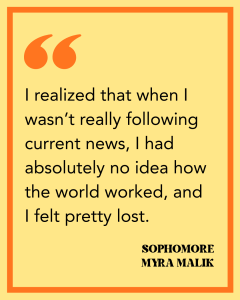
“I realized that when I wasn’t really following current news, I had absolutely no idea how the world worked,” Malik said. “From the way politics work to economic policies and foreign policies, I had no clue about what was going on in the world around me, and I felt pretty lost. Gradually, I made it a habit to go look at the news maybe at least once a day or even once a week and try to understand what was going on. It helped me get a better understanding of how the things I was reading about in the news represented what was going on in my community.”
Similarly, freshman Nitika Karandikar also emphasizes the importance reading current events has on formulating perspectives on politics and the economy. She believes that news literacy helps individuals form opinions about their community after having a more educated background on the topic, and emphasizes the effects that staying updated on current events has on her.
“When I was younger, reading current news to me was sort of just ‘Oh, this is what’s happening right now,’” Karandikar said. “But I didn’t know what it meant to read current news. Now, I feel more confident talking about political events and being able to connect them to wider issues. Knowing what’s going on gives you a more educated basis to form an opinion, because rather than just basing your political opinions on how you feel, knowing all the facts and pros and cons of a certain topic is extremely important when it comes to someone forming their own viewpoints.”
However, Barron, Malik and Karandikar also all agree that reading current news may be a stressful experience. Barron acknowledges the importance of finding the balance between following current events and maintaining one’s own well-being.
“There’s a lot of sad, depressing, awful things that happen,” Barron said. “I’ve talked to a lot of teachers and co-workers who feel like they’ve needed to take a break from the news because there might be some heavy things happening in the world, and it can feel like a lot to keep up with it. Because we only have so many minutes of a day, it also becomes part of the challenge — to actually find ways to get enough of the news so that you generally understand what’s happening, but to also not overwhelm yourself mentally or emotionally with all the other things you’re trying to do in the day.”
For a similar reason, Karandikar’s regular sources for her news updates have shifted from social media to becoming more centered around news articles. Additionally, she realizes the importance of finding her own balance — to process the information but still stay mindful of her own mental health.
 “A lot of the news on social media was just people’s hot takes or information that wasn’t accurate, and it became very stressful for me to keep looking at Instagram,” Karandikar said. “I gradually switched to looking at more news articles because it felt more fact-based. It can definitely be very stressful looking at the news and seeing a lot of bad things that are happening, maybe even take a toll on your mental health and make you feel sort of blown out of proportion to what you should be worrying about as a student.”
Barron, Karandikar and Malik all understand that some might choose to not frequently read about current events because many topics can be sensitive or overly complex to understand. To ease into building a habit of reading current news, Malik suggests entering the process with an open mind, and taking the time to understand the information before proceeding to do more research on a topic.
“You have to realize that there are some things that are just completely out of your control,” Malik said. “You can’t immediately teleport to another country and change their political environment and scene, but I think taking the time to process that information and understanding that there are avenues for you to make a change and actively voice your opinions or protest is pretty impactful as well. There are a lot of things going on in the world and it’s hard to keep track of all of them and find the positives, but understanding that these are big issues that we have to tackle as an entire community can help you be a more community-minded person as well.”
Apart from checking the news throughout the day, Barron also has consistently encouraged her classes to follow current events through various activities. From comparing current events with the historical events in her World History curriculum, to hosting ballot-style voting in class and incorporating current events-related extra credit questions on AP Government exams, she aims to support students to bridge connections between the concepts taught in class to events happening currently.

“When you’re not as updated on current news, it’s harder to put connections together,” Barron said. “When you regularly check in on current news, you just start to put pieces together. I’ve seen students who already have some way of following the news, and they just get the concepts faster, so whether you realize it or not, staying updated on current events makes learning easier, because you can see these connections to build those essential critical thinking skills.”
Ultimately, both Barron and Malik agree that staying updated in current news is a personal choice and preference, and believe that developing a habit in staying updated with current events is beneficial to everyone. Emphasizing the balance between mental health and learning about news, Barron also highlights the positive impacts that knowledge on current events has on formulating one’s own opinions and developing a sense of community.
“We’re all humans,” Barron said. “We all want similar things, so naturally it’s important to be aware of major events and trends that are happening worldwide. It’s interesting to see how governments have changed, developed and how their citizens are affected. Learning about the news also plays out in our politics, such as who we elect, and ultimately trickles down to the policies that affect our lives. There are always overarching stories that connect, and learning about what’s happening around us helps us develop the skill to find bigger themes and trends across events while following major stories, seeing connections and how they impact your life.”