


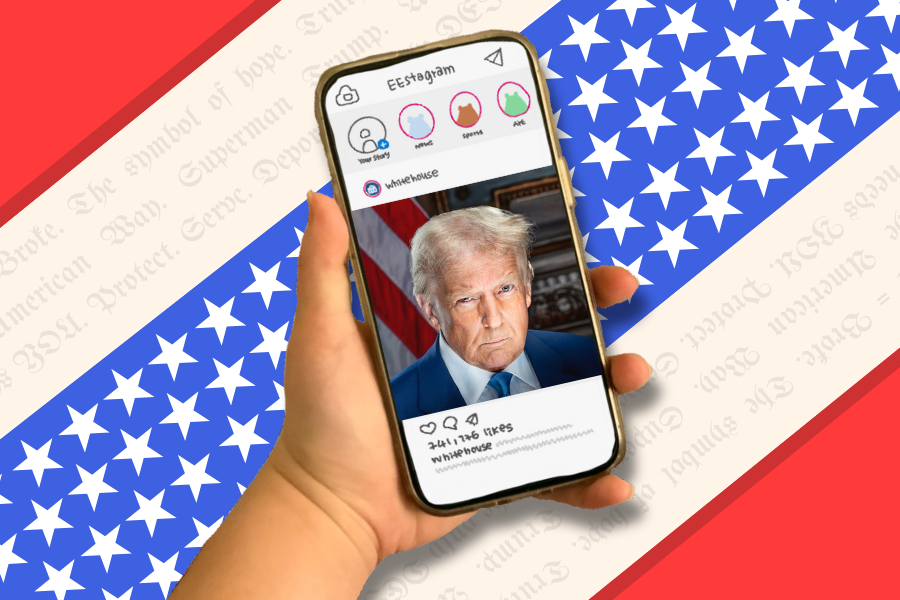
Government and AP Macroeconomics teacher Pete Pelkey prides himself on keeping up with his political feeds on channels like Fox News and YouTube, tuning in to both left and right-wing news feeds to gather information to teach students. Since President Trump’s first term, Pelkey has noticed what he believes to be derogatory and divisive content published by the White House, especially in recent months.
“White House official accounts should just be for the policy of the government — it’s not supposed to be the promotion of a president, and what they’re doing on it is probably illegal,” Pelkey said. “Donald Trump is the president of the most powerful country in the world. He says something stupid, and this whole thing blows up, causing a war. He just posts the most random, ridiculous points of view.”
Before beginning his presidential bid, Trump was a reality star and real estate businessman known for his often sensational and attention-catching social media posts on X, then known as Twitter. This became a central part of his identity as a politician during his first presidential term in 2017. After Trump’s “Stop the Steal” campaign ended due to the U.S. Capitol riot on Jan. 6, 2021, he was banned from social media platforms like Instagram and X.
Since then, Trump has moved to primarily posting his content on Truth Social. After winning the 2024 presidential election against Democratic nominee and then-Vice President Kamala Harris, Trump translated his unfiltered personality from social media to official White House accounts, with posts like AI-generated images of Pope Trump and “WOKE = BROKE” going viral.
Trump pushed back on Biden-era regulations for the immobilization of Immigrations and Customs Enforcement after his inauguration in order to deliver on his promise of removing “criminal aliens” from the United States. Trump and his social media team began posting video edits and photos of deported individuals, capitalizing on popular trends at the time. For example, they used Sabrina Carpenter’s song “Juno” and Olivia Rodrigo’s “all american b—-” for videos promoting immigration enforcement. Both singers made public statements that condemned the White House from using their songs, with Rodrigo commenting, “don’t ever use my songs to promote your racist, hateful propaganda” on Instagram.
Sophomore Krish Kumar has encountered these posts from the White House on X, which he describes as being disrespectful to immigrants and unprofessional. Kumar agrees with Pelkey’s belief that they cross the boundary between being made to inform and being created to incite discord, adding that the posts are not made in the best interest of the American people.
“I think the motive of these posts is to further the divide between Americans in terms of immigration and the ICE situation,” Kumar said. “But I don’t think that’s what our nation needs right now. I feel like right now what we need is unity.”
As an independent voter aligned with neither the Republican or Democratic parties, Pelkey believes that Trump’s posts promote disunity at the cost of civility and go against what he believes is at the core of what the president’s role should be. Pelkey asserts that the American people should embrace their differences and focus on larger societal issues.
“If I were the Secret Service, I would say, ‘Mr. President, give me your phone,’ and then I’d break it,” Pelkey said. “Americans have different philosophical ideas, and that’s OK. We should be able to speak those philosophical ideas without somebody trying to shout us down. We can only come together if we drop the rhetoric and say, ‘OK, how are we going to make this a better country for us, our posterity and our children?’”
Trump’s political and nonpolitical outreach on social media has received both praise and criticism from constituents on both sides of the political aisle and from global leaders. In response to Trump’s post about the deaths of filmmakers Rob and Michele Reiner on Truth Social, Rep. Don Bacon (R-NE) asked if the president could be “presidential.” In contrast, conservative political advocate Joey Mannarino commended Trump’s White House’s social media efforts, saying that he had “never seen a better social media team than this one.”
Sophomore Steven Chi disagrees with Pelkey and Kumar, and argues that the issue doesn’t lie within the White House’s views on key issues — according to Chi, the core issue is the content’s lack of utility. Unlike others who believe the president should maintain a professional social media presence on official accounts, Chi instead questions the idea of a social media account entirely.
“I think using social media as a platform for communication in general doesn’t feel very professional,” Chi said. “I don’t think there’s a necessary ideological opposition to just posting news and spreading information on Instagram. However, if you’re doing this, you shouldn’t be doing it from the official U.S. government account, because there are a lot of people in the government, and your views don’t match with nor represent every single person.”
Pelkey states that the Trump administration’s social media posts have helped to facilitate a political environment where “legitimate conversations” about issues like immigration cannot be held. He posits that Trump’s online activity teaches others to blindly follow in his footsteps.
“Presidents are an example of what Americans should be,” Pelkey said. “That’s one of the roles the president holds. So if the president is acting petty or ridiculous, or he’s saying things that are inappropriate, then everyone down the chain is going to think, ‘Our president does it, why shouldn’t I do it?’”
Kumar believes that Trump and his media team freely posting his online content conditions the American people to become increasingly unconcerned and unbothered by what he posts and says online, even with the responsibilities that come with being president. He fears that as this kind of content continues, the government will be able to enact controversial policies and speak without backlash from the people.
“I feel like people are not going to be taking things as seriously anymore,” Kumar said. “This might not be so great when you’re talking about global politics, which is a serious matter in itself. People are taking immigration, ICE and deportation-related topics way too lightly. It doesn’t really help, because it’s providing us a way to cope with the situation, but we’re not doing anything about it.”
When it comes to how Trump’s content may affect the future of politics in the coming years, Pelkey believes that there will be new legislation put in place in order to regulate social media posts from officials and to reform the government. From Kumar’s perspective, Trump’s social media may create a “ripple effect” as future generations begin to see political discourse through a more unserious lens. Chi disagrees and argues that while influential in the moment, Trump and his administration’s social media posts will play a miniscule role in the political atmosphere of the United States.
“I don’t think it’ll have an effect,” Chi said. “Things have come and gone, and it might influence people to stop using social media because they view Trump’s posts as stupid. It might stop social media use for the future of politics, but I don’t think it’ll have any significant effect. People naturally just forget, especially in this day and age.”