


A teacher source is anonymous due to potential backlash and will be referred to as Teacher A.
Fremont Education Association President Carley Stavis released a statement addressed to FEA members via email on Oct. 9, which reflected on the Israel-Hamas conflict and stated that the FEA — the FUHSD teachers’ union — stands in solidarity with Palestinian students and educators. In response, community members spoke at FUHSD Board meetings throughout October to discuss the statement, and some critics of the statement sent Stavis, FUHSD administrators and FUHSD Board members hundreds of emails calling for their resignations or a formal apology.
Carley Stavis declined to speak with El Estoque. In the statement, Stavis emphasized the importance of educational opportunities and the harmful effects of being indifferent to injustice. While acknowledging the controversial nature of the statement, she invited FEA members to discuss the issue further.
“In the interest of personal transparency as a leader in this system, I have wrestled with whether or how to write about this as your union president throughout the past two years — not because I question my own solidarity with Palestinians, but because I know the 500 or so of you who make up our FEA hold diverse perspectives, each of you with the right to think and feel what you do,” Stavis wrote in the statement. “Some may not want to hear from me on an issue that is so charged and painful. I honor that. But I also know that silence has consequences.”
Sophomore Ahmad Subeh, who frequently speaks at community and City Council meetings, spoke at a FUHSD Board meeting on Oct. 21 to commend Stavis for using her platform to bring attention to underprivileged and oppressed people. Subeh, who is Palestinian, says that it’s important to him to stand up for what he believes is right — something he thinks should be expected of everyone, not just those directly affected by events like the war.
“People are silent about the genocide that is currently happening in Gaza, and it really makes me angry,” Subeh said. “And I thought, ‘Why are people not speaking up about this?’ This is happening in real time. We learn about genocides in history textbooks, and people are not doing anything. Then, I saw the FEA president send out a letter, and I thought, ‘It’s good to know that some people are actually waking up.’”
FEA representative and math teacher Kathleen McCarty says the statement “came out of left field,” since there wasn’t a union-wide vote or discussion on whether to release the statement or take a stance on the Israel-Hamas conflict. However, McCarty says Stavis probably discussed it with union executives, rather than just releasing it without consulting anybody. To McCarty, the FEA making a statement of solidarity around controversial issues can easily be “awkward,” due to the immense emotional charge surrounding these topics.
Teacher A shares McCarty’s sentiment, saying that many of their conversations with colleagues after the statement’s release centered around the erasive and silencing effect of solidarity statements made on the behalf of union members without their input or consent. As a Jewish person, Teacher A says their feelings about the war are nuanced, though they stand with Palestinians. However, they feel it is their duty as an educator to not discuss their views in the classroom to ensure all their students are treated equally.
“I don’t mean that we turn a blind eye to what is happening in the world, particularly when those things impact the community that we serve,” Teacher A said in an email response. “But I do think that my job is to serve all students, fairly and without bias. To focus on creating a welcoming and safe environment where all of my students can succeed academically. And the truth is, there are many Jewish students on our campus — and I’d imagine, throughout our district — who don’t feel safe, or even comfortable, identifying themselves as Jewish. Students who do not feel they can bring their whole selves to school each day. This is not speculation; I have heard students share this. This is heartbreaking to me.”
To Teacher A, the diction of the letter, which focused on solidarity with Palestinians, felt as though it intentionally erased alternative perspectives, leaving Jewish students, staff and families feeling unsupported and unrecognized. In addition, they believe that teachers making political statements contributes to the belief that public schools indoctrinate students, potentially eroding public trust in the union’s credibility.
Board Trustee Rosa Kim states that the Board does place restrictions on speech like this, such as through FUHSD Board Policy 4119.25. This policy states that while school employees have the right to engage in political discussion, they cannot act as representatives of the district when doing so. However, Kim points out that Stavis’ statement was on behalf of the union, not the district. Thus, there is no legal issue with it, and the controversy is unrelated to the Board and district leadership. Nevertheless, Kim says many community members came to the Board, through emails and in person, to state their concerns and ask for recourse. To her, the Board’s and Superintendent Graham Clark’s responses are emblematic of the district’s commitment to ensuring a safe learning environment for all students.
Kim, along with other Board members, district leaders and Stavis, received thousands of emails en masse calling for Stavis’ firing and removal from her position as president of the union. Kim described the challenge of hearing community members during public comment while being unable to respond directly due to Board governance rules. She noted that, although Board members are prohibited from speaking during public comment, she appreciated the courage of those who shared their perspectives and wished she could thank them directly.
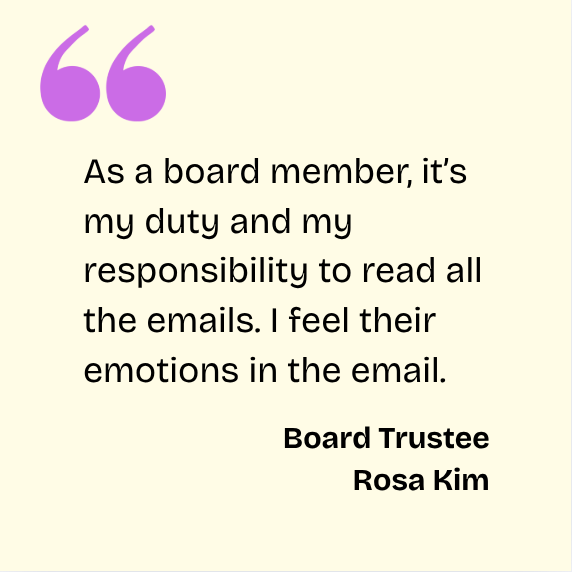
“As a Board member, it’s my duty and my responsibility to read all the emails,” Kim said. “I feel their emotions in the email. When I hear very negative comments, I feel stressed. People have strong emotions about this, and it’s a really serious issue. Receiving so many emails is hard for the Board, but I understand how stressful this topic is for other people, too.”
The pushback against Stavis’ statement disheartens Subeh, who thinks the statement is self-evident and important in nature. While Teacher A views the lack of mention of Israeli victims in the war as a major erasure of their experiences, Subeh believes that not focusing on them doesn’t discredit the suffering of Israelis. He likens this to the Black Lives Matter versus All Lives Matter debate, arguing that focusing on one doesn’t negate the other.
“A key thing that people have to realize is we all have a voice,” Subeh said. “We can choose not to use it, or we can choose to use it, and if we do use it, we have to make sure that we are still responsible for what we don’t speak out against. If we witness injustice, we have to take action against it.”