


The student source in this story is anonymous due to potential legal concerns in this ongoing matter and will be referred to as Student A.
President Donald Trump issued the Restriction on Entry of Certain Nonimmigrant Workers proclamation on Sept. 19, followed by a clarification by the U.S. Citizenship and Immigration Services, and the White House. The proclamation was aimed at companies sponsoring foreign skilled workers, requiring them to pay a $100,000 fee for every H-1B petition to bring new workers into the U.S. The order was announced without prior notice or public comment, leaving immigration lawyers, companies and H-1B holders scrambling to interpret the new rule’s meaning and who it would affect.
Business Insider reporter Pranav Dixit, who covers Silicon Valley news and was among the first to track and cover the new proclamation, recalls the chaos that rippled through Silicon Valley and immigrant circles alike. For many, the news was broken through frantic social media posts and panicked group chats.
“We saw companies send out internal memos,” Dixit said. “Almost every major company in the U.S. — like Microsoft, Google, Amazon or Zoom — told employees: ‘If you’re on an H-1B visa, don’t leave the U.S. If you’re outside the U.S., come back immediately within 24 hours.’ Some people actually walked off flights that were about to depart, because they didn’t want to risk being stuck abroad. Others canceled vacations or booked the next flight back to get in before anything changed.”
On Oct. 20, the USCIS released long-awaited guidance clarifying the proclamation’s reach, explaining that the fee only applies to new H-1B petitions filed on or after Sept. 21 for workers outside the U.S. without a valid H-1B visa. Renewals, amendments and existing visa holders are exempt, and exceptions will be granted only in “extraordinarily rare” cases deemed to be in the national interest. Under the proclamation, employers must include proof of payment or an approved exemption when they file for H-1Bs, although lawsuits already underway, such as Global Nurse Force et al. v. Trump and another filed by the U.S. Chamber Of Commerce, demonstrate the policy’s uncertain future.
The overhaul of the H-1B system appeared to be far less consequential than initial headlines suggested, according to Clifton Wu, an immigration attorney and co-founder of Immigration Law Group LLP. The proclamation applies only to new H-1B applicants filing from outside the U.S., starting with the March 2026 lottery. This excludes the majority of H-1B applicants, specifically renewals and foreign students transferring from F-1, a non-immigrant visa for full-time students, to H-1B.
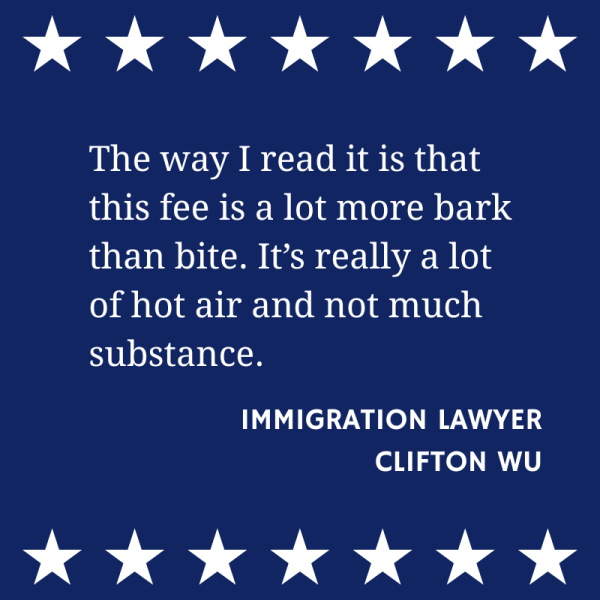
“The way I read it is that this fee is a lot more bark than bite,” Wu said. “It’s really a lot of hot air and not much substance. The vast majority of potential H-1B applicants are already in the U.S., so this proclamation doesn’t even apply to them.”
However, for the thousands of H-1B workers who power Silicon Valley’s backbone, making up two thirds of its tech workforce, the announcement still struck a nerve. Even if the fee didn’t immediately affect them, many said the policy was another reminder of how precarious their immigration status feels in the current situation and how easily their futures can shift with a single executive order. Student A is one such case — they have been in the U.S. for 12 years on an H-4 visa that is dependent on their parents’ H-1B visa.
“My initial reaction was like, ‘Oh, I’m gonna have to go back to India,’” Student A said.
Although Student A’s initial reaction did not come to fruition, it reflects both the fear and confusion surrounding current immigration policy changes. While the new fee doesn’t directly impact current H-1B holders, it serves as a symbolic gesture reinforcing the administration’s tougher stance on immigration.
“It’s almost as if the administration wanted to make it look like they’re doing something that’s really going to restrict H-1B’s,” Wu said. “But in fact, it’s really not going to — the fee is not applicable to a vast majority of them.”
Dixit says that in the long term, the order could force companies to offshore talent to hubs outside the U.S. or use other visa alternatives like the O-1 for “extraordinary ability,” which often requires submitting evidence that meets the strict criteria. According to Dixit, for smaller startups that lack the capital of big tech, sponsoring new H-1B hires could be virtually impossible due to their exorbitant fees.

“Canada has always been an attractive alternative,” Dixit said. “If you know you can’t get through the U.S. immigration system, you can always move to Canada. Every big tech company has offices in Canada. It’s very similar culturally. It’s very close to the time zones. I think even when it comes to startups, they’ll lean more on remote workers or open engineering offices abroad.”
Regardless of the proclamation’s effectiveness, the messaging is clear, according to Wu. It echoes the Trump administration’s longstanding goal to be tough on immigration while “putting Americans first,” even if it comes at the cost of devaluing foreign talent, Wu said.
“It’s sending a signal that the U.S. is not as welcoming as it used to be for foreign nationals,” Wu said. “Despite the fact that some of our best companies were started by people who moved to the U.S. as immigrants.”
Unlike U.S. citizens or permanent residents, H-4 holders who are dependent on H-1B visas are unable to apply for many scholarships or get internships, limiting their ability to compete on equal footing, said Student A. Alongside the decreased opportunities, they must further face the unpredictability of not having permanent residency.
“It makes you feel a little bit uncertain about your future,” Student A said. ”I had to spend two or three days making peace with the fact that there’s always this possibility that I might not stay here. People in my position have to face that reality.