


Celene Chen
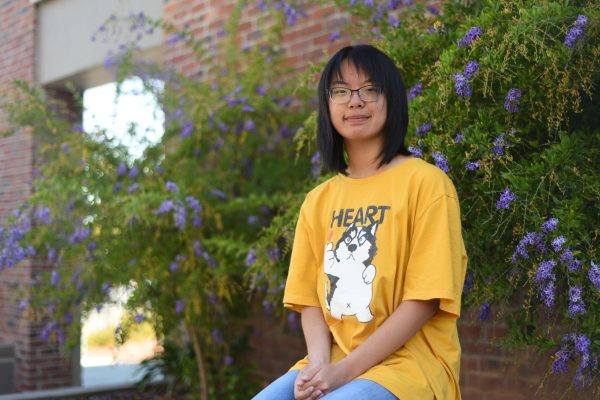
Though junior Celene Chen had heard good things about California State Summer School for the Arts’s environment from a friend, she didn’t understand why until she got there. Held at California Institute of the Arts, the program lasted four weeks and included classes on illustration, animation and creative writing, among other topics. Chen applied for a major in Digital Media and a minor in Sculpture — both held at CalArts’ visual arts department. Prior to attending, Chen admits she felt nervous, as she had never attended a camp by herself before.
“Then I actually attended and was surrounded by so many other artists,” Chen said. “Being surrounded by so many artists who share the same passion as you for creating things — it really motivates you to continue. It’s like, ‘You’re not alone in this passion,’ because especially at MVHS, we’re so STEM-focused. I felt really happy, and I was really inspired by my peers too, who were so motivated.”
Chen quickly became friends with her roommates, often chatting well into the late hours of the night. One of Chen’s favorite memories was watching Kpop Demon Hunters with 16 of her friends in their dorm. As for the lessons, Chen was intimidated by figure drawing — sketching human forms in a short amount of time — due to inexperience with it, but was pleasantly surprised with how the class prioritized self expression over skill.
“I don’t think CSSSA was necessarily focused on technical training,” Chen said. “I felt like it provided you the resources and the environment for you to thrive. I really enjoyed that — of course there’s always space for technical improvement, but it wasn’t as scary as I thought. It was very free, in a sense, because CSSSA really let us try to express our opinions.”
According to Chen, CSSSA encouraged artists to experiment with different techniques and go beyond their comfort zones. Chen herself took a chance by applying with a sculpture-based piece despite being less used to the medium. For her final project, she created a zine — a mini booklet containing her memories at CSSSA — meticulously completing its layout in Adobe and then cutting it out by hand.
“That process was so tedious, and it hurt my back really bad,” Chen said. “I think I turned into a shrimp. But the end product was so rewarding because I got to pass one to every student in the digital media class. So I felt like I was leaving something with them, like, ‘This is a part of CSSSA you’ll never forget.’”
Bhaavya Renukuntla
Junior Bhaavya Renukuntla didn’t fill out an application for her summer vocation — she simply asked her family dentist. Over the summer, Renukuntla interned at iTooth Dental, shadowing the dentist, doing administrative work, cleaning all sorts of dental equipment and talking with patients. Renukuntla, who wants to enter the medical field someday, has previously shadowed a cardiologist in a similar manner. Some of her fondest memories shadowing the dentist included talking to the dentist during lunch breaks, when they would go to McDonald’s along with the rest of the staff.
“I would just talk to the dentist and get a feel for what her life is like,” Renukuntla said. “I wanted to learn about her life, not just professionally, but also personally, because I want to see if that’s something that would fit the kind of life I want for myself.”
Though the experience with the dentist exposed her to many technical procedures, such as repairing and replacing damaged teeth, she also learned many personal skills in dealing with patients. She recalls learning how to bond with adults and children alike, such as a patient who attended MVHS around 60 years ago.
“I’ve become a more social person just because of this internship,” Renukuntla said. “I think I’ve learned to talk to people from adults to kids. I’ve always felt a little bit uncomfortable talking to adults because they’re a little bit intimidating, but after this experience, it’s definitely shown me that they’re not.”
Apart from small talk, Renukuntla says she has gained experience socializing with patients going through more serious situations. Having tact when talking to patients who had just gone through a personal loss, for example, was a skill she developed during her time in the dental office. Renukuntla believes that the internship helped her care for patients’ mental and physical health in a more compassionate way.
“Being a doctor, you’re helping people, but you’re also helping yourself, because you’re learning about people around you,” Renukuntla said. “You’re learning how to be empathetic and how to walk in people’s shoes, because it’s not something that you can just learn. You can experience it.”
Horton Zhu
Senior Horton Zhu chose the MIT Beaver Works Summer Institute for his first experience at a summer program. Zhu found out about the program from two underclassmen he TA’ed for last year, saying that he decided to apply after seeing that applications weren’t too selective.
The BWSI spanned four weeks and consisted of multiple 30-student courses covering a variety of tech-related topics, from AI technologies to radars and satellites. While attending his online course, Zhu completed hands-on experiments, listened to lectures from guest speakers and worked with Arduino kits to complete projects. While Zhu expected the program to be more lecture-intensive, to his surprise, most of its activities were hands-on.
“Originally, before I saw circuits as something I understood, microcontrollers were foreign to me,” Zhu said. “But the instructors made everything really, really easy to understand. It was like Lego, but using different pieces, and they gave us really clear instructions. So I think that was pretty unexpected — I thought I’d fall behind more, but I didn’t.”
Zhu got along well with his assigned group of all rising seniors, bonding over similar academic backgrounds. Based on their final project theme of “helping someone,” they created a mini habitat with sensors for temperature and motion, among other things. For his work, Zhu was awarded the Dr. Bob Berman Disruptive Innovation award, granted each year for students who make outstanding contributions to their team. The award was given to one person in each of the ten courses. But according to Zhu, everyone did their equal share of the work — he just did different things, like making videos.
“It’s definitely made me a lot more interested in engineering,” Zhu said. “It made it seem feasible that I could become an engineer, or I could go into some kind of engineering degree. It’s made that a lot more interesting and realistic to me.”
Zhu joined the Solid-State Circuits Society Arduino Contest, a separate contest that he discovered while at BWSI, with people whom he met from the program. They competed under the assigned theme of this year: “assisting people with a disability.” Although his team is still waiting on their results, Zhu is happy that they entered, saying that prior to attending BWSI, he would not have known about other contests nor had the confidence in his engineering to enter them. He encourages other students to participate in contests or programs that they are interested in, even if they feel hesitant to do so.
“Don’t be intimidated,” Zhu said. “Before this, I had really little experience in engineering or circuits in general. I was really surprised to get in, but I still applied. That’s the only reason I got in: I wasn’t scared to shoot my shot.
Correction (Oct. 3 7:15 p.m.): This article has been updated to correctly reflect the number of students who win the Dr. Bob Berman Disruptive Innovation award.