


The Gender and Sexuality Alliance Club hosted its annual panel on May 19 and 20, in collaboration with freshmen Biology teachers as part of the Sexual Health and Relationship Education (SHARE) unit. Since the curriculum includes topics regarding sexual orientation and gender, the GSA Club hosts an annual panel of queer students to share their experiences and answer questions about the LGBTQ+ community.
Prior to the panel, students were given a form to submit anonymous questions to be answered during the panel. Freshman Ryan Bao recognizes the Biology curriculum in his class briefly covers gender and sexual education and was interested in developing a better understanding about the LGBTQ+ community.
“During our classes, we did learn about all the different terms in the queer community,” Bao said. “One thing the panel really addressed was the multitude of terms, where the terms originated from, why there are so many, and that a lot of them can mean a lot of different things for different people.”
For Bao, the panel was able to cover information in a way that was more accessible to a larger audience. Compared to textbooks and slideshows filled with information, he believes that hearing from real students who are a part of the queer community can help other students understand and learn the content in a more meaningful way.
“I think that was a really thoughtful and easy-to-digest way for a lot of the students to understand these types of topics, other than just being in the classroom and learning from a website,” Bao said.
Senior Archana Kakar has been a part of the GSA club for two years, initially joining when she attended meetings with her friend during her sophomore year. Now, as the Vice President of GSA, she hopes that speaking to and teaching freshmen at MVHS will encourage more of them to join the GSA club.
“I really hope that the main thing that they took away from the panel is not only how to best support your friends, but also to destigmatize the LGBTQ+ community,” Kakar said. “Then the LGBTQ+ community can feel more comfortable with exploring their own identity, as well as supporting their friends.”
In her own classroom, Biology teacher Lora Lerner strives to create a safe and inclusive environment for all her students. She believes that the Biology curriculum and GSA panel educates students on not just terminology, but also how they can relate to people’s real experiences and to develop particular attitudes around inclusivity.
“We can’t always imagine what it feels like to be someone else or what their experiences are,” Lerner said. “And I think hearing somebody say it from their own mouth, there’s just a different sense that makes it more human. Hopefully, you also get a little bit of a spectrum of responses that somebody might, for example, have had a good experience coming out to their family, and somebody else maybe that didn’t have a good experience, and to recognize that that’s all there.”
After the first day of the SHARE Panel, Kakar reflected on how the event went across all three periods, noting how the first two periods had a plentiful amount of questions for the speakers. However, she did emphasize that when students are given a notecard to write any questions they may have, some do tend to be inappropriate. Lerner adds that the Biology department and GSA continue to figure out how the panel can voice real experiences while also being school-appropriate. She notes that sometimes behaviors between audience members and panelists may not come out in the best ways, so she emphasizes the importance of being more conscious of what is said during the panel.
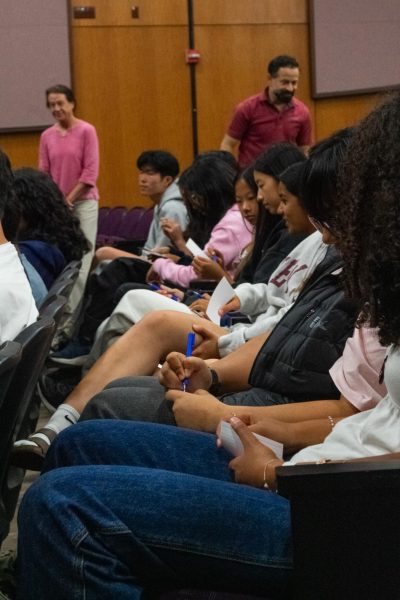
“Unfortunately, it doesn’t always go perfectly,” Lerner said, “I think an ongoing issue for all of us is that we’re still human, and we do need to have this back and forth of, ‘Hey, what’s an appropriate way for the audience to act? What’s an appropriate way for the panelists to act?’ I think you may find that some people had super positive experiences, and other people might not have, and I think that we can all recognize that we’re not perfect, and it’s a work in progress. I do still think overall it’s worth it, but we need to be putting a little more effort into making sure it’s positive.”
Despite a few bumps during the SHARE Panel, Bao believes it was a good learning experience for him. He enjoyed listening to the stories that the panelists shared as it allowed him to connect with the MVHS community further.
“Even though for me, there were some answers that I wasn’t fully grasping, I feel like at the end of the day, I was able to much better understand the queer community,” Bao said. “I know one of the panelists shared that their brother was part of the queer community, and it was really eye-opening to hear about these experiences. Overall, it really just helped a lot of students that I know understand these topics better instead of just learning them passively during class.”