


Growing up as the only girl in the family, Vocal Music Director Lofn Young felt the heavy weight of gendered expectations fall upon them. Their family wasn’t the only one pushing these expectations, as they resided in the Deep South, where pressure to conform to gender stereotypes made expressing themselves unsafe. Young recalls a girl from their high school wearing a tuxedo for senior portraits, which became a large controversy and even made the news. With a similar incident occurring in 2016, when Pennsylvania high school senior Aniya Wolf was kicked out of prom for wearing a suit instead of a dress, it’s clear there is stigma attached to dressing in gender nonconforming outfits at formal events.
“I had learned how to perform gender in a way that was very pleasing to everyone else, and that was my goal,” Young said. “I was reliant on these people for my safety and security and well-being, and I needed them to like me. I was very constrained in what I was allowed to do. So I definitely took that femininity to the 99th degree. If I got to go back and attend prom, I wouldn’t do the same things. I would wear a purple sparkly tux. The point of our clothes is that they can just be art. They can be a form of expression.”
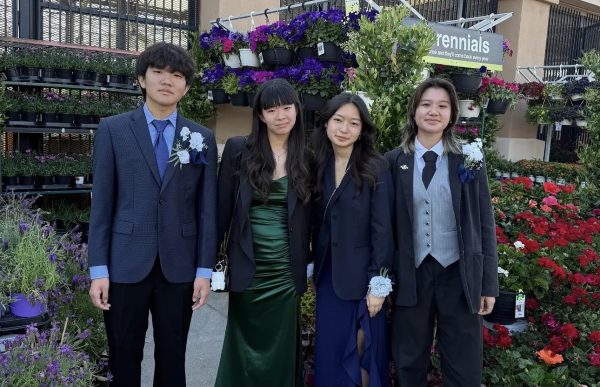
Similarly, while growing up, senior Rowan Chang would dress femininely but realized they preferred more androgynous clothing during the COVID-19 pandemic, with the social isolation allowing them to feel more confident expressing themselves freely. In their junior year, Chang chose to wear a suit, but wore a dress to their senior prom. Instead of dressing based on gender, Chang wears what feels more comfortable to them on different occasions. They add that people often have misconceptions about them due to their dress.
“People, when they see somebody dressed gender nonconforming, they think that they’re non-binary, but that’s not necessarily the case,” Chang said. “It could just be a style thing. It’s not an inherently bad conception to have, but it is a misconception.”
Young notes how clothing isn’t only about self-expression, but also has practical purposes. When they taught theater in Florida, their school had a strict dress code, expecting them to wear restrictive gendered clothing that impeded their ability to do their job. For instance, they were expected to show up in pencil skirts and heels, which constrained their movement. However, once they moved to California, they were able to freely express themselves by dressing in a gender neutral manner.
“There are no clothes that are boys’ clothes or girls’ clothes,” Young said. “I’m a person. I put clothes on my body that make me feel comfortable or reflect how I feel that day. As a queer person, I love queer fashion. I love clashing, loud patterns. I love going against the heteronormative standards, especially when it comes to professional dress as a teacher. What we have on our bodies has absolutely nothing to do with our ability to do our job well.”
According to Chang, many aspects of prom and other formal events are strictly gendered. Young mentions how when they go to formal events, they are often one of the only ones dressing in a gender nonconforming way. Additionally, they note that they sometimes face judgment from older individuals. Senior Alex Sharma is non-binary and chooses to celebrate prom by matching with their friends. While they acknowledge that prom has many gendered aspects, such as boys asking out girls, they note how their choice to go with friends is not an uncommon one.
“When I was in middle school, prom definitely seemed a lot more gendered to me,” Sharma said. “But now that I’m in high school and things have changed, it definitely seems a little less gendered. People who are friends can wear boutonnieres and corsages. So I think prom is a little bit less gendered, and it is more just like the celebration of high school.”

While Chang believes that prom is inherently gendered, they also explain that there is enough room for people who don’t want to conform to gendered standards to coexist without being uncomfortable. They agree with Young that most people wear gendered clothing to these events, adding that living in a progressive area reduces the stigma surrounding dressing gender nonconforming.
“I don’t think the current gender expectations are harming anybody, because it’s not like you can’t dress nonconforming,” Chang said. “It’s just the societal norm that we have. There are already people who dress nonconforming to go to prom; it’s not like they’re shunned if they do dress that way.”
Young believes that there is still a lot of progress to be made in incorporating gender expansiveness in formal clothing. Despite struggling to find good gender neutral formal wear, they find that queer artists like Billy Porter or drag artists serve as good baseline inspiration. For students who are afraid to dress outside of the gender binary, Young emphasizes that there is still time for them to find themselves.
“In high school, there is an environment where the people are perpetuating this culture of judgment for dressing outside of the binary,” Young said. “It does get easier as you get older and you get more comfortable in your own skin. The people who respond negatively to choices that make you happy are not your people. Dress how you want. Have fun. Life’s too short. You have free will.”