


A student source in this story is anonymous due to potential backlash and will be referred to as Student A.
After the 2023 American Math Competition exams were leaked online and circulated by thousands of students before the test, many students and educators began to question the legitimacy of the results. A few years later, skepticism has only risen as score distributions on these exams have shown an unusually high number of perfect and near-perfect scores, fueling allegations of widespread cheating on some of the nation’s most prestigious exams.
The American Math Competition series, F=MA and other olympiad competitions are seen by many as rigorous indicators of strong problem-solving skills and prestige for the nation’s top high school students. These exams serve as a part of the selection process for the country’s numerous national olympiad teams.
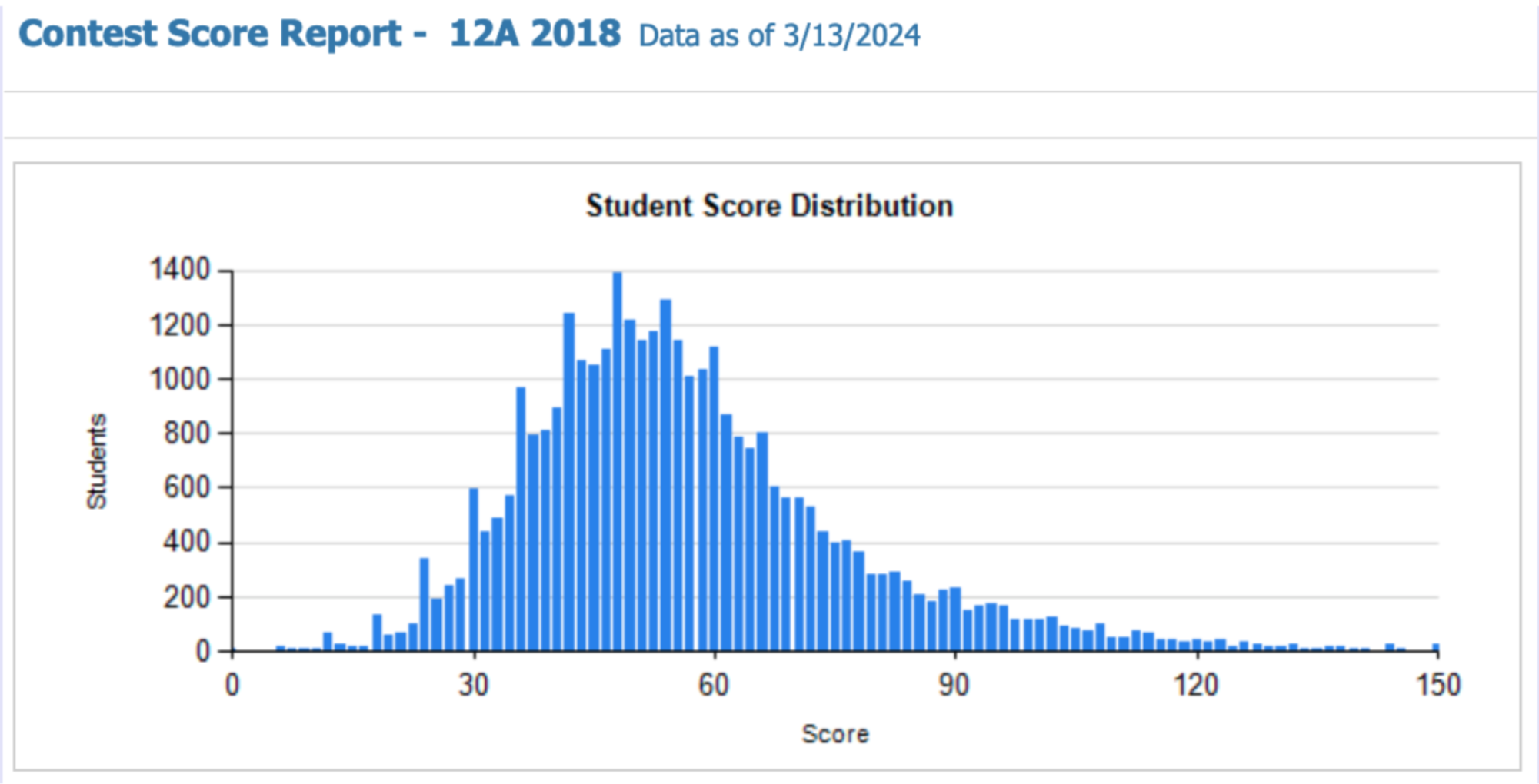
Student A, a high school student who has participated in both the AMC and the American Invitational Math Examination, was made aware of the cheating issue in late 2024, posting about the situation on the Art of Problem Solving forums, attracting attention from many like-minded students. Consequently, he started amcchange, an initiative to petition the Mathematical Association of America — which administers the AMC and AIME exams — to strengthen cheating prevention. The website features score distribution graphs displaying the disproportionate number of perfect scores on recent exams, which are significantly higher compared to older exams. They allege that it is evidence of cheating.
“The score distributions show that the mean, median and the overall shape of the middle of the graph haven’t changed much between 2023 and 2018,” Student A said. “The main issue comes with the right tail of the graph, with the extremely high and perfect scores that weren’t there in the 2018 score distributions. It isn’t definitive evidence, but it’s still very suspicious.”
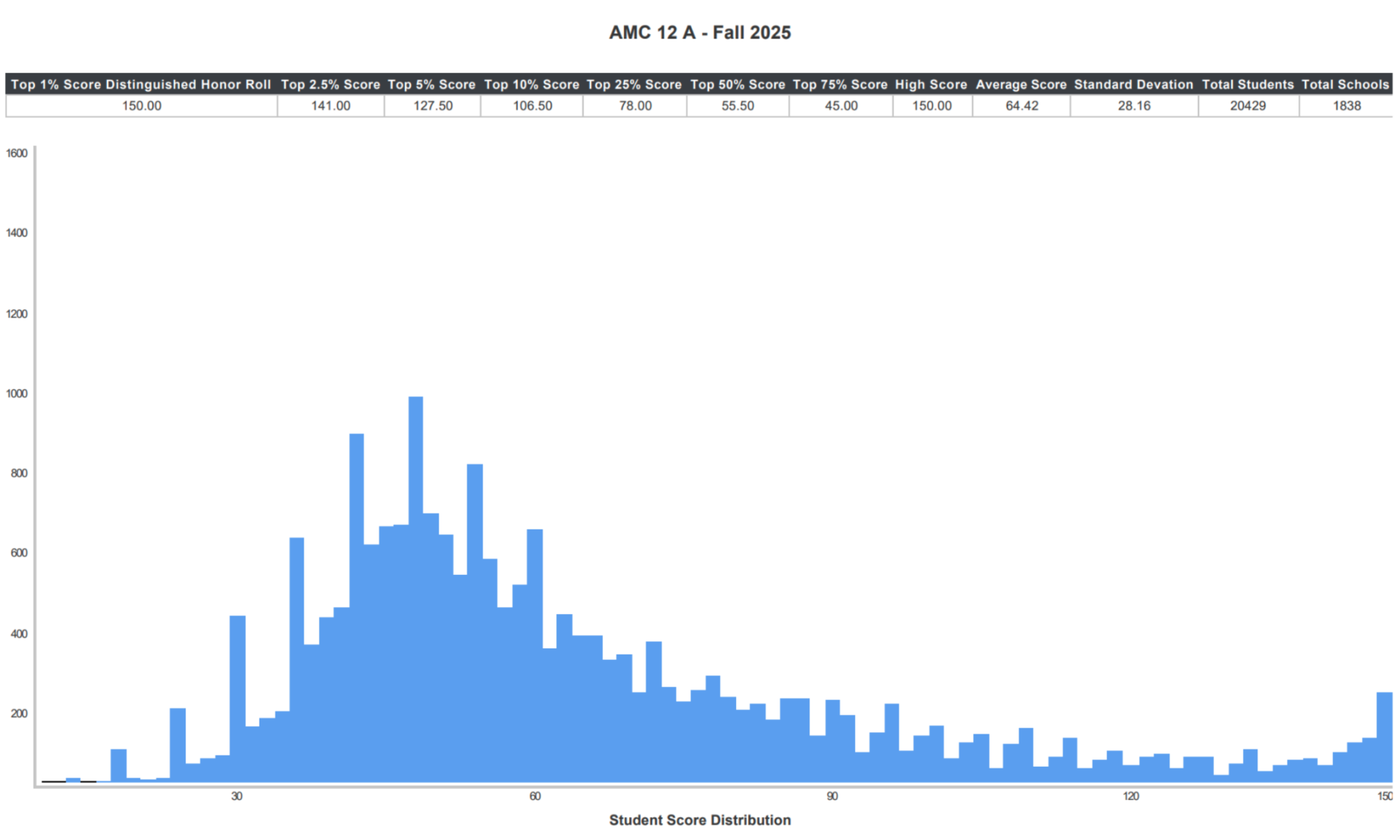
In 2025, the top 1% cutoff scores for the distinguished honor roll award on the AMC 12A and AMC 12B were 150 and 145.5 out of 150, respectively, higher than all cutoff scores in the past.
In addition to analyzing score distributions, Student A says there are online groups of students on Discord and other platforms dedicated to distributing exam leaks. Student A says they have heard rumors that these groups include students who own proctor accounts to get the tests beforehand, and international students who take the tests early and distribute the exam to test-takers in the U.S.
One way Student A hopes to prevent these incidents is by limiting testing sites to schools and trusted centers. Similarly, Manish Mishra — chief operating officer and co-founder of Random Math, a mathematics school in Cupertino — believes that the strict testing regulations he enforces at his center should be the standard nationwide. This includes transitioning all competitions to paper-only and mandating that student devices be put away during testing, instead of allowing testing centers to choose between paper and digital. He also calls for greater transparency from organizations that host the tests. This year, cutoff scores to qualify for the USA (Junior) Math
Olympiads were not publicly announced and individual scores from the F=MA exam were not released to students, leaving many confused about their scores. Additionally, for the past few years, the names of the AIME and USA(J)MO qualifiers have not been publicly released.
“Not publishing cutoff scores is pathetic to say the least — they should be published,” Mishra said. “In addition, the scores of each USA(J)MO qualifier should be published. People should know that if somebody had 150 in AMC 12 and 12 or 13 in AIME, what was the reason that they got a zero in USA(J)MO? We want to know who those students are. We want to get their names. Even if MAA publishes its intent to do that, cheating will stop to a large extent. People will not want to go to USA(J)MO and show that, ‘I was a cheater and I got a zero, right?’”
In the past, the MAA has made changes to its policies by shortening the test-taking window for the USA(J)MO in 2024 and using “human resources” and “artificial intelligence” to detect anomalies in individual scores, according to an email from the MAA. Student A believes that although MAA has taken some steps to address the cheating, it still needs to go further by further shortening the testing window. Mishra adds that he has witnessed many students lose interest in competitive math due to the lack of integrity.
“Now, I do not know the goal of the MAA,” Mishra said. “Is it to encourage mathematics in society or is it to just select the six students for the International Math Olympiad team? If their goal is just to select a few top students for IMO, then they are fulfilling their objective. But if the objective is to promote problem-solving and mathematics learning, then the integrity of the test is their responsibility.”
The MAA declined to respond to a request to comment. Sophomore Rohan Agarwal, who has participated in the AMC, AIME, F=MA, the qualifying exam for the United States Physics Olympiad, and teaches competitive math to younger students, says he has spent years since middle school studying for these exams, even working up to 15 to 20 hours a week during peak competition season. He enjoys the problem-solving nature of competitive math and how the skills built from it can apply to various scientific fields.
“It’s definitely a morale hit,” Agarwal said. “It’s demotivating to see yourself have so much experience and exposure to the competition, only to find people who’ve not spent as much — or any — time preparing and still do suspiciously well. Obviously, some people just take to it really quickly, but I’ve seen the score distributions and what they suggest makes me think a little bit more is involved.”
Agarwal acknowledges that although it may be tempting to get sucked into cheating, one should stay honest to get more out of the process of preparing for Olympiads. Mishra agrees, believing that, in the long term, honest kids will benefit much more from studying hard and developing long-term skills rather than cheating and not learning from it.
“We live in the world of AI now,” Mishra said. “Capability is important, result is not. College is not important. Your degree is not important. What you are capable of doing is important and motivated, honest students are just going to work even harder because the number of seats for honest students has shrunk.”
According to Mishra, cheating doesn’t just hurt honest students’ motivation — it’s disastrous to cheaters in the future. According to a study by researchers from Harvard University and Duke University, cheating allows many students to trick themselves into believing that they are more capable than they actually are and go through mental gymnastics to justify their actions, which damages professional and academic habits in the future.
“I know many students at MIT, and many of my students attend MIT,” Mishra said. “From them, I know a lot about what happens not only at MIT, but at many of the top universities. Those who force their way into these colleges without deserving to get there suffer. They suffer from depression, are not able to graduate and are not able to socialize properly because if you go and speak to other genius students, they will figure out who you are — you will feel isolated.”
Prestigious universities, such as MIT, place significant weight on these competitions in their admissions process. He urges that admissions committees screen cheaters by checking whether students participated in other competitions that uphold their integrity and by verifying AIME and USA(J)MO scores. Agarwal hopes that colleges put less emphasis on these competitions so cheaters don’t get an unfair advantage.
“If you’re trying to get into the math competitions, don’t let all the cheating deter you,” Agarwal said. “Just go out there, do your thing. Learn as much math and physics as you can, because doing it honestly and studying hard is going to help you in your future.”