


Craft store owners in Palo Alto look up from their stations as a quiet bell rings from their store doors. As new and familiar customers walk in, perusing folds of fabric, unique selections of yarn and piles of colorful buttons, heartwarming smiles bloom across the owners’ faces at the tight-knit community they’ve created with their love for hands-on art — one that continues to bloom amid a difficult time for small businesses.
For fabric store Needles Studio founder and owner Erika Harrington, opening a fabric store has always been about encouraging inclusivity in a field that has been limited by categorical labels — regarding gender, profession and age — throughout her life.
“When I went to high school in the 80s, girls took Home Economics, which was cooking, cleaning and textile arts, and boys took Auto Shop and Welding,” Harrington said. “It was a lane that you had to be in, and I was enraged by it as a kid. I went to the principal’s office and said, ‘I don’t think girls should have to take that class. That’s baloney.’ So, I went to the auto shop class instead and did welding, which was really fun. Ultimately, I probably would have enjoyed Home Economics. I just resented being told that that’s what I needed to take.”
As a Bay Area resident, Harrington saw an opening in the broadly tech-focused market to found a store that challenged stereotypical biases. Her goal was to give diverse, everyday people the opportunity to learn how to sew, not just the conventional older female generation or fashion students. To create a welcoming environment in her store, Harrington shares that she developed a gender-neutral curriculum with gender-objective materials such as utilitarian sewing machines and classes ranging from sewing shirts to carving wooden spoons.
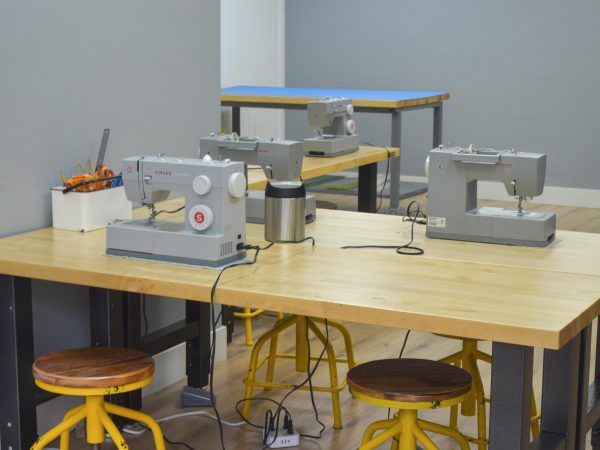
(Stella Petzova)
“A lot of times when I see beginner classes, it’s like, ‘Here’s your first class, make a skirt,’” Harrington said. “But not everybody wants to make a skirt. So I try to have our beginner class very neutral. We might sew a sunglass case or a pillowcase — something that all humans need. So it’s something that everyone can relate to and be excited about. Ultimately, when you sew something, nobody wants to sit down and spend their time sewing something that they’re not excited to create.”
Currently, with more diversified perceptions and resources for hands-on arts, the owner of yarn store Uncommon Threads Stephanie Heim shares that crafting activities — namely knitting, sewing and crocheting — have been gaining popularity among Gen Z and younger Millennials in the Bay Area. At MVHS, interest in hands-on crafts can be seen at Crochet Club meetings, where students learn new crocheting techniques while conversing every week, according to sophomore and Crochet Club officer Adeline Fam.
“I do think that the youth are becoming more involved in crocheting, but it’s still primarily considered an ‘old woman’ activity,” Fam said. “I think it’s really important to let people know that crochet is open to anybody of all ages, and of all genders — it doesn’t matter who you are, because it’s just a safe space for you to express yourself.”
Fam also shares that she sees the art form as an often overlooked but strong form of connection and expression. For club activities, Fam says that the club’s officers buy all the supplies for members and spend a whole semester going over the basics, removing the barrier to entry into textile arts.
“It forms a welcoming environment for anybody, because we want to just spread the joy of crocheting to everybody,” Fam said. “Even if you aren’t a beginner, you do get to meet beginner crocheters, and that’s really fun, because you can help teach them.”
Like the club, Heim shares that the craft stores in the Bay Area have also built a “third space” community. She defines this “third space” as a place outside of work and home, where people can connect with one another by bonding through a shared interest in crafts. In this space, individuals feel more comfortable sharing details about their lives, which helps foster the formation of a close community.
“We get to know more about their lives,” Heim said. “The reason that brings customers in is not always good. Sometimes it’s sad, but it’s still something that ties them together. Sometimes it will be that someone is having a new baby, going through chemotherapy, or celebrating a new daughter-in-law or son’s wedding. They say, ‘I need to make this thing for that life event.’ It’s really special.”
However, a rise in technological advancements and import pricing threatens the closure of craft stores like Needles Studio and Uncommon Threads. Fabric chain store Joann closed over 500 locations in the past year, including one on Stevens Creek Boulevard, due to bankruptcy. As a result of these recent changes, Uncommon Threads teacher and employee Erin Laser encourages people to continue shopping and learning at local craft stores, emphasizing the unique individuality each of these shops brings to their towns.
“I still want to foster the teaching community and the knitting community instead of just doing it all online, because it will bring people into the shop,” Laser said. “The face-to-face connections you get in-store create a community that you’re not going to get online.”
Heim agrees that locally-owned craft stores still hold their value, not only materialistically and in terms of quality and expertise, but also socially, as a place for people to come together, support one another and make new experiences as a community.
“I love that there’s so much to learn about yarn, knitting, crocheting and all that stuff, so we always have a lot of classes running,” Heim said. “I think we forget, as adults, how humbling it is to not be good at something. So in these stores, you’re kind of in a space where you have to be vulnerable, and I think it opens you up to making connections with other people. My customers say, ‘We had such a great experience. What are we doing next?’ and they come back again and again.”