


In March of 2024, the American Youth Symphony — a professional ensemble on a mission to “inspire the next generation of classical musicians” — announced that it would permanently cease further operations, attributing its closure to financial hardships. The symphony’s closure incited discourse about the state of the classical music scene: some noted that the closure was a “tragic loss” for the nation’s music community, while others called upon organizations to “adapt” to modern audiences.
Other classical music ensembles have recently closed like the American Youth Symphony, the most recent being the shuttering of the Boston Philharmonic Orchestra and its youth counterpart. The BPO’s closure has brought forth criticism about the need for classical music institutions and education, with one commenter describing classical music as a “spiritual anchor.”
Instrumental Music Director John Gilchrist says people have come to listen to classical music passively, rather than what the art form is designed to be: an immersive, active experience, especially for the performer. Gilchrist posits that one of the barriers that stands in the way for people to access classical music is the gatekeeping and elitism in the orchestral world.
 To Gilchrist, the gatekeeping stems partially from the shift the art form took in the 19th century; symphonies turned from a “place of the people” to an aristocratic experience. However, Gilchrist doesn’t believe that classical music is fading away — rather, he feels the art form is evolving. Gilchrist believes the way to keep the flame burning is for more people to learn an instrument, and while he acknowledges that mastering an instrument is a form of delayed gratification, he believes that it will allow people to “slow down and just put in the work.”
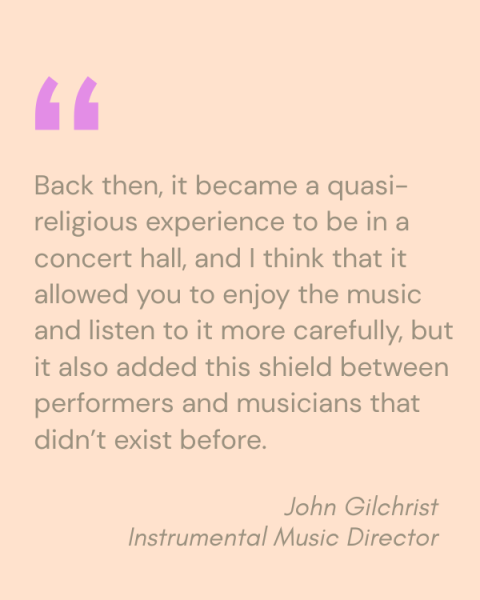
“Back then, it became a quasi-religious experience to be in a concert hall, and I think that it allowed you to enjoy the music and listen to it more carefully, but it also added this shield between performers and musicians that didn’t exist before,” Gilchrist said. “There’s a lot of people who are a little bit more conservative in their approach to classical music and they want to preserve that kind of music.”
Freshman Ryan Bao, who serves as one of the concertmasters with the Chamber Orchestra, says people are not as aware of the art form and may be less incentivized to listen to it because of its complex nature, elitist reputation or because they do not play an instrument. While Bao understands where criticism of the art form’s current standing comes from, he believes that it is part of the art form’s natural life cycle.
“My opinion is that it makes sense why the public has this opinion,” Bao said. “If I wasn’t that well researched into it and looked at it from a general standpoint, I’d probably have the same notion that classical music is fading away. But people have to realize that classical music has held on for hundreds of years, and with every art form, there’s bound to have moments where it falls short, it declines, where it faces obstacles and challenges. And I think that’s all the more reason to enjoy it and to invest in it and really partake in it.”
Chanjin Mo, who plays violin with the Chamber Orchestra, also lends credence to criticism about the standing of classical music. However, Mo says that he is focused on his role as a player and musician, rather than on outside opinions.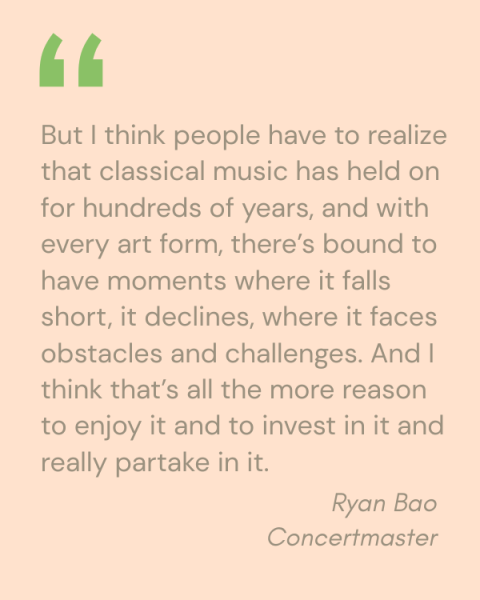
“People have a lot of different opinions, and as time goes on, people think differently, and that’s going to affect how the music is played,” Mo said. “I agree that it’s fading away, but my role is just focusing on the score itself — it’s not focusing on what other people think.”
Gilchrist feels a personal responsibility to bring more people under the umbrella of music education. As a member of the board and collaborator in regional music education organizations and conferences such as the Santa Clara Band Directors Association, Gilchrist is focused on advocating for youth to partake in music education.
Like Gilchrist, Bao has taken up advocacy to keep awareness and the momentum for classical music going. Bao encourages his family and friends to take time to support the arts through concert attendance, volunteer opportunities and donations. Bao has aspirations to help increase concert attendance and enhance the orchestra as a whole.
Mo believes that classical music is on a trajectory to succeed in the future, which he attributes to a desire from the people to enjoy human-made art in the midst of a rise of technology. Bao believes the art form will further its growth, and is excited to see how new programs, composers and more will help shape classical music. Bao hopes to prolong his participation by practicing his instrument in college, community orchestras, concert attendance and financial support through board membership.
Gilchrist says that classical music should be separated from competition with pop music, and foresees people embracing it as an active and intentional listening experience through soundtracks for movies and games, as well as a part of the human experience.
“On a societal level, we need to embrace classical music and stop trying to compete with pop music — it’s not going to work,” Gilchrist said. “A really essential part of the human experience is to perform music, and while there always needs to be a listener, I don’t think commercial music sales is the point. I think the point is to express the full depth of the human soul through our art.”