

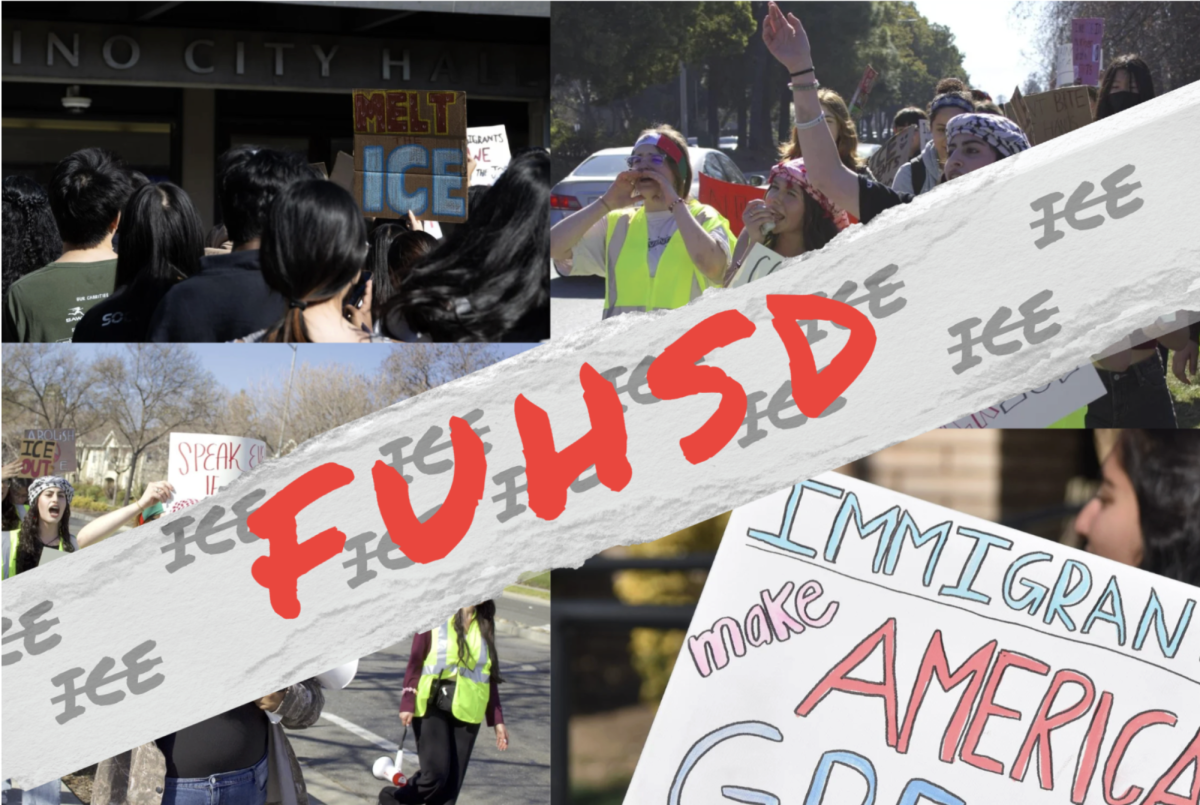
“Every city, every town, f— ICE, shut it down.”
The crowd pulsed with energy as Lynbrook High School students crammed the entrance of Cupertino City Hall, chanting slogans and waving their vibrant posters. Senior and Co-editor in chief at The Epic — LHS’s official student newspaper — Crystal Zhu felt the intensity in the air, and she clutched her camera closer to her body as students swarmed together. Zhu and her co-writer covered the student-led walkout, one of many student protests throughout FUHSD, in response to the federal government’s immigration policies and Immigration and Customs Enforcement.
During the first week of February, hundreds of students from schools including Fremont High School, Homestead High School, LHS and MVHS left campus during the school day and marched toward different local city halls. For Zhu and the rest of The Epic’s staff, the protest quickly became breaking news. She first learned about the protest through the newspaper’s internal Slack channel.
“I definitely felt a sense of pride that people were mobilizing and doing something physically for something that they feel passionate about, even if it might not directly affect our school,” Zhu said. “As soon as we found out about it, we knew that we were going to cover it.”
For FHS senior Penelope Carrasco, one of the students who helped organize the FHS walkout, the planning process began with gauging student interest. Carrasco runs an account dedicated to raising awareness on issues impacting the Hispanic community. Carrascoe got in touch with another account organizing a protest at HHS, combining the efforts between the two schools.
The goal was just to get as many students as possible, because the more students that showed up, the more attention we attracted, and the more eye-catching it would be,” Carrasco said. “It wasn’t just 100 students. It was 200 to 300 from FHS, and then 300 from HHS as well. I don’t think we could have done it without HHS.”
According to Superintendent Graham Clark, who walked to Cupertino City Hall with LHS, and to Sunnyvale City Hall with both HHS and FHS, the district took many precautions to ensure student safety during the march. Staff members from each school accompanied students during the walkout, keeping participants on sidewalks and distributing water and first-aid equipment to manage the crowd. He adds that the district also informed local law enforcement of the demonstrations, which Clark noted as a “necessary measure for student protection.” Clark, and other district officials also developed a letter for the staff of FUHSD schools, explaining that through California Senate Bill 955, students are permitted one excused absence for civic or political participation.
“Students have a right to exercise their First Amendment rights, but schools are also responsible for the safety of students during the school day,” Clark said. “We’re responsible for the safety of students on their way to school and also on the way home. Even though students are demonstrating, we’re still responsible for their safety.”
Carrasco emphasizes the need for student safety, highlighting that many immigrant students have been scared to attend school and other public places. She says the walkout was necessary to demonstrate community support to these students, especially given her own Hispanic and Filipino background.
“I have a lot of family that aren’t originally from here,” Carrasco said. “For me, the impact if my family were to be taken is what empowered me. I was scared for my own family. Seeing families being ripped apart is kind of what fueled the walkout. I couldn’t imagine myself in that situation.”
Zhu echoes Carrasco’s concerns, — adding that she is proud of LHS students for taking action beyond social media by walking out and protesting in support of immigrant students. She says that the turnout of the demonstration shows how deeply students were affected by immigration issues, emphasizing that continued student protests could have an even greater impact across FUHSD. Clark adds that the younger generation must continue to express their own opinions as political issues affect more than just adults.
“Students are the future, and each generation has to find its voice,” Clark said. “A lot of decisions that are made right now by people who are in their 40s, 50s and 60s will affect people in their 20s and in their teens for a long time. Different generations can have different views on an issue. Making sure that part of the decision-making process is how the whole community feels about something, not just maybe the generation that appears to be in power, which is the older generation, is necessary.”