



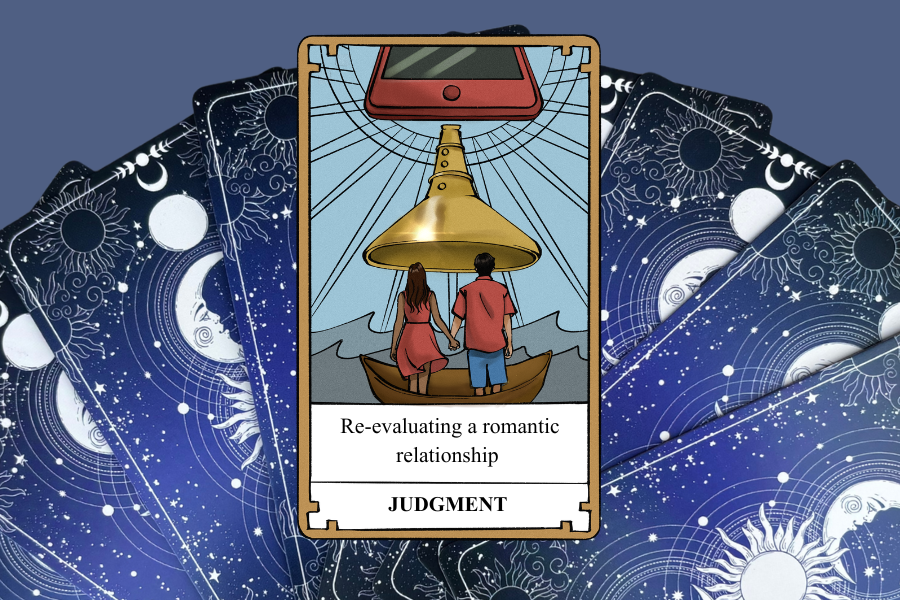
Social media platforms, notably Instagram and TikTok, have created an unspoken framework of expectations for relationships. They emerge in the form of various gifts for your partner at every minor holiday, crudely named TikTok “theories” about romance and inherently harmful perceptions about the “right way” to approach relationships. Whether it be the three-month rule, the belief that after roughly 90 days, a partner’s true intentions and compatibility emerge, or the sidewalk rule, a gesture in which a man walks on the street-facing side of the sidewalk to symbolize protection, these fleeting trends encourage performative behavior to define romantic relationships.
The rules these trends create suggest that love is measured by specific and rigid milestones or tests. The three-month rule dictates that within 90 days, a relationship either moves on to commitment or fizzles out, as the “honeymoon period” ends and “true personalities” come out. But what if some couples just click faster? What if others need a little more time to get comfortable? Not only do such ideas create a timeline for how relationships “should” go, but they often don’t account for the diversity of relationship dynamics.
Gestures like burr baskets — small trinkets, like candles, blankets, stuffed animals or candy in baskets as a Christmas gift — are often treated as a test for your partner’s love based on whether they choose gifts without having been told to, even though the desire is rarely communicated. Under the guise that having to communicate such desires presents a lack of care on the partner’s part, communication loses its importance as a key tenet of a healthy relationship.
Beyond the deterioration of communication, financial and gendered expectations create unhealthy stressors in relationships. Outdated conjectures about relationships insist that the man in the relationship must pay, or that he should conduct elaborate romantic gestures. As high school students, many of us don’t have part-time jobs or can’t obtain them, whether because of a lack of transportation or free time. The pressure to constantly pay for dates or buy random gifts might be mitigated if the teen has access to their parents’ credit card, but for many, that’s not an option. For students with a disposable income, perhaps these expectations aren’t so cumbersome, but it’s still unrealistic to expect a teenager to pay for gifts every other month.
There are many reasons a woman might pay over a man — maybe she asked him out on the date or she earns significantly more than he does — or maybe she just wants to! However, the heavy expectations and stigma around it, even on social media where the audience is mainly unemployed teenagers, make such actions feel potentially shameful or like a test.
At the center of this culture is the popular phrase “if he wanted to, he would.” In certain contexts, this captures when someone consistently ignores expressed needs or avoids accountability; inaction can indeed signal disinterest. But social media has applied it not to patterns of neglect, but to unspoken expectations, and encourages the belief that needing to communicate your expectations — as opposed to having your partner know what you want by themselves — is proof of their lack of care. People are expected to infer what to do next. What might once have been a spontaneous, personal gift becomes evidence of affection. Flashy gestures like burr baskets are no longer a way to show care, but are now seen as a way to measure one’s affection.
It’s totally fine for people to want to receive or give gifts. After all, a survey of over 7,000 respondents found that 11% of people consider gift-giving their top love language. However, the issue emerges when people feel pressured to do this, or when they believe that when their partners don’t do this, it’s a sign of indifference.
For high schoolers, this model is especially harmful. After all, we are still learning how to navigate our boundaries, needs and vulnerability. A study on the impact of social media on teens found that nearly all participants acknowledged that social media influences relationship expectations, even when they could recognize that online portrayals were unrealistic, with several noting how even being aware of the gap did not prevent comparison. Believing that asking for what we need invalidates what a “good” relationship looks like ultimately discourages honesty.
The alternative to this model is neither radical nor unromantic: communicate. Say what matters to you. Ask what matters to your partner. These discussions may feel uncomfortable, as they require admitting you don’t have everything figured out. But the awkwardness of these conversations is far better than the resentment that builds when expectations go unspoken.
Different people approach relationships differently, with different timelines and ways of showing care. We can’t hold our relationships to standards set by social media or unspoken tests. Instead, we should define them through our own, clearly communicated expectations.