

A wave of violent protests broke out in Iran’s capital, Tehran, on Dec. 28, 2025 due to the economic repression in the country. According to Al Jazeera, protesters demonstrated against the high cost of living, low-paying jobs and high unemployment rates. As the protests spread nationwide, attention also shifted towards Iranian’s lack of fundamental rights — including the freedom of religion and clothing, particularly for women — as reported by WBUR. In response to the demonstrations, the government used tear gas and arrests to suppress protests. According to the Human Rights Activists News Agency, at least 18,470 people have been arrested and 2,615 Iranian citizens have been killed during the protests.
Iran has undergone political upheavals over the past hundred years. In 1921, Reza Shah Pahlavi came into power and was later succeeded by his son, Shah Mohammed Reza Pahlavi in 1941. During his leadership, Iran was under autocratic rule, which consisted of institutions such as the SAVAK secret police, the White Revolution, which modernized Iran’s economy and excluded many sectors of the society and an alliance with the United States supporting the dictatorship of the shah. These factors led to the Iranian Revolution of 1979, which overthrew the shah, and the Islamic Republic of Iran was established and the Islamic Revolutionary Guard Corps came into power. The IRGC was led by Ruhollah Musavi Mostafavi Khomeini, also known as Ayatollah Khomeini, who stayed in power for 10 years. After his passing in 1989, Ali Hosseini Khamenei, a close follower of Khomeini, took over as the leader of Islamic Republic of Iran.
Biology teacher Pooya Hajjarian immigrated to the United States from Iran 12 years after the Iranian Revolution. According to Health and Safety International, “during this time, workers and their families faced extended periods without income.” Hajjarian said this issue continues today, and employed citizens are earning wages that do not match the cost of living, this issue has built up over several decades causing the protests to break out.
 “People are tired of what’s going on economically,” Hajjarian said. “my aunt [who lives there] was telling me that something as simple as eggs is no longer for everybody. It’s for the upper class, for the wealthy, for the affluent. People’s salaries are low. The cost of living is really high. Jobs are hard to come by, and people are finally getting to the root of it.”
Born in 1980, Hajjarian recalls growing up in the initial years of the Khomeini regime in what he calls a “phase of oppression and repression.” Gender-biased laws mandated separate schools for female and male students. In 2012, 36 universities in Iran banned 77 majors for women to pursue, according to the U.S. Department of State.
“Women did not have the same rights as men in the new regime,” Hajjarian said. “I remember my mom liked driving, but it was not normal for a woman to drive. So even when my mom drove, she would get weird looks from guys.”
Staff member A also fled Iran at the age of 17 for a better life and to avoid religious persecution for being Baha’i. The Baha’i faith was another minority religion whose people could not practice their religion and pursue a higher education due to Iranian laws. According to Human Rights Watch, they were also persecuted as they were seen as a threat to the Islamic beliefs and although the number of killings is not recorded, many were tortured and killed after the regime came into power after the regime came into power.
“I didn’t want to leave my parents and migrate and go somewhere that’s all new for a better life and education,” Staff member A said. “Baha’is are not allowed to study past 10th grade and definitely not past getting a high school diploma. They’re not allowed to go to any universities. There are no colleges.”
According to junior Tara Brumand, who is Iranian, the people were kept oppressed by the regime’s enforcement and interpretation of Islamic teachings, which has altered how people would live their day-to-day lives because of how dictatorial the implementation of these teachings were in the laws.
“The Iranian people ended up with a much worse situation under Islamic leadership and that is not to say Islamic leadership is the problem,” Brumand said. “It’s just these corrupt group of leaders that are using Islam as an excuse for keeping the people oppressed. They would kill people who didn’t agree with them. It was very violent. It was bloody.”
According to MERIP, the implementation of Islam law in the law caused many minority groups like Jews, Persians and Baha’is to flee Iran because of their fear of persecution. This has also caused increased restriction in clothing as women have to cover their entire body and men cannot wear shorts due to religious requirements.
Women outside of Iran have also been showing support for the protest on social media by taking off head coverings to express their defiance toward the mandatory hijab law in Iran. This has sparked debates among people about the possible offensive aspect of this form of protest: while some have argued it is Islamophobic, others say that this is a way to express the freedom of religion.
“I definitely don’t think the enforced hijab has been about religion,” Brumand said. “It’s always been about keeping them controlled. These women are covering themselves against their own will and many of them are not even religious, and I think taking off their hijab as a form of protest is really powerful because it’s shedding an oppressive weight that has been placed onto them against their will. I stand by the fact that people have the choice to choose whether or not they wish to cover their hair and their body.”
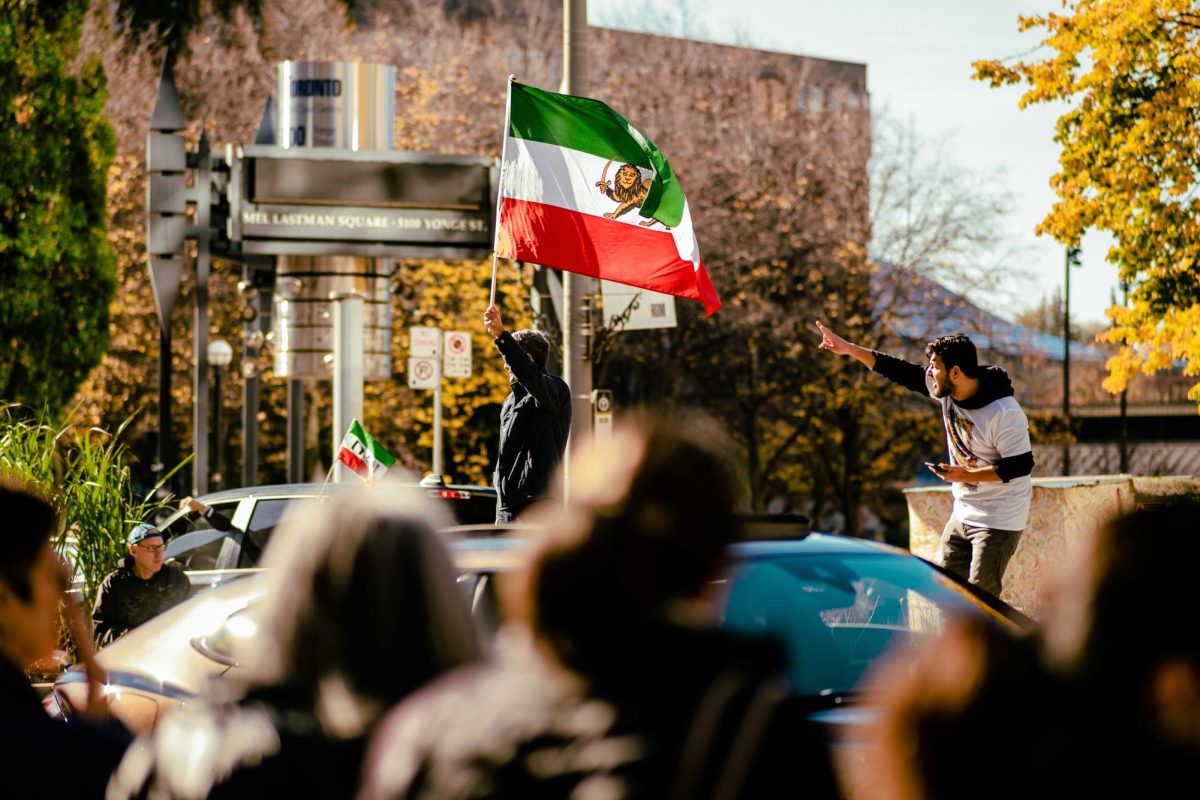
Protesters have also been using the Persian flag of the sun and the lion to represent their needs of freedom and not be tied to a religion. Persia is the former name of Iran which was changed in 1935 in the rule of Reza Shah Pahlavi to “step toward modern nation state-hood.” The use of this flag sends the message that they don’t want the current regime or the rule of the Shah; according to Iran International, over 60% of Iranians want to transition away from the Islamic Republic.
 “The current Iranian flag is green, white and red striped,” Brumand said. “And there’s an emblem: Allah in the middle. The old flag that people are using now as a symbol of resistance is a flag that has ties to Zoroastrian theology. The sun and the lion are parts of old, ancient Persian culture. The flag that they’re bringing back is their old cultural pride in being able to express themselves as they are. It’s a big ‘F you’ in the face of the people who are oppressing the Iranians under Islamic dictatorship.”
According to the Council on Foreign Relations, on Jan. 8, 2026, phone services and electricity were cut across the country, which led to massive protests. The lack of communication between family members living in the U.S. and Iran has increased due to the power services and electricity being cut, a move taken by the regime to prevent the news from gaining an international news. Brumand, Hajjarian and Staff member A have not been able to get in contact with family in Iran during the blackout which makes them fear for their safety. Despite the restrictions and enforcement measures, people have continued protesting in hopes of systematic change.
“If I had a vision for Iran, it would be a liberated country where the people who are such dreamers, such inspired bright individuals, can have the future that they dream of,” Brumand said. “They can sing in the streets, walk proudly, freely as they are, and build themselves up from the ground.”