

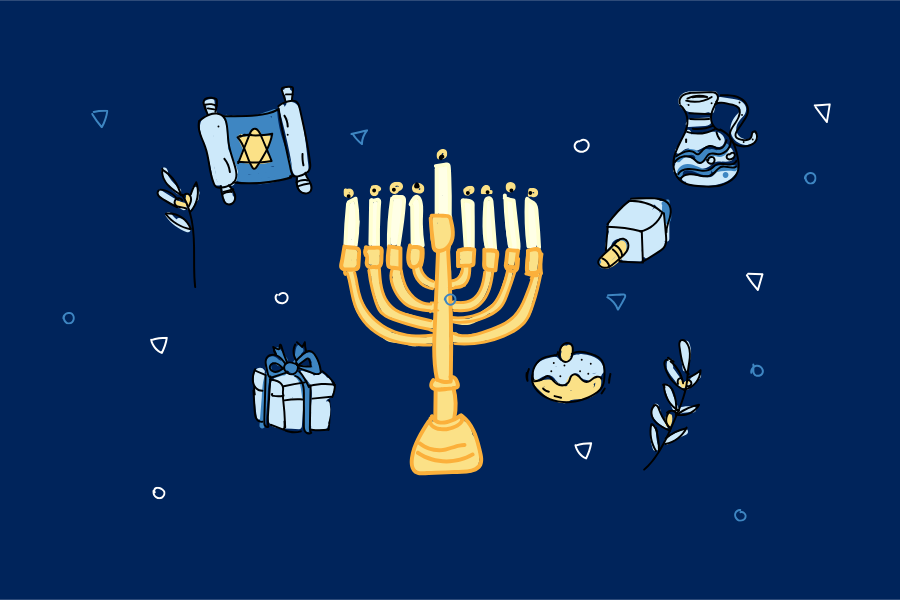
Hanukkah, the eight-day Jewish holiday that commemorates the reclaiming of the Second Temple, is celebrated on the 25 day of the Hebrew month: Kislev. The warm scent of fried latkes, a potato pancake or fritter, fills homes at dinner time, during which religious observers will light yet another candle on the hanukkiah — the eight armed menorah, a candelabrum or lampstand used specifically for Hanukkah. As the Christmas season dwindles down, the light of Hanukkah ignites, marking the beginning of a new holiday.
DAVID BIGLEMAN
Flames dance on a brand-new oil-based hanukkiah brightening art teacher David Bigleman’s home. He lights an arm on the hanukkiah for each day Hanukkah is celebrated, honoring the tradition of spreading hope and light during the darkest time of the year.
“The holiday starts from the fight to reclaim the temple, and there’s not enough oil in the temple,” Bigleman said. “The light continuing to burn — it’s like trying to keep the light burning in times of struggle in people’s lives.”
According to Bigleman, Hanukkah isn’t one of Judaism’s largest religious holidays but rather Passover or Rosh Hashanah
would be considered bigger holidays. Yet, Bigleman believes that the holiday serves as a reminder to give back to the community and focuses his observation on reflection.
On the final night of Hanukkah, Bigleman joins his community at the synagogue, where families bring their own hanukkiah to be lit together during a special service conducted by the rabbi — a Jewish spiritual leader.
“It’s just a reminder that you want to be doing something more than just for yourself,” Bigleman said. “You can have spiritual work or meditation to improve yourself, but you also want to try to do something for the world.”
SARAH FINCK
The soft crackling of a candle about to go out floats in the air as French teacher Sarah Finck watches the last of the candlelight. Finck believes Hanukkah is about helping her daughter embrace both her French and Jewish identities.
An important part of the tradition in the Finck household is opening a gift for each day of the holiday. Finck’s mother ensures that she sends something for her family to open for each day of Hanukkah and is especially involved in the process of immersing her granddaughter in Jewish customs.
Finck encourages her mother to send something that she and her family can eat. This often includes foods like maple syrup, seasoned nuts or even Hanukkah Gelt. Gelt is customarily golden coins, but now comes in the form of chocolate coins.
She is also subscribed to a program called PJ Library. The program sends books about Jewish traditions every month, with each story becoming more detailed as the years pass. According to Finck, the stories are a way for her daughter to learn about jewish traditions and festivals through stories.
They sense that if you had an age-appropriate kid’s book coming into your house every month that you can read to your kid, then your kid would be exposed to it, and the families don’t have to go out of their way to seek that,” Finck said. “Telling and retelling the story is part of the tradition as well.”
When Finck was growing up, she didn’t have PJ Library — she had her mother. Finck’s earliest memory consists of sitting in a classroom with her mother telling stories and sharing foods traditionally made during Hanukkah. Finck’s parents were from the suburbs of Chicago and Boston and Finck grew up in an area with a small Jewish population. She and her sister were the only Jews at her elementary school, which encouraged their mother to be more proactive in spreading the joy of the holiday.
“She taught us to play dreidel and brought treats and chocolate gelt,” Finck said. “She made sure that the other kids and the teacher understood that not everybody celebrates Christmas.”
IDO NIR
Dreidels spin, clash and collapse, cheered on by the excitement all around them. Students gather around a table, letting their dreidels loose to take part in the competition, a celebration of Hanukkah. The
festival is about community and tradition for Homestead High School junior Ido Nir.
Nir believes that being an active part of his community is extremely important in order to stay connected to his roots and is proactive in his involvement in Homestead High School’s Jewish club. The club celebrates and spreads its joy of Hanukkah at school through dreidel spinning competitions, which are some of Nir’s fondest memories of celebrating Hanukkah.
“It’s awesome that both the Jewish community and people who aren’t Jewish are open to celebrating Hanukkah and our traditions,” Nir said. “I think it’s really awesome that we have a school community that can really support us in traditions we uphold.”
Amongst many classic Hanukkah traditions, Nir and his family always ensure to write down resolutions for the upcoming months. While singing, spinning dreidels or spending time with friends and family are customary, this is a special family tradition passed down from his grandparents.
Since both of Nir’s parents are immigrants from Israel, he understands how hard it is to stay connected to one’s culture in a foreign country. According to Nir, the cultural differences in America make it harder to uphold traditions and celebrate festivals.
“Both my parents are from Israel, so back there, it’s very, very obvious that these traditions will be carried.” Nir said. “But here in America, it’s less obvious that everyone should celebrate every holiday. I think it’s an important thing to pass on traditions.”