



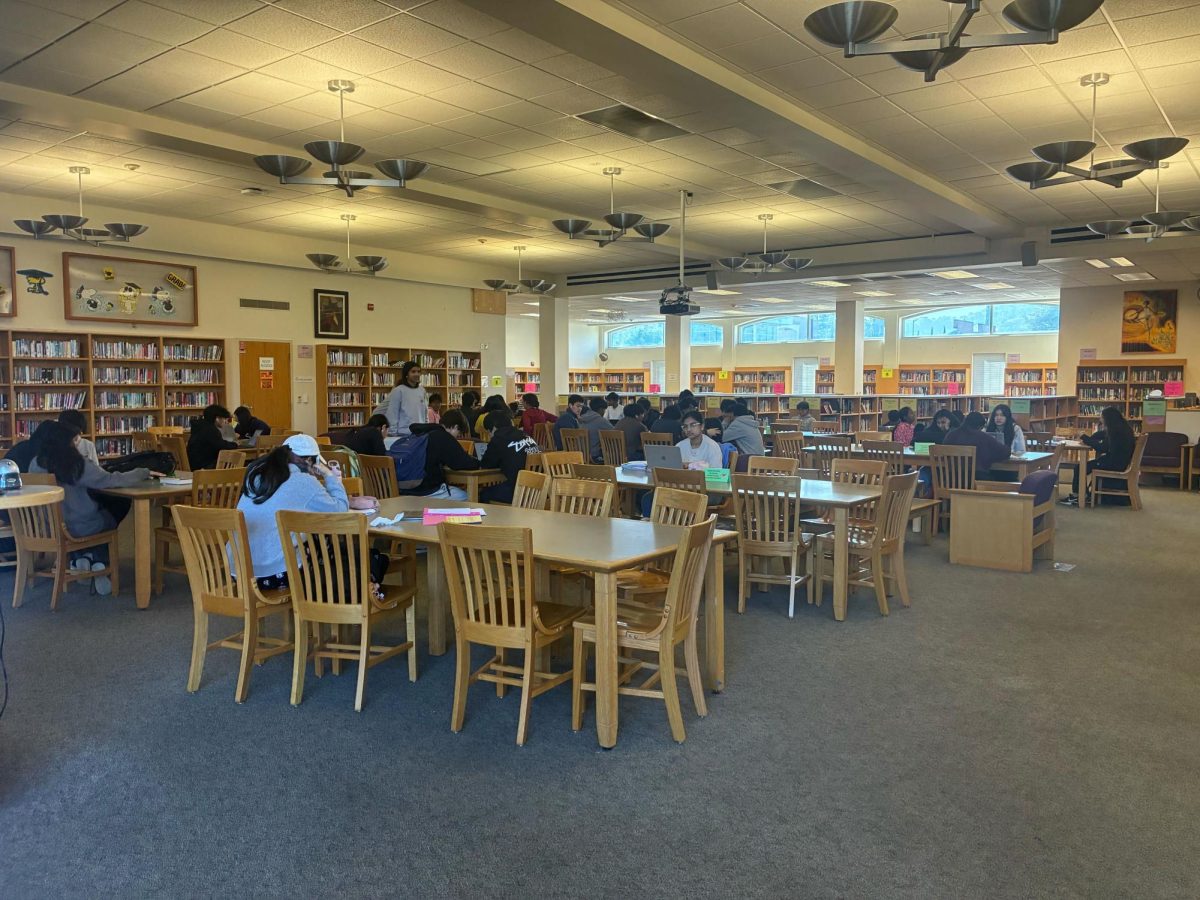
Since his freshman year, senior Tanay Kumar has been a regular visitor to the library, attending almost four times a week during tutorial to work on homework with friends. He had never thought much of using his phone occasionally to check messages or take photos to submit on Schoology — but this year, on a routine visit to the library, Kumar was caught by surprise.
“I pulled out my phone to check some of the assignments, because my laptop had died,” Kumar said. “And then one of the librarians just came and said, ‘Hey, you’re not allowed to use your phones. You have to keep that away.’ That was kind of just jarring to me, since I haven’t really seen much surveillance to that extent in the library before.”
Following the passing of the Phone-Free Schools Act and MVHS’s new ‘off and away’ policy, at the beginning of the school year, the library instated a new sign-in system at entry. Here, students can scan a QR code or use an available device to fill out a form. The form features questions, including the reason for library use, open periods and agreements to keep cell phones off and away. It also includes agreements not to bring in food or drinks, and not to game or misuse library desktop computers. This is in addition to the tickets that are distributed during times of higher occupancy, such as rainy days and tutorials, to reduce the time required to sign in.
Teacher Librarian Laura Utile and Library Media Specialist Maria Pangelina said that phones have long posed an issue in the Library. It has distracted students seeking to get work done and increased noise and crowding when students gather to play video games or use phones to socialize. They mention that this new policy has helped set the environment of the library back to the way it should be.
“We want this space designated for quiet study and collaboration,” Pangelina said. “For years we’ve noticed issues, and with the phone policy, it made sense to implement a policy and a check-in to shift this space back to what it should be like.”
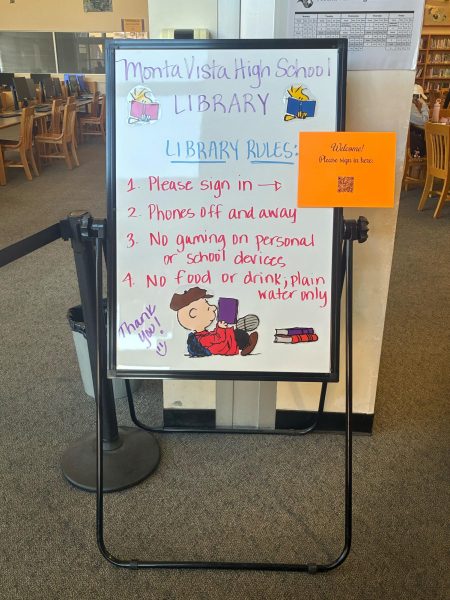
Beyond just making the library a more academic space, the librarians highlighted that the stricter system was also put in place as a response to data relating to worse mental health in teens with phone usage in schools.
“The library under our supervision is dedicated to making sure students are healthy and have a focus on what they should be doing in school,” Utile said. “To support their mental wellness, we believe that limiting their access is beneficial.”
Since implementing the new system, Utile and Pangelina said that since implementing the check-in system and limiting occupancy, they have noticed a marked positive difference in the library environment, highlighting that the issues of overcrowding, volume and device misuse are notably lessened, alongside fewer problems with trash and ants. However, Kumar points out a different perspective on the change in the library environment.
“It feels more controlled,” Kumar said. “I feel like the library used to be a lot more of an open place for people to come and study or write essays as they please. But now it feels almost like a study hall place where you have to go and sign in and just do a specific task and leave.”
He also mentions that the sign-in system has discouraged him and others from using the library, calling it over-the-top. According to Kumar, since more restrictions were placed on how many students could come in at a time, people who used to go to the library are going less often.
Kumar says he understands this shift to enforcing academic focus, especially during tutorial times and to minimize volume and distractions. However, he still believes that students should be given more trust to self-regulate their phone usage while studying.
“I feel like, as high schoolers, we can have our own autonomy in terms of choosing when we need to use our phone versus when we’re studying,” Kumar said. “Some people would study for an hour, and look at their phone for five minutes, and that’s fine.”
He also pointed out that having to fill in a check-in form with questions like “reason for library use” and asking for students’ open periods can feel invasive or like surveillance at times. However, Utile clarified that the question asking for “reason for library use” is there as a way to fulfill a requirement for the school’s WASC accreditation next year. This provides data to know where to make improvements, such as adding charging stations in the library to provide for the continuous improvements, called for by WASC’s Standard A4. Utile further adds that in an emergency, knowing who is in the library at a given time is important.
Utile and Pangelina acknowledge student reactions like Kumar’s, but Utile maintains that the policy is a net positive. According to her, the policy is simply an extension of existing guidelines for library etiquette.
“Some students are not happy with the policy, or may feel they are getting something taken away from them,” Utile said. “But we’re making an atmosphere for students to do what they really need to focus on in the library: studying. We’re not taking the right to use the phone. If a student needs to do it, they can also use the Student Union instead. It’s always been a policy and an expectation not to use the cellphone in the library.”