

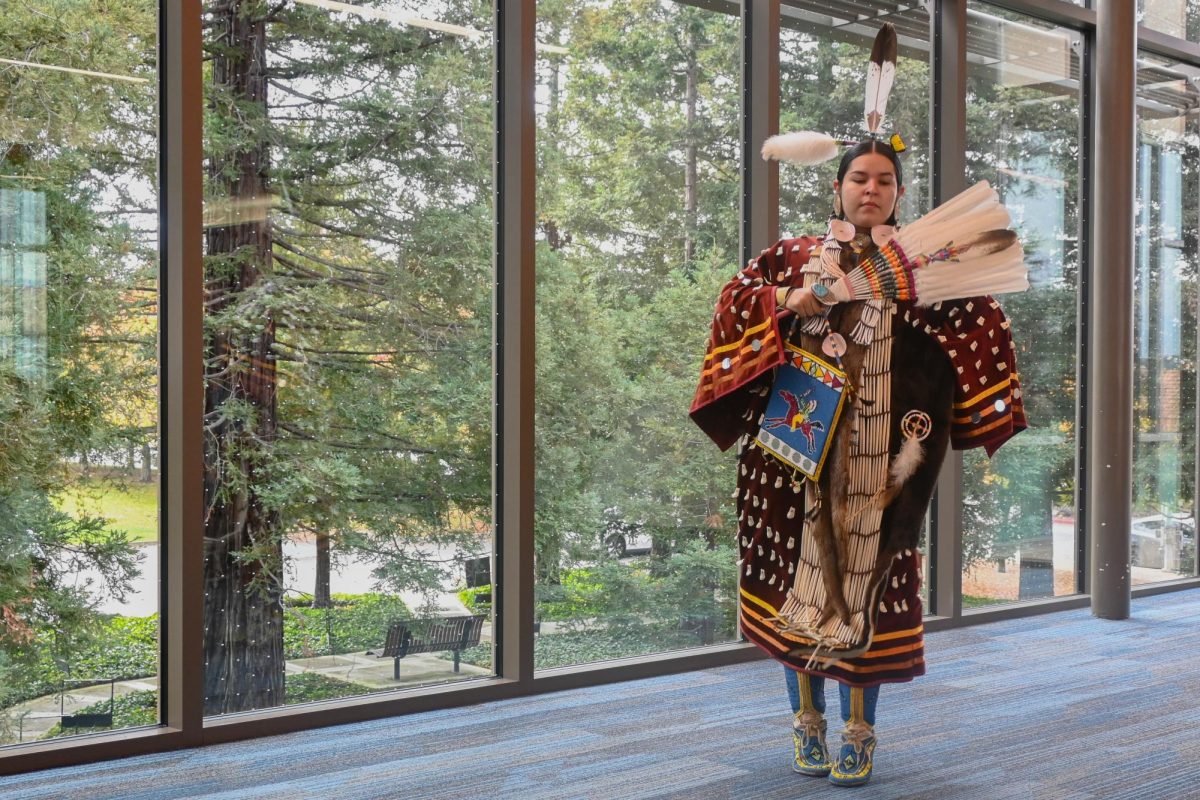
The Cupertino Library hosted the Native American Song and Dance Celebration on Sunday, Nov. 23, from 11 a.m. to 12 p.m. The event featured the cultural dances of multiple Native American tribes, performed by Neela Samayoa and Naataanii Montalbo. Samayoa showcased the Women’s Northern Traditional dance, which is performed while waiting for warriors to return from battle, while Montalbo performed the Jingle dance, done to foster healing. They danced to traditional music that featured Jake Miller, Montablo’s stepdad from the Northern Plains, on vocals accompanied by a buffalo hide drum.
Unlike most dancers from Samayoa’s tribe who start dancing as early as when they start walking, she began her dance journey when she was 13 years old. She explains that in Native American culture, dancers need their families to formally introduce them to the dance community: an event known as a dancer’s coming out. Samayoa had her coming out at the age of 16, when she had the revelation that dance was a major component of her identity that had been missing her whole life.
“You go your whole life without doing something, and then when you do it for the first time you’re like, ‘Oh my god, I need to do this every day, every hour, every minute and every waking second,’” Samayoa said. “It truly is a different feeling when you dance, because it’s almost like an out-of-body experience. You feel like no matter where you are, no matter what style you’re dancing, no matter where you’re dancing, you’ll always be home because you have that with you.”
Traditional Native American dances from different tribes are often performed at powwows, in which members of all tribes come together to celebrate their culture, showcasing their respective dance and music styles and talents. Locally, powwows are held at Stanford University and West Valley College, and Montalbo’s mom, dancer Anecita Miller from the Navajo tribe, grew up attending one that used to occur at De Anza College. As a dancer, Anecita explains that before powwows in which dancers from different tribes competed, there was a competition between the dancer and the drum.
“It’s a beautiful thing to see,” Anecita said. “Sometimes we get a little off beat, or maybe we miss a stop. That’s the connection with the drum. Who can out-dance or out-sing one another? We’re really trying to see who’s going to win when we have more competitive styles.”
Anecita bought her husband, Jake, the featured buffalo drum during a powwow they had attended together in their youth. At the powwow, traditional drums made from various animal hides were on display, each producing distinct sounds. According to Jake, the drum is a well-respected instrument and an integral part of Native American culture. Traditionally, aspiring drummers like Jake needed to ask respected musicians in the community to recognize them as someone who had the right to play the drum, similar to a dancer’s coming out. Jake, in particular, felt a calling to the drum from the age of 7, which motivated him to continue working toward his aspirations regardless of setbacks from prominent older men of stature.
“It was just a natural, gravitational pull to the drum,” Jake said. “And then beyond that, it was a deep passion or desire to be good at singing. Later on, I found out there were competitions with a lot of prestige. It’s family representation, it’s tribal representation for your nations or your community or your different areas. It’s so much that involves being a champion. So from that, motivation just pushed me to try to be the best.”
Jake explains that Native Americans use the distinguishable sound to create energy as a form of celebration. Anecita adds that the drum also represents the joined heartbeat of the nation. After Jake had performed a song, she explained to the audience that if they checked their Fitbits for their heartbeat, they would be synchronized.
“As long as we have our songs and our drums, then we will remain strong as people,” Anecita said. “And when that drum is shared with us, then we are all in unison, and we are all able to be in sync and our hearts will beat as one.”
Anecita and her family frequently share their culture at events like these. Both Anecita and Samayoa work at the Indian Health Center of Santa Clara Valley, where they foster a tight-knit community with other Native Americans in the Bay Area. Samayoa says that whenever there is an event at which either of them is asked to present, they often invite the other to share more information and personal experiences related to their cultures.
For Jake, it’s important to teach others about his culture because of the misconceptions and misrepresentations of authentic Native American ways and art. He says that people often ask him if he “is a real Native American” or if he “has to pay taxes like everyone else.” Anecita agrees, stating that schools need to do a better job of teaching students the true history of America. She explains that from her experience, people have this misconception that Native Americans don’t exist anymore, even in educational settings. She adds that there is a large community of Native Americans who represent survivors of genocide, and the fact that they’re still thriving and carrying on tradition speaks to their resilience. Samayoa agrees, stating that people fail to realize that the only difference between her and other Americans is that her family performs traditional Native American songs and dances together on the weekends.
“We are still here,” Samayoa said. “I’ve heard so many times, ‘I thought you guys went extinct. I thought Natives weren’t real, I thought they wiped you guys out.’ No, we’re normal everyday people walking amongst you in the library or the grocery store. It’s important that we get the correct history out there. We’re not looking for pity or handouts of ‘Oh, look what happened to the poor little Indians.’ It’s just knowledge that needs to be corrected.”