

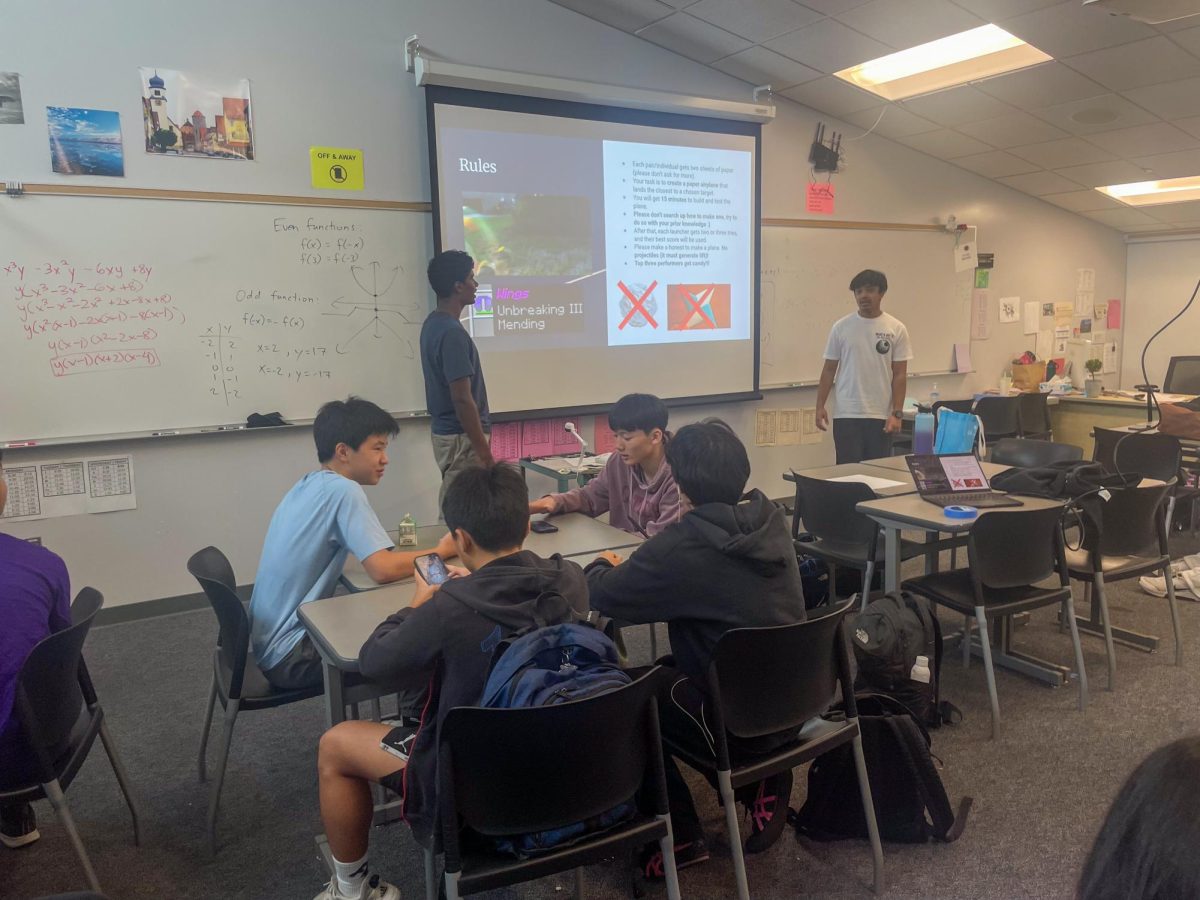
Aerodynamic paper aircrafts zoom across the room as sophomore Krish Vimalkumar carefully steps aside to avoid their path. As co-president of the Aerospace Engineering Club, Vimalkumar has experimented with different methods of teaching complex rocketry concepts in ways that welcome students regardless of their past experience.
When he initially founded the club, Vimalkumar didn’t have much experience in aerospace engineering. But as a physics enthusiast, Vimalkumar was interested in starting the club to give people the opportunity to learn about what he believed was a distant topic. He felt the club was necessary to fill a gap among the many STEM clubs that already existed at MVHS. Turning that vision into a reality, however, wasn’t simple. The club, now in its second year, started during the second semester of the 2024-25 school year, meeting every Friday at lunch in room E202.
“We faced a good number of challenges when we were first starting the club,” Vimalkumar said. “It was difficult to get enough people interested in our club, so we had to take some time and talk to different people.”
Another challenge Vimalkumar faced while creating the club was finding an advisor. Eventually, Vimalkumar approached his Java teacher, Terry Yu, to request he be the advisor. Yu agreed and has hosted the club in his classroom since its founding.
“They don’t really expect me to do anything,” Yu said. “I just provide them a room, and very rarely, when I can help them, I try to help with advice on where to buy stuff. But in terms of aerospace, I think most of them know more than I do, anyway.”
To keep the weekly meetings interesting, the club follows a structured format that balances education with engagement. Although rocketry requires a deep understanding of many complex topics such as physics, aerodynamics and structural engineering, the club aims to teach these in the most entertaining way possible.
“Generally, we start off with an overview of what we will be discussing in the club,” Vimalkumar said. “If we’re talking about just theory that day, we’ll get right into the information, but we will usually have some kind of quiz at the end to help people retain information. We also frequently have activities where we have different things planned to allow people to get some hands-on experience.”
According to Vimalkumar, even though the club’s structured meeting schedule keeps things engaging, there are still limitations to what they can do. Many people might expect an aerospace engineering club to be launching rockets, but due to safety concerns, extensive paperwork requirements and a lack of locations to launch rockets nearby Cupertino, the club has had to adapt to a more theoretical approach.
“Instead of doing actual launches, we provide a lot of theory and information regarding rockets and the physics behind them,” Vimalkumar said. “But we also do fun activities which help people gain some physical experience with handling the things you will need to build rockets in the future.”
Sophomore Derek Li joined the club this year, captivated by the subject matter and the competitive aspect of the club — such as the occasional Kahoots and other competitions. Li says he is not only interested in learning more about aerospace engineering, but he’s also interested in being more involved with the club in the future.
“I decided to join because it’s a new club and there are opportunities for me to become an officer,” Li said. “I like engineering and building things, and I also have a lot of experience with coding, which is going to help me.”
In the future, Vimalkumar and his team have ambitious goals for the club. Beyond simply maintaining their membership, they plan to expand their leadership and enhance the club experience for members. Currently, roughly 15 students, including officers, attend each meeting, though the attendance is flexible and the club remains open to anyone interested in joining. They are determined to continue growing the club to give more students the opportunity to learn about aerospace engineering.
“I don’t think there’s a requirement to join,” Yu said. “Anyone who is interested in either working on aerospace engineering, learning more about it, or even if they just like Elon Musk or SpaceX, can join.”
Despite the club’s hospitality, it still struggles with maintaining membership from upperclassmen. Vimalkumar and Yu both recognize this pattern and believe it has to do with their current officer team being composed of sophomores.
“For our club, most of our members are either sophomores or freshmen,” Vimalkumar said. “I feel that this is because not a lot of seniors or juniors know about our club. So by word of mouth, a lot more sophomores and freshmen know about our club. But I also feel that for most clubs, you find it hard to find seniors who actually come to the meetings, because a lot of them are done with their college apps and already got all of their extracurriculars.”
Though the club struggles with maintaining a diverse membership, Yu has observed positive things about how the club’s performance has improved this year compared to last year. He notes that not only has the membership grown, but it has also stabilized, indicating that the club has finally found its footing among the clubs at MVHS.
Rather than viewing the demographic as a limitation, Vimalkumar sees it as an opportunity to introduce younger students to aerospace engineering and allow them to explore their interests. Ultimately, the club’s mission remains the same: take a subject that feels distant to most and make it approachable for curious students.
“A lot of people are like, ‘Oh, wow. I wonder how they build rockets?’” Vimalkumar said. “But a lot of them are scared of the topic because it might seem intimidating. I feel that that’s what sets this club apart from other clubs. For them, I feel that aerospace engineering might be something interesting that they might want to try.”