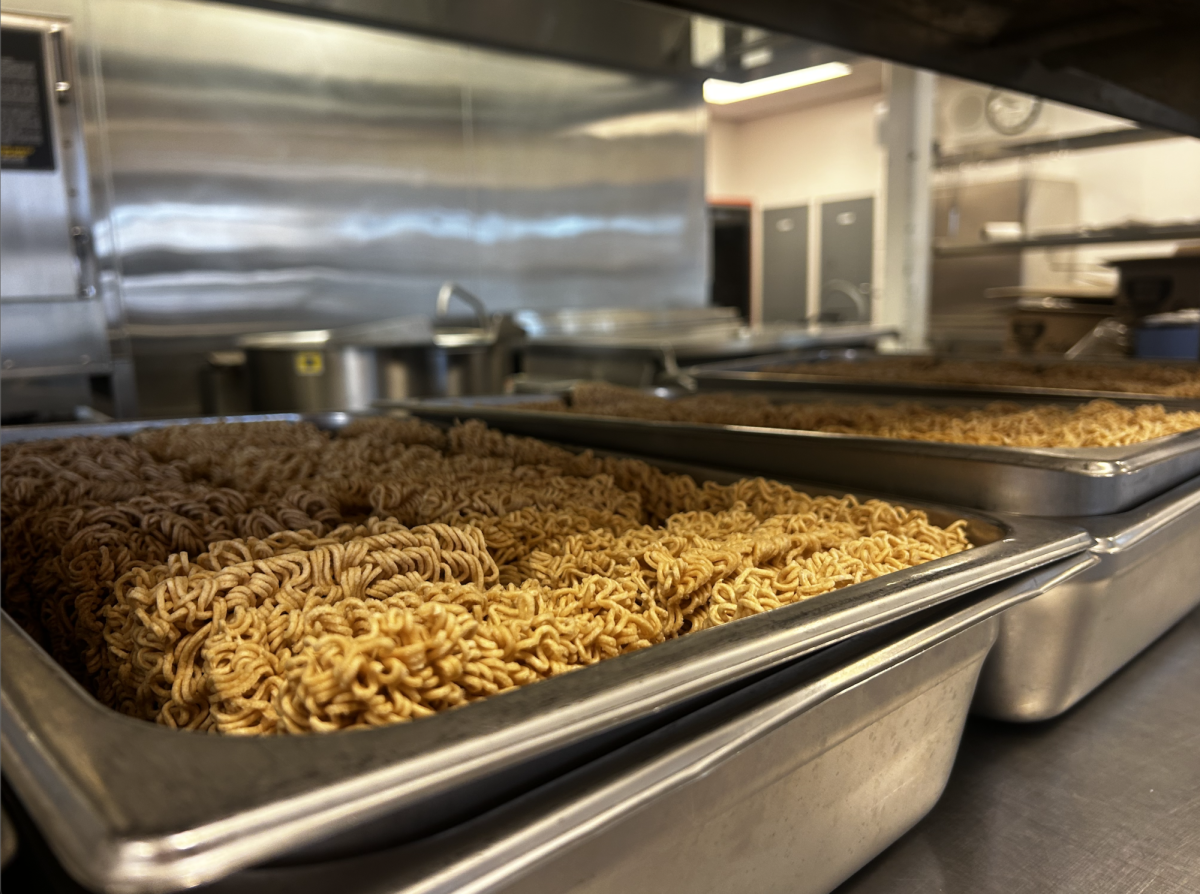



Upon stepping into the kitchen every morning, Edgar Rodriguez is greeted by smiling student workers and the aromatic scent of fresh food. When he chats and shares laughs with the students, the momentarily lighthearted ambience of the kitchen is a stark juxtaposition to its normal hecticness, making the task of preparing the day’s food seem less of a chore. When the brunch bell rings, Rodriguez stations himself at the far right scanner, waiting to scan the IDs of the hundreds of students who file through the cafeteria every day.
As MVHS’ food services manager for four and a half years, Rodriguez ensures that the kitchen runs smoothly to produce enough food to serve the student body every day. He’s a member of the FUHSD Nutrition Board, which aims to run a food service program that complies with regulations but also maximizes student enjoyment of cafeteria food. To prepare meals for students, he works closely with Divya Puri, the FUHSD nutrition services manager of five years, and other staff members. Together, they recently revised the menu and will continue adjusting it each semester to meet student needs.
“I wouldn’t say the Board itself was involved in making these changes,” Rodriguez said. “It’s more Divya herself wanting to make sure that there’s choices for everybody. That includes people who have Celiac disease, so we have a lot of gluten-free, vegetarian and vegan items. We just make sure that there’s choices out there for everybody.”
Puri, a registered dietitian, drove this year’s menu changes in hopes of increasing student engagement with cafeteria food, especially those with dietary restrictions. But one challenge the Board faces is not knowing how many students will need these meals. This makes it difficult to prepare enough to feed everyone without wasting the excess.
 “The last person may only get two choices, so that may not be the choice they want,” Puri said. “That’s a little frustrating, because there’s no winning. We can’t expect every child to be happy, and no matter how much we try, there’s always going to be some dissatisfaction.”
Puri has devoted herself to working with students to provide them with food that they will enjoy. To do this, she collaborates with district-wide representatives on the FUHSD Nutrition Services Student Committee, which conducts surveys and samplings to collect student feedback on cafeteria food. Junior and MVHS representative to the NSSC Aadhya Gupta has vitiligo, which causes restrictions in her diet. She advocates heavily for allergen-free food and believes this year’s menu is a big improvement from last year’s in terms of inclusivity.
“It’s really cool that I have a voice in what goes on because the food is a really big part of the school that almost every student here eats,” Gupta said. “And it’s a pretty cool thing that I’m contributing and making it better and setting out some menu items there.”
Currently, the Board and NSSC are testing how appealing the menu is based on how often each food is being selected by students. Based on this data, they will tweak the menu to fit the demands of the student body. This process can’t be completed overnight; for example, having the new menu ready by October means beginning to plan six months ahead in April. Part of the reason they plan so far in advance is attributed to the recent merging of the district’s vendors, Gold Star and Danielson.
“Those items that I used to order for the week, I now have to order three weeks ahead of time,” Rodriguez said. “I have to be very organized with my deliveries, or else I don’t get the food.”
One such scenario has already occurred, and Puri stepped in to bring a truckload of 150 to 200 cases of chicken to FUHSD sites. Even though the occasional missed deliveries from vendors causes stress for Puri, she notes that the implementation of California’s state meal mandate has drastically helped her achieve her goals of ensuring that every student has access to food. Funding decreased following the change in federal administration, so the district has relied on state funding for support in recent years.
“This year will be supported by the district funding,” Puri said. “Student participation has increased a whole lot, and in some ways, that’s helped academically, too, because students don’t have to leave campus for food or have to worry about where their meal is coming from. It’s changed a whole lot, but it’s a good change, as far as needing to feed the students goes.” 
Ultimately, Rodriguez, Puri and Gupta all recognize the common perception that cafeteria food is unhealthy or unappetizing. Puri believes that students’ dissatisfaction with the program stems from a lack of awareness of the program’s efforts, as they may not realize how much effort the Board and NSSC put into providing healthy, organic and locally sourced meals for the district.
“It’s not as easy as they think it is; it’s very complicated,” Rodriguez said. “Students need to understand that we do what we can with the parameters that are given to us. I understand that students want all this delicious food, but we are very tightly managed by the state, and we can’t give you guys everything that you want.”