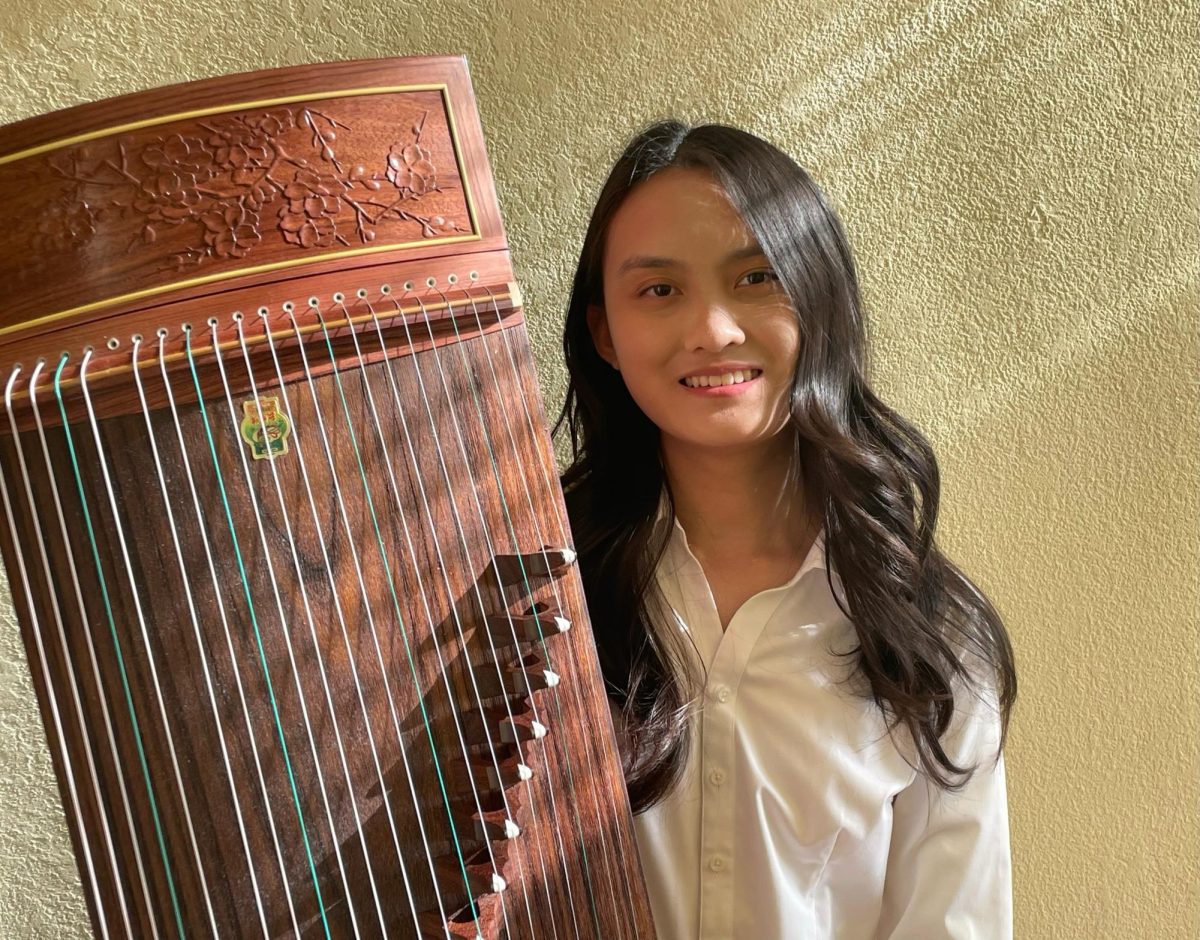



Belinda Olson
Within the familial environment of the MVHS counseling team, Olson has found inspiration in her female co-workers. She recalls that although she didn’t have many female friends when she was younger, she began to form meaningful connections with her female colleagues when she became a working mother. She particularly admires their ability to balance their personal and professional lives.
“There are so many women who work at MVHS that I see are killing it in the workplace and in so many other facets,” Olson said. “Their ability to switch and prioritize from their personal life to their work while not losing a sense of themselves is inspiring to me. It helps me understand that it’s not a struggle to choose either my personal life or work. There’s a sense of community and camaraderie.”
Olson adds that the counseling team has also inspired her to grow through learning new counseling strategies from her peers. She notes that MVHS counselor Sylvia Lam serves as a role model for her in terms of presenting and communicating with parents, at events like parent night.
Olson says that after her transfer from Cupertino High School, where she worked for 15 years, to MVHS, the counselors were very accommodating. This openness allowed her to understand her co-workers’ personalities and work habits within the first year, enabling them to work effectively together. Olson adds that although initially she was afraid of becoming an obstacle in the team’s pre-existing flow of work, they actively helped her integrate.
“I really appreciate how intentional this team has been with being really gracious,” Olson said. “With learning different practices, and not saying stuff like ‘You’re with us now, you have to do it our way.’ Also involving me when they sense that I am not so comfortable with inserting myself. For example, if I didn’t want to be the kink in the system since it runs so smoothly. I appreciate them being gentle and still embracing and welcoming me; that’s been really critical.”
Olson highlights that seeing her female colleagues being successful in their jobs reflects how much women have progressed in factors such as opportunities and women rights. But she also believes it is crucial to discuss with female students the struggles they could face outside of Silicon Valley, as women only make up 35% of the workforce in STEM fields. She explains that areas such as these can be improved on and Women’s History Month helps people think about that.
“I think that any kind of celebration of a group is an amazing thing,” Olson said. “For women, it’s been quite a journey, from my grandmother’s generation to my mother’s to now mine, it’s been a lot of progress. This allows us to be really intentional and reflect on the progress. Also, it helps us think about what progress we’ve already achieved, and where else we need to go.”
Shozo Shimazaki
The vast expanse of ice at Glacier National Park stretches for miles, as English teacher Shozo Shimazaki gazes at the never-ending mountains with his 97-year-old mother, Michio Shimazaki. She has loved nature since she was a young child, whether by looking at the picturesque fields of flowers in Japan, or more recently, hiking with her children.
Shimazaki reflects that his mother’s love for wildflowers mirrors how she lives — finding peace in simplicity, shielding him and his siblings from his father’s temperament, and always putting her children first. He also mentions that at times, he would come home late, but instead of being mad, she would care about his well-being and safety. He says that moments like these stood out to him, as it showed that she not only trusted him, but she also understood his perspective, and that allowed him to build a deeper connection with his mom.
“I’m always amazed at how my mom never judged my actions and never criticized me about things that I did,” Shimazaki said. “Thinking back, I now realize that she was super patient and accepting. Over time, that molded me into the person I am now. You don’t find many people like that, and it makes me appreciate her more.”
Shimazaki’s mother had a difficult childhood as she grew up in Japan during World War II before moving to the United States. Specifically, he recalls a story that she told him about bombers dropping leaflets on the ground, and her mind not being able to comprehend what they were, and even almost playing with them. Despite this, Shimazaki admires how his mother has always maintained her humanity, staying positive and being flexible about whatever situation she was in.
“My mother always giggled at things,” Shimazaki said. “I remember when I was a teenager, I thought to myself, ‘If something embarrassing or something bad occurred, why would you giggle?’ But then, I realized that she knew that sometimes things were out of her control, and bad things do happen. So then she realized, she didn’t have to take it too hard, and just giggle it off as a natural reaction.”
Shimazaki believes that mothers need to be more widely recognized. He considers Women’s History Month an important month of recognition for half of the population that he says don’t always get the credit they deserve.
“If you look at my dad and his professional achievements, he would stand out much more,” Shimazaki said. “As a result, she could be easily overlooked and forgotten, as if all she did was stay at home and raise the kids. But I think that was an enormous contribution, and in many ways I respect her even more than the professional achievements of my dad.”
Now, Shimazaki takes his mom’s influence into his own teaching. He shares that as a teacher, he tries to approach every situation with empathy and patience, understanding that students can make mistakes.
“I’ve learned that there is a bigger picture to every student that goes beyond just what’s happening on one day, or how they react to one situation,” Shimazaki said. “The person my mom is has allowed me to reflect on these situations, and change for the better.”
Josh Kuo
Pre-Calculus and AP Statistics teacher Josh Kuo, then 17, sat in the warm office of the School Registrar, Mary Lou, eating his microwaved lunch and drinking the free soda that she gave him. After immigrating to America from Taiwan just a few weeks before, Kuo recalls that she helped him get accustomed to his new school, Willow Glen High School. Furthermore, she was a big factor in his ability to graduate, helping him navigate the high school state exam requirements, and giving him the confidence to connect with new people.
“She was very warm and taught me a lot of things about how to interact with other people, and how to look and listen to people,” Kuo said. “She had a lot of understanding and was just very accepting with a very warm personality.”
Kuo adds that she inspired his perspective when teaching MVHS students. He explains that due to his experience with her, he always tries to make sure every student is taken care of by making sure they know what they’re doing and are set up for success. Kuo shares that he tries to do this in a supportive way rather than a disciplined way, just like Lou. He believes that if others adopt Lou’s philosophy and actions of always acting with care to everyone , it will help them become successful.
“No matter what your background is, you have to come in with an open mind,” Kuo said. “When it comes to people, give them a chance and always build good, genuine connections; it will go a long way.”
Kuo believes that people continuing to advocate for women’s rights is crucial, as although he thinks society is heading towards equality, there is still inequality left to overcome in terms of people’s mentality. He explains that although people realize that they should not be prejudiced to others, they are often not able to overcome that unconsciously, and treat everyone equally, like Lou did for him.
“Overall, thinking about Women’s History Month reminded me a lot of Lou,” Kuo said. “I honestly don’t know if she’s still living right now, because it’s been a while. When I invited her to my wedding, which was almost 10 years ago, she was already sick, so who knows? Maybe I’ll give her a call.”