




Every autumn, MVHS seniors join a wave of more than 1 million adolescents nationwide in the intense fight to apply for and enroll at the universities of their choice. For each school, selecting a strategic decision plan has become increasingly important, as each avenue — early decision, early action, restricted early action and regular decision — provides different timelines, conditions and benefits.
Early decision, a singular binding application, becomes a crucial tool for many seniors gunning for elite colleges, as it offers higher acceptance rates in return for the student’s guaranteed enrollment at the school if accepted. Early action applications, however, are non-binding, functioning largely the same as regular decision applications except for earlier timelines on deadlines and results.
Senior Megan Yang recalls her experience with choosing decision plans being especially turbulent. Because Yang chose to apply for business-aligned majors like accounting and finance, she mainly considered ED for elite business schools: first to New York University’s Stern School of Business, which she later changed to Wharton School of Business at the University of Pennsylvania because its program was higher-ranked than Stern’s. After being faced with logistical issues surrounding teacher letters of recommendation, she was unable to submit ED to Wharton, shifting once again to the Marshall School of Business at the University of Southern California before being deterred by its expensive tuition and ultimately choosing not to pursue ED at all.
Yang instead submitted several non-binding EA applications, mostly to public out-of-state schools like Purdue University, the University of Virginia and the University of North Carolina at Chapel Hill. She says that while EA didn’t necessarily give her the same boost in acceptance rate as ED would, the opportunity to receive her decisions earlier still gave her peace of mind, especially after receiving many acceptances.
“I wanted those few months of feeling free and secure,” Yang said. “My EA schools were schools that I had an OK chance of getting in anyway, so I thought I might as well get that earlier on.”
Conversely, senior Carolyne Chiang was able to submit a successful ED application to Carnegie Mellon University. Because Chiang hopes to pursue interdisciplinary programs in soft technologies where she can use her artistic skills in conjunction with engineering, she decided to apply after researching many universities and finding that CMU had the most comprehensive bridge between art and mechanical engineering.
Chiang notes that receiving an ED acceptance relieved the pressure of both finishing tedious applications for regular decision schools and deciding what college to go to later. However, she still thinks ED has some drawbacks, namely the lack of options to fall back on if one gets rescinded. In general, Chiang believes that everyone should apply EA if they have the time, in order to get ahead of the admissions process, but she thinks students should only pursue ED with thorough consideration beforehand.
“Only apply ED if you had the conversation with your family and they’re truly OK with you applying to that school,” Chiang said. “My mom wanted me to stay in California, and she didn’t fully believe that I would get in. But when I did, she started realizing that I’m going to be an entire five-hour flight away for the next four years.”
Considering the restrictions that come with being an ED applicant, Chiang tries to stay practical. Regular college applications are full of logistical deliberations — over tuition, transportation, housing, culture, academics and size, among others. ED exacerbates these issues, because once a student is accepted ED, they generally have no choice but to work around any issues that arise. Weighing tuition and financial aid, especially, was a crucial part of how Yang approached her ED considerations.
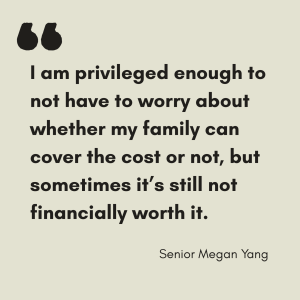
“I am privileged enough to not have to worry about whether my family can cover the cost or not, but sometimes it’s still not financially worth it,” Yang said. “For example, USC is so expensive, and their business program is strong, but I’d be paying so much for education that I could probably get at a different, cheaper school.”
ED admissions in top colleges have been criticized for unfairly favoring wealthy students. Although ED plans offer boons like higher acceptance rates and fast results, low-income families are disincentivized from applying ED, since ED requires applicants to commit to attending the school without knowing how much financial aid they’ll receive and without negotiation leverage from better financial aid offers elsewhere. Recently, a group of former students sued 32 elite colleges in a class-action lawsuit that accused them of “entrenching patterns of inequality of access while inflating the price of attendance.” Yang corroborates this reasoning, explaining that ED admits often receive the least generous aid packages because schools don’t need to incentivize them to enroll.
Trinity University, a liberal arts college nestled in San Antonio, Texas, has found a way to circumvent many of the affordability problems that usually surround ED. Assistant Director of Admissions Sarah Yaccino says that in order to secure yield, Trinity is especially aggressive with its two ED plans, and on average, ED applicants (which make up approximately a quarter of each incoming class) are around four times as likely to be accepted as regular decision applicants.
Because Trinity is a small private school, it has the bandwidth to provide each ED applicant with a complete financial aid package estimate before they submit their applications. This estimate includes both need-based and merit-based scholarships, which allows prospective students to know the financial commitment that they’re making before settling on ED or backing out, if necessary. Because of the financial aid predictions Trinity offers, its ED commits rarely have to withdraw after the fact for financial reasons, a phenomenon that Yaccino calls “melting.”

“Implementing all of our financial aid tools is really the right and ethical thing to do,” Yaccino said. “Especially for our more vulnerable populations, where a difference of $5,000 will have a really big impact on a student’s family, we can do the right thing by providing and honoring that offer. It’s not even a ballpark — we will honor that prediction to a T.”
Despite widespread pushback on its alleged classism and corruption, the ED model is likely here to stay. Many elite colleges have adopted ED options, and several schools — including the University of Chicago, Tulane University and Northeastern University among others — now bring in almost all of their incoming classes through ED rounds. So, it remains a powerful avenue for seniors to get a leg up on their most anticipated colleges’ applications and acceptances.
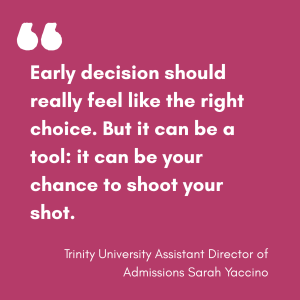
“Students should never feel pressured into ED,” Yaccino said. “It should really feel like the right choice. But it can be a tool: it can be your chance to shoot your shot, especially if you’re looking at highly selective institutions that fill the majority of their class with ED admits. This can be the card that you play — it’s your best shot at getting into your top school.”
Reflecting on her high school experience, Chiang says that even though her ED application led to a rewarding acceptance, she wishes she focused less on college admissions. She says that amid the pressure and stress of application season, seniors should remember to focus on themselves and live their lives fully.
“I’d advise not to put college on such a big pedestal as everyone else does in this community,” Chiang said. “I thought that if I got into a really good university, I would finally feel secure about my accomplishments. I was really happy for a week, but then everything just came back. Now I’m dealing with some imposter syndrome, where I feel like the admissions committee made a mistake, and I didn’t really deserve to get in. Getting into a good college doesn’t solve all your insecurities and feelings. Just focus on living your best life.”