




“The aperture must widen to reflect our diverse global population in both the creation of motion pictures and in the audiences who connect with them,” reads a page of the Oscars’ official website, quoting Academy President David Rubin and CEO Dawn Hudson’s comments about the Academy Awards.
Although the Academy Awards pledges a commitment to recognize global storytelling and foster inclusion, this year’s nominations show a different story: international Asian films and actors, despite record-breaking box office successes and immense critical praise, are completely absent. The worst part? This isn’t the only year of questionable omissions — the underrepresentation is only magnified as the accomplishments of Asian films have grown undeniably great.
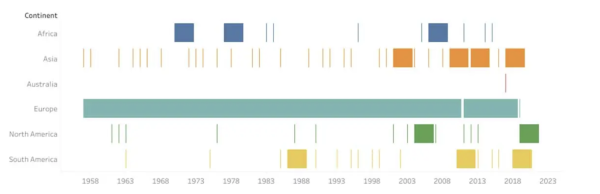
According to Screendaily, since the International Feature category was created (formerly Best Foreign Language Film), Asian submissions have won only three times. Japan’s “Gate of Hell” was the first in 1954, and the next two — South Korea’s “Parasite” (2020) and Japan’s “Drive My Car” (2022) — came more than half a century later. European entries dominate over 80% of wins, despite Asia producing a huge number of internationally acclaimed films. Furthermore, Southeast Asian cinema has earned only two nominations in the Academy Awards’ history, highlighting how rare recognition still is for films from most of Asia.
2025 was not a dry year for Asian media, yet these incredibly accomplished international Asian films remain absent from nomination categories. The Chinese 3D animated film “Ne Zha 2” became the highest-grossing animated film worldwide and entered the top five highest-grossing films, yet failed to receive a nomination. Similarly, Japan’s “Demon Slayer: Infinity Castle” set records as the highest-grossing 2D animated film, with additional global fan support compared to “Ne Zha 2,” which was a box-office hit mainly in China. South Korea’s “No Other Choice,” a Golden Globe nominee praised by critics and widely labeled one of this year’s biggest snubs — most notably from director Guillermo Del Toro speaking out on the film being overlooked — also made no appearance. Together, these omissions underscore how even when Asian films see such groundbreaking achievements, success does not reliably translate into recognition.
Past milestones show that there has been progress, but that progress is rare and movies that get recognized are often “firsts.” In more recent years, Michelle Yeoh becoming the first Asian actress to win Best Actress for her lead role in “Everything Everywhere All At Once” in 2023 was considered a great breakthrough. In fact, many Asian wins, international or not, are breakthroughs — and have stayed that way. Although we should be proud of these momentous accomplishments, they happen inconsistently and sometimes decades apart. Nominations and wins of Asian films and actors, especially in recent years, should not be something out of the ordinary.
Japanese films are the most consistently nominated out of films produced in Asia. This may be attributed to Japan’s advantageous cultural “soft power” in the U.S. and the country emphasizing marketing in the West, which has worked in their favor. This makes “Demon Slayer: Infinity Castle” being omitted from this year’s Academy Awards even more shocking, even angering to many.
In comparison, some attribute the lack of recognition for “Ne Zha 2” to U.S. tensions with China, with some critics believing that the Academy considers politics when choosing nominations and wins. Some also speculate that the Chinese Ministry of Culture simply chose not to submit it or that it simply didn’t resonate with the voting bodies. Because “Ne Zha 2” was released in the United States through A24 Films, LLC, some believe the studio chose to submit “Legend of Hei 2” instead, after the latter appeared on its official submissions list.
Meanwhile, “No Other Choice” was listed on the International Feature shortlist, but was ultimately not chosen as one of the final five official nominees. With “No Other Choice” not making it off the short list, there remains not a single international Asian film nomination this year.
Other reasons that Asian films have been omitted from nomination may include language barriers and limited resources for higher production, marketing or making their films more accessible to audiences outside their country. But this explanation doesn’t fully hold up. Western European films continue to earn nominations and wins despite also being non-English.
Some may also argue that representation is improving, pointing to nominees like “KPop Demon Hunters,” a film with an all-Korean cast that gained notable recognition this awards season. However, the film is still American-produced and primarily in English, reflecting how international visibility often depends on their ability to cater Western audiences.
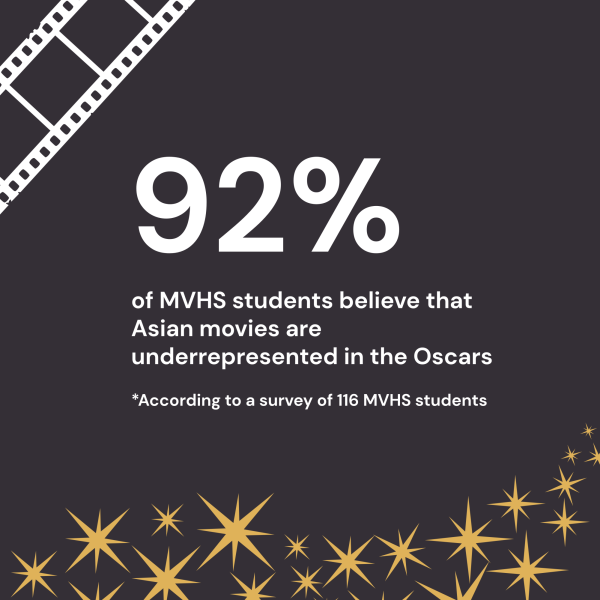
It’s important to note that awards are not just shiny statues handed out on a stage. They influence which films get attention from the public, which cultures receive recognition worldwide and drive an incentive for countries to fund future projects. At MVHS, where 80% of students are Asian, and where 83% of students watch media made in Asia (according to a survey of 111 students), when these stories are not featured on a major global stage, it sends a message that Asian media and experiences are not considered mainstream enough to be recognized.
Fortunately, it’s not impossible to bring change to the industry. Some advocacy has proven effective. The 2015-16 #OscarsSoWhite movement, which was started after all acting categories only had white nominees, showed that public pressure can change long-standing patterns and encourage influential institution

s to change. After the movement, seven out of 20 acting nominees in the 2023 and 2024 Academy Awards were actors of color. So, even if there is still a long way to go, it is clear that the industry has faced improvement. If audiences continue to advocate for better representation and support diverse storytelling, there is a chance that the industry will once again take notice.
At the same time, while awards from the Academy carry influence, they are not the only measure of a film’s value. Critics, independent awards and international film festivals continue to celebrate global cinema, often highlighting international Asian films that significant Western institutions overlook.
But ultimately, although cultural impact and global recognition of films and performers don’t depend solely on Western institutions, the Academy Awards still play a major role in determining what kinds of films gain visibility, funding and long-term recognition. If the Academy wishes to continue presenting itself as a global and comprehensive celebration of cinema, its nominations must better reflect the breadth of stories and audiences that define the industry today.