De Anza College is a community college located four minutes from MVHS and supports a widely diverse student population. La Voz News, DAC’s student run publication, represents more than 21,000 students. Their staff acknowledge that though it is impossible to represent the voices of every single student, they work to include as many different perspectives as possible. “La Voz” is Spanish for “The Voice,” and the publication has been engaging with the student population of DAC since 1967 through regularly occurring stories like DA Voices and their mini-features series, Humans of De Anza, that reflect the individual diversity of their campus.
News editor Gavin Rust emphasizes that despite having a staff of less than 40 students, La Voz News’ coverage spans from Cupertino to Fremont to South San Francisco. Whether it be local news or global news, La Voz News’ writers always try to find a way to connect the story back to DAC. For example, when La Voz News writes about global events, they are able to find sources because DAC’s student body is international.
“We have people from all over the world,” Rust said. “And that means there are people who are going to have reactions and feelings about this. We’re trying to distribute ourselves as much as possible, but that’s a challenge. We can never say we represent everybody. We represent De Anza, but we don’t represent what every student is thinking, because every student is different.”
Staff members pitch stories, then push through various edits including section edits, copy edits and edits by the editor-in-chief, with new staff members often guided by section editors through their first few stories. Managing editor Ann Peñalosa, previously on Homestead High School’s publication The Epitaph, highlights the importance of commitment in journalistic writing and helping staff with mistakes and learning.
“You get what you give,” Peñalosa said. “If somebody is willing to sit down and go through their article with me and be on call for five hours at 3 a.m. and be like, ‘Hey, so how can I actually turn this into something publishable,’ then I’m willing to sit down with them, and a lot of editors are willing to sit down with them too.”
Farideh Dada, the Journalism Department chair at DAC and La Voz News’ adviser, emphasizes the importance of student journalism at both the high school and college levels, noting that the role of a journalist is to ensure that their community has a reliable source of news. Rust and Peñalosa also acknowledge the dangers of news deserts, defined as communities without a local source of news for local issues or events. Local news outlets have been declining dangerously in America due to a combination of low engagement and lack of funding, leaving roughly 50 million Americans with little to no access to local news.
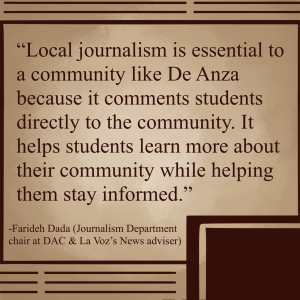
“Local journalism is essential to a community college like De Anza because it connects students directly to the community,” Dada said. “It helps students learn more about their community while helping them stay informed. By practicing journalism at a community college, students aren’t just practicing journalism, they’re contributing to the democratic life of their community. Above all, journalists should have one agenda, and that is to seek and report the truth accurately, fairly and fast. That means accountability, reliability, objectivity, curiosity and integrity. It also requires passion, because this work is demanding and challenging.”
Peñalosa believes that student journalism is especially important and praises the fact that every FUHSD school has a student-run publication. She mentions that journalism ensures that local schools and communities are properly informed, not just on community events but also on other potentially influential issues affecting their area. She references the currently ongoing lawsuit involving Mountain View’s Oracle two to three years ago because the principal wanted them to revise an article reporting on sexual assault at the school so that it was less negative. Peñalosa expressed concern over the ways in which student publications can be threatened even in nearby districts. Although the publication itself was not shut down, the advisor was still fired and the case is still being litigated in court.
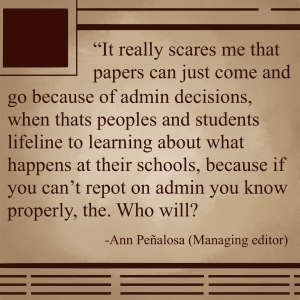
“That’s not even that far from FUHSD,” Peñalosa said. “It scares me. It really scares me that papers can just come and go because of admin decisions, when that’s people and students’ lifeline to learning about what happens at their schools. Because if you can’t report on admin you know properly, then who will? It’s really important because it’s a form of oversight, and it’s a watchdog to make sure things are moving the right way.”
Rust believes that journalism isn’t just extremely important for updating the community, but in particular protects transparency in schools and acts as a way to hold those in power accountable. This is especially applicable when the different issues brought up within districts and schools often aren’t covered by broader news outlets. Many of their stories, despite being related to national events, are deeply personal to DAC, especially when relating to their students’ safety and wellbeing.
“I’m a student journalist, but my work is public,” Rust said. “It’s a form of public record and that’s the most important thing, especially in very pivotal moments like right now in the world. ”
Correction (Jan. 29 1:01 p.m.): This article has been updated to correctly state the pull quote and La Voz News’ name.