


JIVIKA GULRAJANI
A glittering ruby encased in a shiny gold band shines on senior Jivika Gulrajani’s middle finger. However, the ring is a lot more than just an ordinary piece of jewelry — it’s a key piece of Gulrajani’s family history. Originally bought by her paternal grandmother in her home of Sindh, Pakistan, the ring was passed down to Gulrajani following her grandmother’s passing five years ago. Gulrajani didn’t know her grandmother well, and initially wore the ring out of obligation due to her uneasiness about not wearing a gift from a deceased family member.
“I felt like she should have given it to someone who deserves it more — someone who actually knew her,” Gulrajani said. “But my dad said, ‘No, the reason she would have wanted you to have it is for that reason: the fact that you didn’t know her.’ It’s sweet that family or blood can transcend me not knowing her.”

Gulrajani first felt attached to the ring when she discovered that its center stone — a ruby — was the birthstone of July, the month that both she and her grandmother were born in. However, her connection to the ring amplified after sophomore year, when she discovered the history behind the piece. For a school project, she interviewed her mother about her childhood, prompting her to inquire about her father’s as well. She learned that all four of her grandparents grew up in Sindh and were forced to flee to India during Partition. Gulrajani’s grandmother brought the ring along with several other pieces of jewelry to India in hopes of selling them for a profit.
“For me, the ring symbolizes her resilience,” Gulrajani said. “It symbolizes perseverance and the fact that my grandparents had to come to a new country, learn a new language and build from the ground up. I think all of that reminds me of who she was, even if I didn’t know her personally.”
The ring has also grown to symbolize the values Gulrajani’s grandmother upheld throughout her life. She is remembered as bold and outspoken — something Gulrajani notes was uncommon among Indian women in the 1970s. Gulrajani recalls hearing a story where her grandmother secretly ensured her daughters and nieces received COVID-19 vaccines, even though most relatives strongly disapproved. Having worn the ring every day since she received it, Gulrajani believes that, like the ring, her grandmother’s beliefs play a daily role in her life.
“What makes jewelry really cool — especially when it’s inherited through your family — is that it can remind you of who the person was and their presence,” Gulrajani said. “I’m not saying this ring is my grandma, but I’m saying that this ring reminds me of my grandma. When I get reminded of my grandma, I get reminded of her values, and those values drive me every day.”
YASH THAPLIYAL
Glittering, gleaming and glossy, MVHS alum ‘23 Yash Thapliyal’s gold pendant holds a deep connection to both his family and his style. Gifted to him by his mother at 2-years-old shortly after the birth of his younger brother, the pendant hangs on a ridged gold chain in the shape of a “Y,” Thapliyal’s first initial. While it has now become one of Thapliyal’s favorite pieces of jewelry, the pendant initially went untouched for years until Thapliyal began wearing the necklace as a teenager.

After Thapliyal joined the fashion magazine Roam Boulder during his freshman year at the University of Colorado Boulder, he began developing an interest in formulating his personal style. Thapliyal experimented with how his clothing could complement the pendant, and learned that its gold shine went best with neutral toned clothing. As a result, Thapliyal has expanded his wardrobe to include more black-colored clothing to compliment his outfits, pendant and skin tone.

“It’s a part of my daily life to the point where people notice it all the time,” Thapliyal said. “I get a lot of compliments on it, and I think it also influenced the way that I bought other jewelry. I’ve stuck to a lot of gold as my big sets mainly because this was the first gold piece that I owned.”
Over time, Thapliyal has expanded his jewelry, adding a gold ring, bracelets, cuffs and another gold chain to his collection. Thapliyal notes that his favorite way of accentuating the necklace is by pairing it with other gold jewelry. While he no longer wears the pendant every day and opts to style it with certain outfits, Thapliyal advocates for other men to explore wearing jewelry beyond just what is trending in order develop their own unique jewelry style.
“I think a lot more people should wear jewelry,” Thapliyal said. “There is this societal standard that’s been getting a little bit washed away for men as a whole for wearing jewelry, but that has mainly manifested in chunky rings or chunky necklaces and chains. There’s other jewelry out there, there’s a lot more that you can kind of branch out into. So if you’re just into jewelry, you should definitely go ahead and get something for yourself.”
ANIKA RAMACHANDRAN
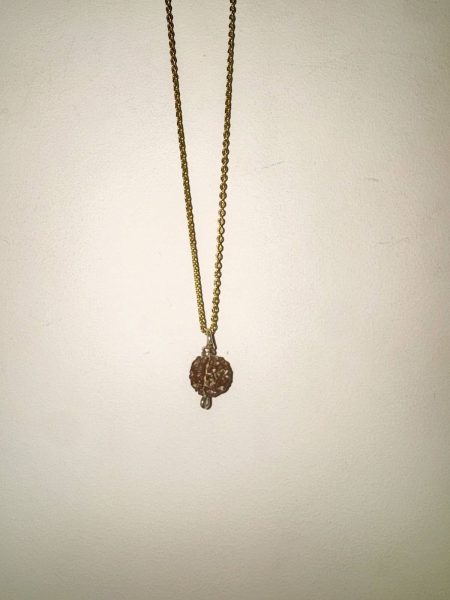
A unique, brown bead attached to a gold chain hangs around senior Anika Ramachandran’s neck, jostling as she rubs her fingers over its rough edges. The bead, called a rudraksh, is a sacred dried seed often found on a chain around the neck of depictions of Lord Shiva, a prominent god in Hinduism. Ramachandran’s mom acquired the rudrakshs at a temple in India, and gifted them to Ramachandran and her siblings when they were in elementary school.
“At first, wearing it was a chore for me because my mom wanted me to wear it,” Ramachandran said. “You tend to rebel against things when your mom wants you to do them, but there was definitely a gradual appreciation, and now I’ve become very attached to it.”
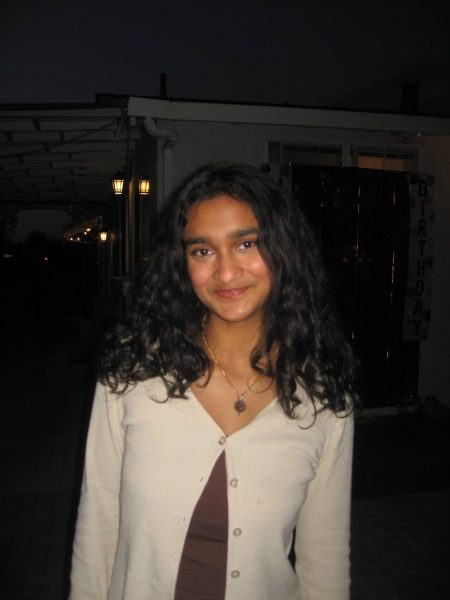
As Ramachandran continued to wear the necklace nearly daily, her connection with the piece developed into a sentimental reminder of her devotion to Hinduism and her family. Ramachandran now sees her necklace as a symbol of good luck, and uses it to ground herself when she gets stressed or nervous. Having briefly lost the necklace once before, Ramachandran feels a deep protectiveness over the piece and rarely removes it.
“The only times I’ve stopped wearing it were during school dances,” Ramachandran said. “I took it off to wear other jewelry that matched my dresses better, but other than that, I’ve kept it on every single day — even when I travel.”
Along with her necklace, Ramachandran owns several other pieces of sentimental jewelry, including golden bangles and a ring she received from her grandmother. Like her rudraksh, Ramachandran wears her bangles daily and rarely removes them. In addition to these pieces, Ramachandran’s family owns their own collection of various jewelry. As a result of jewelry’s large presence in her life, Ramachandran explains that it has become an integral part of her identity today.
“Jewelry ties you to your culture and is a way for me to express myself,” Ramachandran said. “I really like to curate my jewelry stack for dances and other occasions, like when I’m getting ready for something special. I feel like jewelry just makes me feel more like myself.”
RUTH SEYER
Vibrant beads of red, blue and yellow hues tumble alongside silver and gold metals as Special Education Department Head Ruth Seyer searches for the perfect piece of jewelry to complement her outfit. Seyer’s jewelry collection has an assortment far from traditional: she opts for handmade, unconventional pieces that she finds at craft fairs. However, the one commonality between them is their uniqueness: each piece comes from a different culture.
Seyer’s love for handmade crafts started off when she was a student at Lynbrook High School, her schedule filled with art classes. She often spent her free time in the art classroom making jewelry, fiber arts and wearable goods, and pursued this interest at San Jose State University, where she received a degree in art.
Seyer attends local craft fairs like the annual one at LHS held by the Lynbrook Instrumental Music Boosters, but keeps her eyes peeled for fairs when visiting countries abroad, too. According to Seyer, going to craft fairs is a chance for her to get exposed to diverse pieces of art and talk with other artists about their creative processes.

“Those artists make amazing, colorful jewelry, earrings and all kinds of things, but just with things that they have found,” Seyer said. “They repurpose them and create jewelry around it. It’s all about the artist and the person that made the piece and what they pulled together.”
Seyer’s collection also features pieces given to her by her elementary school teacher turned close friend, Gail Randolph. After her passing, Seyer was gifted many pieces of jewelry that they had bonded over, such as the friend’s old charm bracelet and an original piece by Laurel Burch — a local jewelry maker that they both admired.
“She knew I really liked the charm bracelet, so she saved some things for me,” Seyer said. “She had put notes on things she knew we wanted based on conversations and set some things aside. So I always think about her when I open my jewelry box. I miss her, but it’s a really nice memory that warms your heart when you see it.”
The large and diverse jewelry collection that Seyer has curated over the years provides her with unique pieces to pair with her outfits. To Seyer, finding a piece that pairs well with her outfit is a random, “happy coincidence.”
“It makes something more interesting when you can find a connection, or colors that work,” Seyer said. “Hold onto your jewelry, even if it seems out of date now, because it can bring back some fun memories down the road.”