

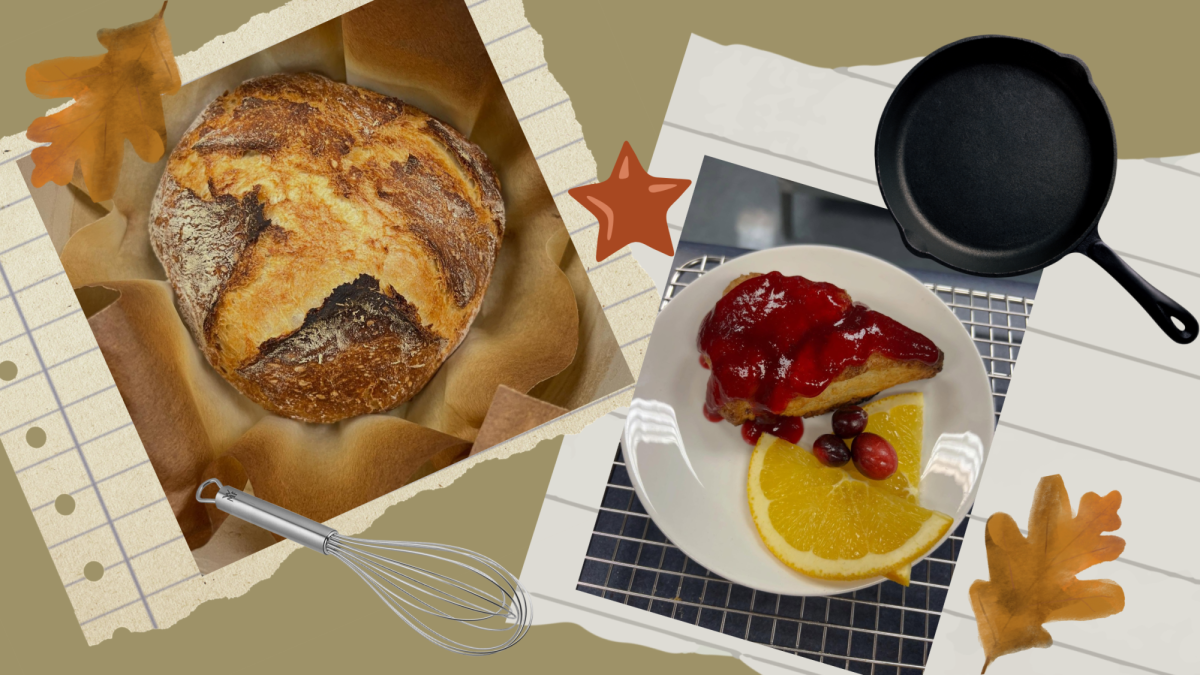
After planning with colleagues over summer break and brainstorming recipe ideas with her husband, Lynbrook High School Introduction to Culinary Careers and Culinary Food Science teacher Megan Miller put the final touches on her class’ pre-Thanksgiving break cooking lab. Half the class would work on savory cheddar thyme scones, and the other half would attempt sweet cranberry orange scones. The matching recipes were her husband’s idea, but it was now up to Miller to lead their execution.
As Department Lead of the Culinary Science program — a department of one — Miller aims to strike a balance between teaching with slides, graphic organizers and videos and including weekly labs in her curriculum. Though being a department lead involves Miller in a lot of solo planning, shopping and setup during the school year, she enjoys having the freedom to choose exactly how to demonstrate culinary concepts or techniques.
Currently, three out of the five schools in FUHSD offer culinary classes — LHS, Fremont High School and Cupertino High School. A variety of course options are available to students, covering a variety of concepts from food science to hospitality. Miller says that one of her favorite parts of teaching is seeing how students learn to enjoy the process of cooking.
“It provides a creative outlet for students,” Miller said. “Culinary classes give students the ability to follow a passion that they have developed and they didn’t even know they had, giving them a break from some of the more rigorous classes. I like seeing kids get excited about food and planting that little seed, whether it turns into a passion or just a necessity to cook for yourself.”
In class, students learn culinary technique, familiarizing themselves with the functions of specific ingredients and tools. Afterwards, they move on to more advanced skills, such as knife techniques and temperature control. Then, students begin doing labs focused on a particular skill or ingredient. Students in the past have learned about the uses of egg yolks and whites and have made macarons that expand their understanding of the ingredient.
Every summer, Miller meets with FHS Culinary Careers teacher Nicole Harnett to plan and revise the coming year’s curriculum. By evaluating what went well and what didn’t in previous school years, the two update their respective lesson plans every year. While their methods are not identical — Harnett teaches a class more focused on hospitality and is not the only teacher in her department — Miller still finds it immensely helpful to compare, contrast and improve their classes.
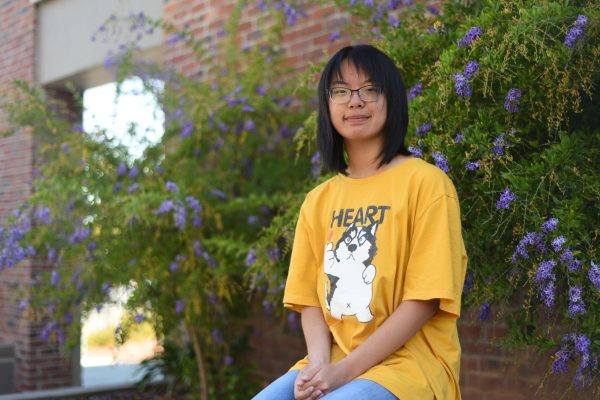
LHS sophomore Amy Yuan regularly helps Miller prepare the classroom during breaks in her schedule, such as brunch or lunch. As a previous student of Miller’s, Yuan is not currently enrolled in a culinary course, but cooks outside of school for friends and family. Yuan says that taking Intro to Culinary Careers her freshman year opened her eyes to the true nature of cooking.
“There are really complicated, finicky things to cooking, because cooking is a science that we use to eat,” Yuan said. “One time my group was making cookies. We found a double chocolate crinkle cookie recipe online, but we didn’t want chocolate, so we took out all the cocoa powder. Turns out when you take out a lot of dry ingredients from a cookie and don’t put it back in as flour, it burns.”
LHS junior Isabella Chiu, who is currently taking Culinary Food Science, agrees with Yuan. Due to her fear of knives, Chiu avoided cooking before enrolling in a culinary class and thus was relatively inexperienced when stepping into the LHS culinary classroom. However, after taking the class, Chiu found that cooking was not as intimidating as she believed, allowing her to overcome her fear of injuring herself and even cook a little outside of school as well.
“It’s definitely made cooking a less overwhelming task,” Chiu said. “In the past, I always thought baking cookies would take so long. But then I realized, when we actually did it in class, it took a very short time. And so it just removes that barrier of cooking being something super overwhelming. It’s actually a lot simpler than I initially thought it was.”
Recipes that Chiu has made include panzanella salad, a type of pancake known as Dutch babies and bagels with cream cheese: Chiu’s favorite. Yuan, who took Introduction to Culinary Careers last year, had a different set of favorites, including apple crumble with vanilla ice cream, potato leek soup and oven-baked mac and cheese. Chiu’s favorite part of the labs is enjoying the meal after all the work is done, and the sense of accomplishment that comes with it.
”Normally, when you go to a restaurant and you’re eating, that’s not the food you made yourself,” Chiu said. “But when you’re in culinary class, even if the food is less good than that of a restaurant, there’s that sense of satisfaction that I’m eating something that I created myself.”
Chiu believes that while traditional courses like STEM, English and history are undoubtedly important, schools don’t emphasize practical skills like culinary arts enough, which she believes is important for students to succeed in navigating adult life. Miller expresses a similar sentiment, saying that culinary classes provide large benefits to students.
“Cooking for yourself or others is one of the most basic skills that every human is going to have to have at some point in their life,” Miller said. “I think being able to approach that in a safe environment, in high school with your peers that maybe know as little as you do is great. Learn the basics. Mess up here. Learn from your mistakes, so that when it really matters, when you’re on your own, you don’t make those mistakes and burn down your apartment.”