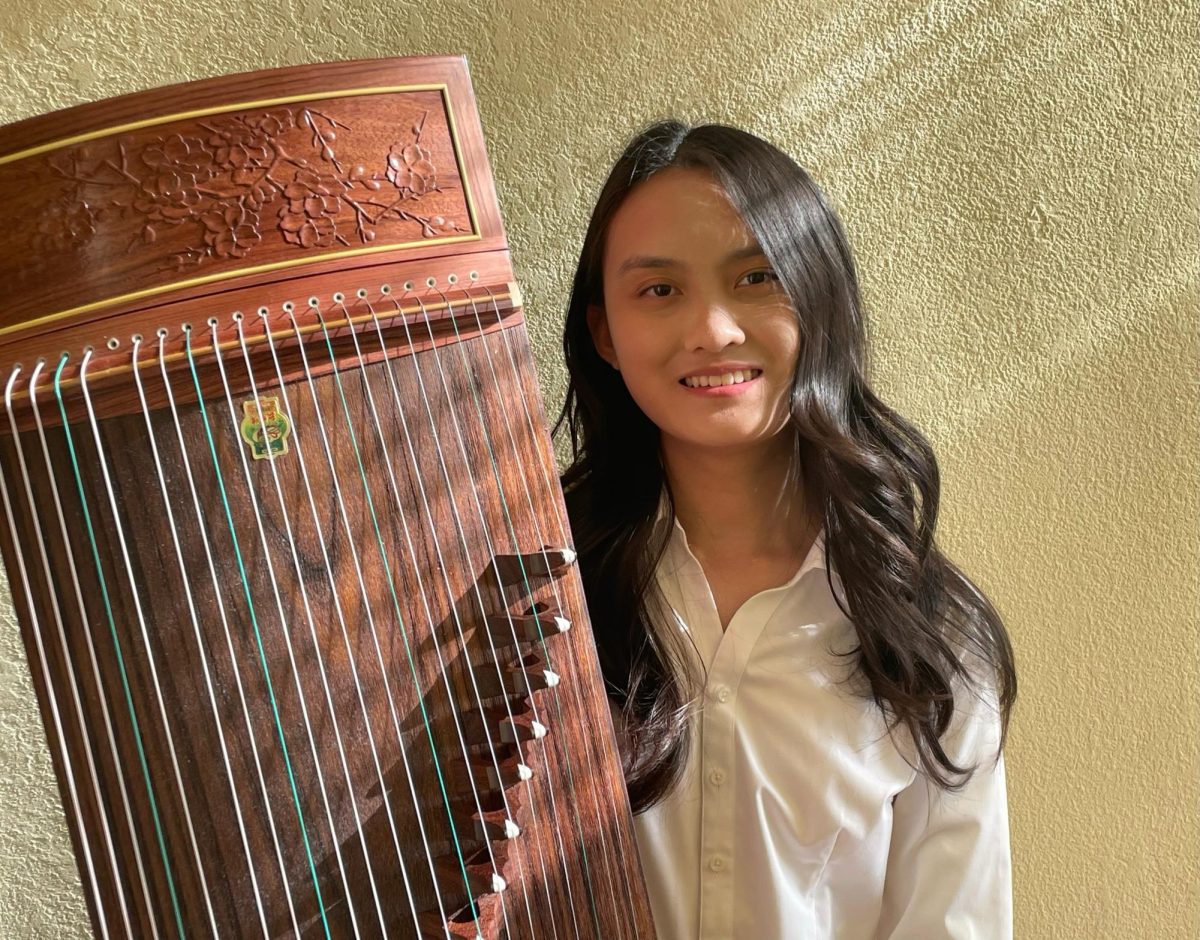


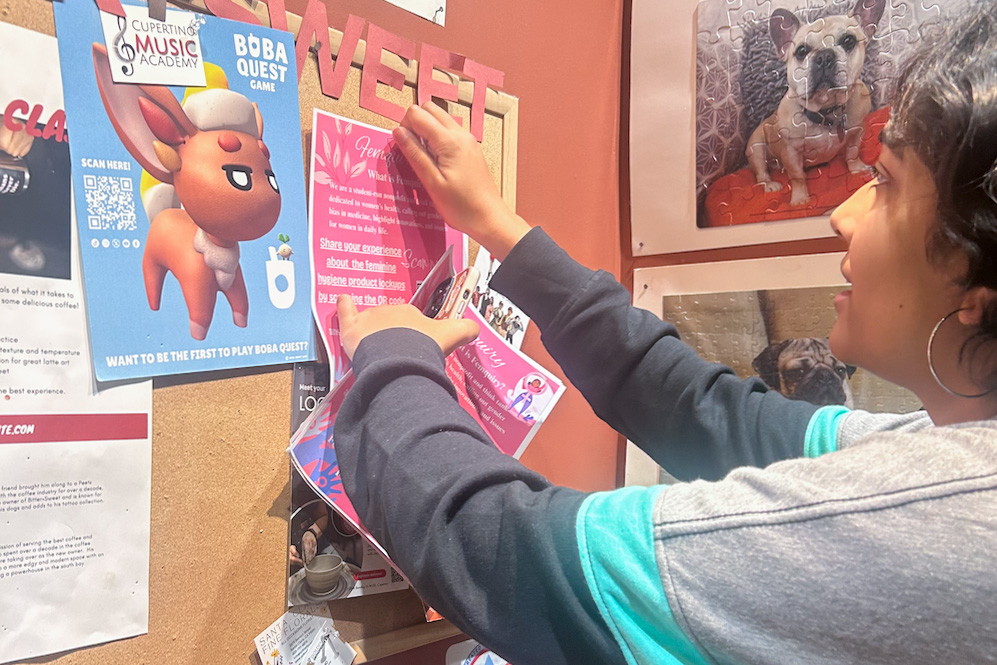
Growing up, summer holidays for senior Krittika Paul meant her yearly visit to her home country, Bangladesh. While these visits often meant seeing the familiar faces of her extended family and walking among the bustling streets of Bangladesh, Paul was quickly exposed to another, much darker reality.
Paul remembers noticing how many of the Bangladeshi women who surrounded her were treated, in her words, “lower than men,” recalling how many women in her home country were forced to conform to typical gender roles as homemakers and be financially dependent on men. Moreover, Paul remembers a lack of support for women in Bangladesh, especially for cases of sexual harassment, noting the strong sense of victim-blaming.
As a young girl encompassed by this misogyny, Paul was quickly drawn to issues pertaining to gender inequality — an interest amplified by a medical equity class she took during the summer of her freshman year. Paul explains that through this class, she became more aware of the gender disparities in medical research and healthcare. After taking this class, she began brainstorming potential ideas to tackle these issues. Towards the end of her sophomore year, Paul decided to create the independent organization Femquiry.
According to Paul, Femquiry aims to provide information surrounding women’s healthcare, both specific to MVHS and on the national and international scales. Originally, Paul planned Femquiry as a nonprofit focused on organizing events to raise awareness. However, as she continued to solidify her plan for the organization, she ultimately decided to establish it as a think tank, which is an establishment of experts that provide information and advocacy on specific issues.
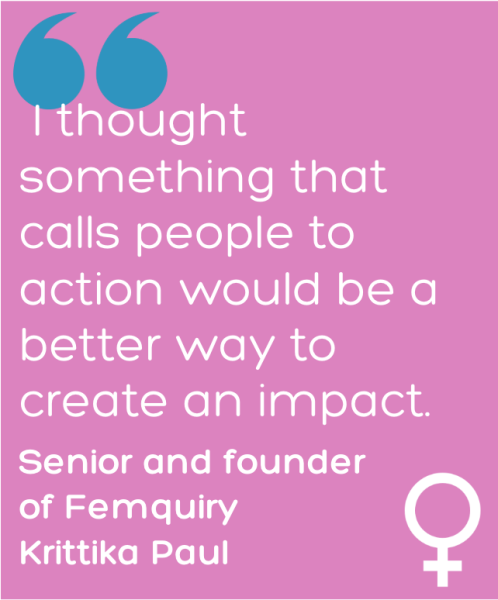
“I was always more interested in trying to get knowledge out there, rather than creating events,” Paul said. “I felt like organizing events was like shooting in the dark and not really being able to create an impact. I thought something that calls people to action would be a better way to create an impact. Also, a lot of the work for a think tank is primarily online. We meet in-person sometimes but most of it’s done online, such as the newsletters and research. I thought that would also make it easier.”
As the founder and president of the think tank, Paul held the first meeting for Femquiry in September of 2024. She recalls that the initial meeting consisted of very few members — her, one PR officer and one writer — which served as a major hurdle for Paul in the organization’s first year. As a result, during her junior year, Paul dedicated time to presenting information about Femquiry to a few classes at MVHS as well as promoting Femquiry through Instagram and requesting teachers to send out interest forms through Schoology in order to gain more members. Paul recognizes that honing in on the MVHS population when gathering interest ultimately led to the growth of the club this year.
Femquiry now has eight officers, which, according to Paul, has led to higher-quality work. Paul explains that with more members, Femquiry is able to conduct surveys at MVHS rather than relying solely on web-based research, which ultimately strengthens the impact of the published articles and newsletters. Femquiry has also been able to focus on its PR, which Paul hopes will lead to even more interest in coming years.
Senior Anya Deshpande was informed about Femquiry through these messages. Hoping to major in computational biology, Deshpande has previously worked on different projects relating to women’s health and saw Femquiry as a continuation of her previous work. Deshpande notes her appreciation for Femquiry’s focus on “getting information out into the world” through writing.
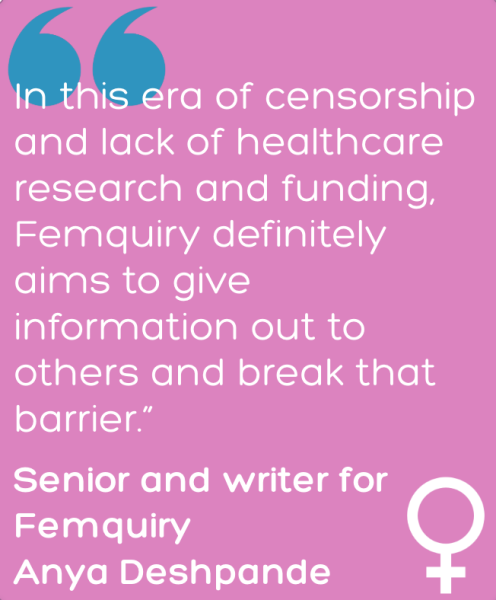
“As a woman myself, why would I not participate in something that could help other women like me?” Deshpande said. “In this era of censorship and lack of healthcare research and funding, Femquiry definitely aims to give information out to others and break that barrier.”
Similar to Deshpande, freshman Mayhar Singh also became familiar with Femquiry via a promotional message on Schoology. Singh grew up utilizing writing as a way to express herself and her emotions. Her passion for writing, combined with her personal experiences and interest in healthcare, quickly convinced her to apply for a position as a writer for Femquiry.
“Growing up as a girl and in general, a sense of being pissed off at the way that women’s health is treated in the U.S. was a big motivator,” Singh said. “Like endometriosis. Endometriosis isn’t even studied — we don’t know the cause. But, instead, there have been studies that say that endometriosis makes women more attractive, which isn’t even an objective thing. Why would we be taking the time to research that versus finding the cause when so many people suffer from it? Personally, I have a lot of family members who were affected by various women’s health diseases. I have an aunt who had breast cancer, and seeing the care she was treated with made me really mad. So when I saw this opportunity, I was like ‘OK, let’s do it.’”
Both Deshpande and Singh also note a common reason for joining Femquiry — to raise awareness around gender inequality in modern-day healthcare in the MVHS community. Deshpande explains that when sending out surveys to the student population in the past couple of weeks, she has noticed that many students, notably male students, treat the surveys unseriously, often filling out false answers. With Femquiry, Deshpande, Singh and Paul hope to change MVHS students’ mindset when it comes to women’s health.
“When it comes to our school culture, I think our teachers are really open about things like healthcare and female products,” Deshpande said. “Many of them have menstrual pads and tampons in their rooms, which is really awesome. But for students, I think that we can definitely be working on dismantling some of the barriers. There are definitely a lot of guys at our school who don’t really take this seriously. I think that Femquiry would definitely help in spreading this information and helping to change their minds about taking this seriously.”
As Paul completes her final year of high school, she hopes to ensure Femquiry’s legacy at MVHS. Since the think tank was able to gain members, especially freshmen and sophomores, Paul believes that Femquiry will continue even after she graduates — she even hopes that Femquiry will eventually become a club at MVHS. Additionally, Paul hopes to carry her ideas at Femquiry to college for a larger, national and global impact.
“Since it’s a nonprofit, it’s not specifically connected to the high school, so I was also thinking I would have more access to other resources in college, which could help me continue this,” Paul said. “I could also help people in different countries, like Bangladesh. I would love to be able to find ways to start initiatives that provide support for women at a global scale. I want to bring more attention to women having more rights rather than being dependent on someone else and living for themselves rather than someone else.”
However, Paul recognizes that global impact is not Femquiry’s current primary focus. Instead, she, along with Deshpande and Singh, believes that for impact to occur at such a large scale, change needs to begin in the MVHS community. Paul explains that Femquiry is currently running polls and surveys on the student population’s opinion on the quality of and access to feminine hygiene products at MVHS to eventually advocate for a call to action. Singh explains that she hopes these surveys, along with Femquiry’s other newsletters and articles, will encourage more conversation around female health, especially educating students about the current issues with women’s healthcare.
“I want there to be a lasting impact so that women’s health is treated seriously in all places, especially in schools like MVHS,” Singh said. “To be honest, that starts in the classroom. If we’re educating the leaders of tomorrow, which MVHS aims to do as one of California’s top public high schools, then we should be making sure that we, as students, get an education in the needs of women’s health that is up to date.”