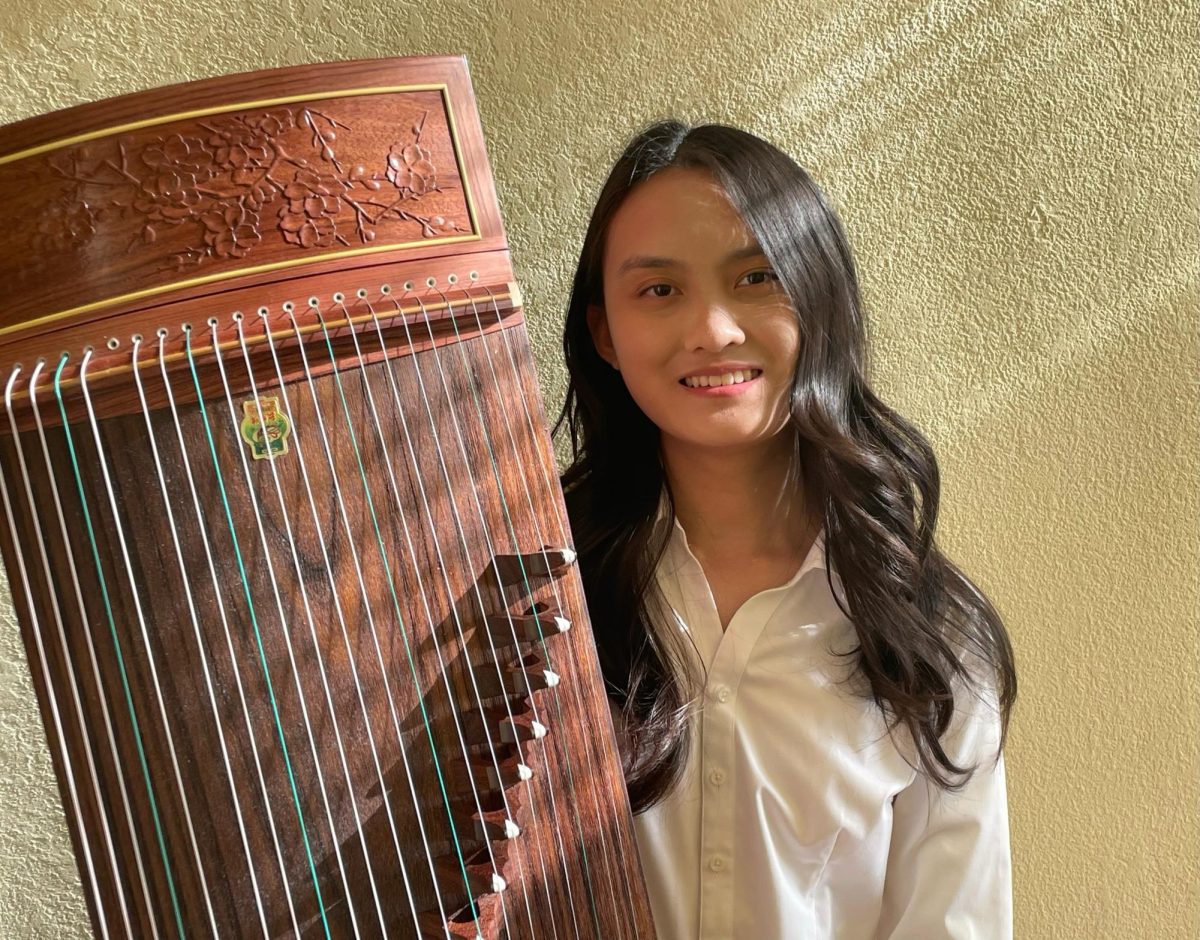



When freshman Dasha Young began her mornings at her grandpa’s house, she wasn’t rushing to catch a bus or find her seat in a classroom. Instead, she’d sit in her mom’s old room, notebooks spread across the desk, while her teacher — her grandfather — reviewed lessons from a stack of well-worn textbooks. As her grandfather rambled on about a math equation, Dasha listened intently; after her lessons, Dasha would teach her little brother counting.
A few months before COVID-19 shut down schools when Dasha was in 3rd grade, Dasha’s family decided to transition her from private school to homeschooling. Dasha had been ahead in several subjects and her parents saw an opportunity to let her move at her own pace. Dasha’s parents divided the role of teacher between her grandfather and mom for different subjects.
According to Dasha, learning under her grandfather’s guidance was different from being in a classroom. Without a group of classmates to blend into, every lesson felt personal and mistakes stood out. For Dasha, when she stumbled on a problem or misunderstood a concept, her grandfather’s persistence could feel overwhelming.
“It could be a little bit stressful,” Dasha said. “He was pretty good at teaching, because I was ahead in most subjects when they came back to public school. For example, when I would get a problem wrong, he would keep pressing, keep trying to teach me and I would get stressed out and start crying. After that, we would always make up at the end.”
As the new curriculum at home catered towards Dasha’s learning, Dasha received a more in-depth education based on what her parents thought was important and what Dasha thought was interesting. For example, Dasha’s father, an Indigenous American, would occasionally teach social studies and incorporate his tribe’s history into the teachings for more nuanced lessons. Combining previous materials from her private school curriculum with his own ideas, Antonenko taught Dasha a variety of subjects.
“Homeschooling helped me to understand what she likes, what she’s interested in and what she’s not as interested in a very direct and everyday way, which is especially important in literature,” Antonenko said. “In homeschooling, you can select what your child reads. And my strong belief is that children should read what they like, and you need to develop them to the point where they can enjoy even very complicated pieces of literature.”
While her grandfather handled math, science and Russian literature, Dasha’s mom, Olga Antonenko Young, took charge of English and composition writing. For Olga, unlike formulas or equations, teaching language arts felt more personal — less about right and wrong, and more about understanding how Dasha thought. As a result, Olga learned a lot about her daughter.
“She wrote a really sweet story about her brother breaking his leg when he was little,” Olga said. “And we just got to talk a lot about emotions and metaphor and really got to bond. That time together is really, really special to me. I think it made us closer for the rest of our lives.”
Antonenko also said he felt closer to Dasha in unexpected ways after homeschooling her. After reading a piece of complex Russian literature, Antonenko said Dasha started crying. When this happened, Antonenko said he was proud that Dasha was able to understand the writing’s deeper meaning, believing that their “souls are on the same wavelength.” However, he knew Dasha would return to public school eventually, especially as the upper school curriculum became more rigorous.
“The more time you spend with your child, your grandchild, the better you understand them, and the closer to each other you get,” Antonenko said. “But as she’s getting older, she needs more social life. And not only that, homeschooling at some point becomes very challenging, because, if I need to do homeschooling at high school level, chemistry and physics and more complicated math, it would take me much more energy than I have.”
Dasha said Antonenko had prepared her well for 6th grade; in fact, she found herself ahead of her peers in many subjects. Surrounded by so many new faces, Dasha said she was caught off guard by icebreaker questions like “What’s your ethnicity?” or “What’s your favorite color?,” which felt unfamiliar after years of homeschooling. As she adjusted to public school, Dasha realized that being around so many different people was actually one of her favorite parts of public school.
“I liked that there were a lot of people that you could become friends with,” Dasha said. “My private school had about maybe 10 people per grade. There were five people with whom I could become friends. Then, I had like 300 people to become friends with, which seemed like a giant opportunity to me. I found a group of friends halfway through sixth grade, and I’ve stayed with them ever since.”
Even though she misses their time together, Olga was also happy when Dasha began attending public school and describes feeling a weight lifted from her shoulders once she no longer had to serve as Dasha’s teacher. Watching her daughter adapt to public school has been rewarding, she said, adding that she feels proud to see Dasha carrying the values and discipline she developed through homeschooling into her new environment, as well as watching Dasha develop as a person.
“I love seeing her develop new relationships. I was very impressed with her teachers at Kennedy,” Olga said. “They really cared for her. Part of our fear was like, ‘Oh, now she’s in a big school, and it’s going to be hard for her to manage.’ But it really made us happy about how smoothly it went. The school, despite being big, was pretty nurturing. The teachers were nurturing. The friendships happened organically, which I was happy about. It was fun to watch her be out there and have these new experiences.”